
How Hard Is the Part 107 Test? Pass Rates and Study Time
11 min read ·

Co-founder of MindMax and Memrise, Grand Master of Memory
How hard is the Part 107 drone license test, really?
The Part 107 drone license test is moderately hard. Most people pass, but it isn't a formality. In 2025 the FAA recorded an 82.96% pass rate across 73,914 attempts, so about 1 in 6 tests failed. You need 70%, which is 42 of 60 questions. The average score was 79.31%, less than 10 points above that line. It's hardest if you've never touched aviation, because sectional charts, airspace and weather reports feel foreign at first. Most first-timers who put in 10 to 20 hours of focused study and score consistent 90s on varied practice tests pass.
What the Part 107 test actually asks of you
The test's official name is "Unmanned Aircraft General, Small", or UAG for short. It's federal, so it's the same in every state. The FAA Airman Knowledge Testing Matrix sets out the basic rules.
- 60 scored multiple-choice questions, with 2 hours to answer them
- A passing score of 70, so at least 42 correct
- Possible unscored validation questions on top of the 60. They don't count for or against you, and the 2 hours includes the time for them. The FAA doesn't say how many there are. Prep providers say 5, and candidates report seeing 65 questions on screen.
- No instructor endorsement needed, either to test or to retest
- Minimum age of 14 to take the test, though you must be 16 to hold the certificate
You book through PSI and sit the test in person at a testing center. Prep providers and candidates report a fee of about $175 per attempt. The FAA pages don't list it, so check the price when you book.
The FAA's remote pilot page lists the topics. They include regulations, airspace and flight restrictions, weather sources and effects, loading and performance, emergency procedures, crew resource management, radio communication, drugs and alcohol, aeronautical decision-making, airport operations, maintenance and preflight, and night operations.
Where candidates actually struggle
The same two areas come up again and again in candidate reports. The first is sectional charts and airspace. That means when to read altitudes as MSL versus AGL, what shaded magenta lines mean, and the tiered layers of Class B and C airspace. The second is weather, especially decoding METAR and TAF reports.
Next come the rote numbers, like day counts, deadlines and the $500 property damage threshold. Then there are the rules added in April 2021 on Remote ID, night operations and flying over people. Drone U's breakdown of FAA data names "Declaration of Compliance", part of operations over people, as the most-missed topic. It was missed 78.58% of the time from July 2024 to June 2025.
Candidates also say the mix of topics varies from test to test. One person gets heavy weather and airport operations, while a friend gets mostly regulations. So you can't skip a topic and hope it won't show up.
A change that starts October 26, 2026
The FAA's September 2026 testing advisory says that beginning October 26, 2026, the UAG test will include image-based questions taken from the latest Sectional Charts, not from the printed testing supplement. The date for retiring the printed supplements hasn't been set.
In practice, memorizing the supplement's figures won't cover every chart question anymore. You need to be able to read any sectional, not just the ones you've practiced. And if your study material predates April 2021, it may not cover Remote ID, night operations or flying over people at all.
What is the pass rate for the FAA Part 107 knowledge test?
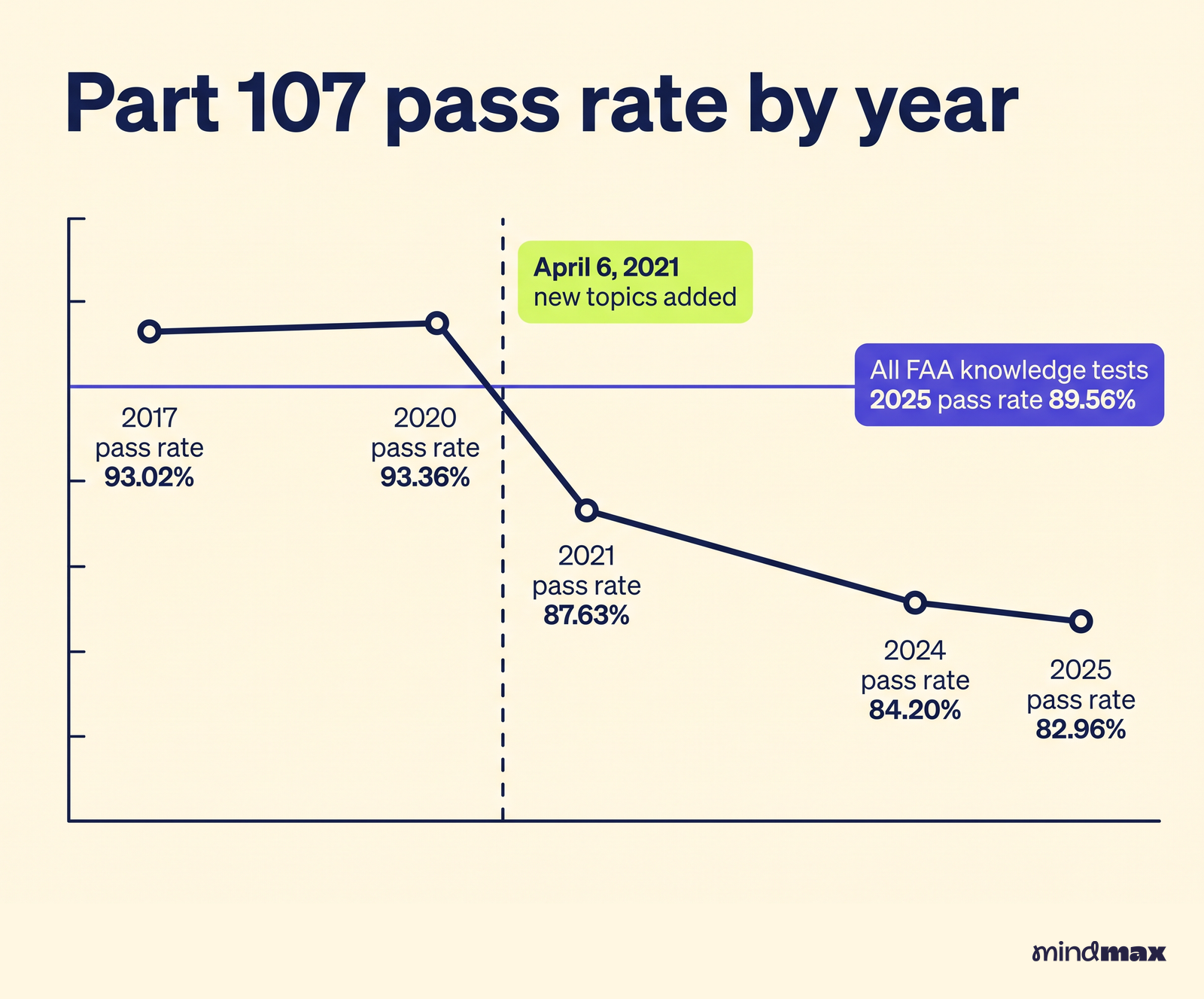
The FAA Part 107 knowledge test had an 82.96% pass rate in 2025, with an average score of 79.31%, according to the FAA's CY2025 knowledge test report. The FAA posts earlier years on its airman test statistics page.
Keep two things in mind when you read these numbers.
- They count tests, not people. If someone fails and retakes, they appear twice. The FAA doesn't publish a first-attempt pass rate.
- The trend is down. Drone U's year-by-year table, which cites FAA reports, shows 93.02% in 2017 and 93.36% in 2020. After the FAA added operations over people, Remote ID and night operations on April 6, 2021, the rate fell to 87.63% in 2021. By 2024 it was 84.20%, and in 2025 it was 82.96%. Drone U itself points out that the timing alone doesn't prove the new topics caused the drop.
For context, the average across all FAA airman knowledge tests in 2025 was 89.56%. So the drone test passes below average. It's still far friendlier than the Aviation Maintenance Technician General test, which passed at 69.59%.
How long should you study for the Part 107 exam?
Plan on 10 to 20 hours of real study, spread over 1 to 3 weeks. The FAA publishes no recommended hours, so these ranges come from prep providers and candidates.
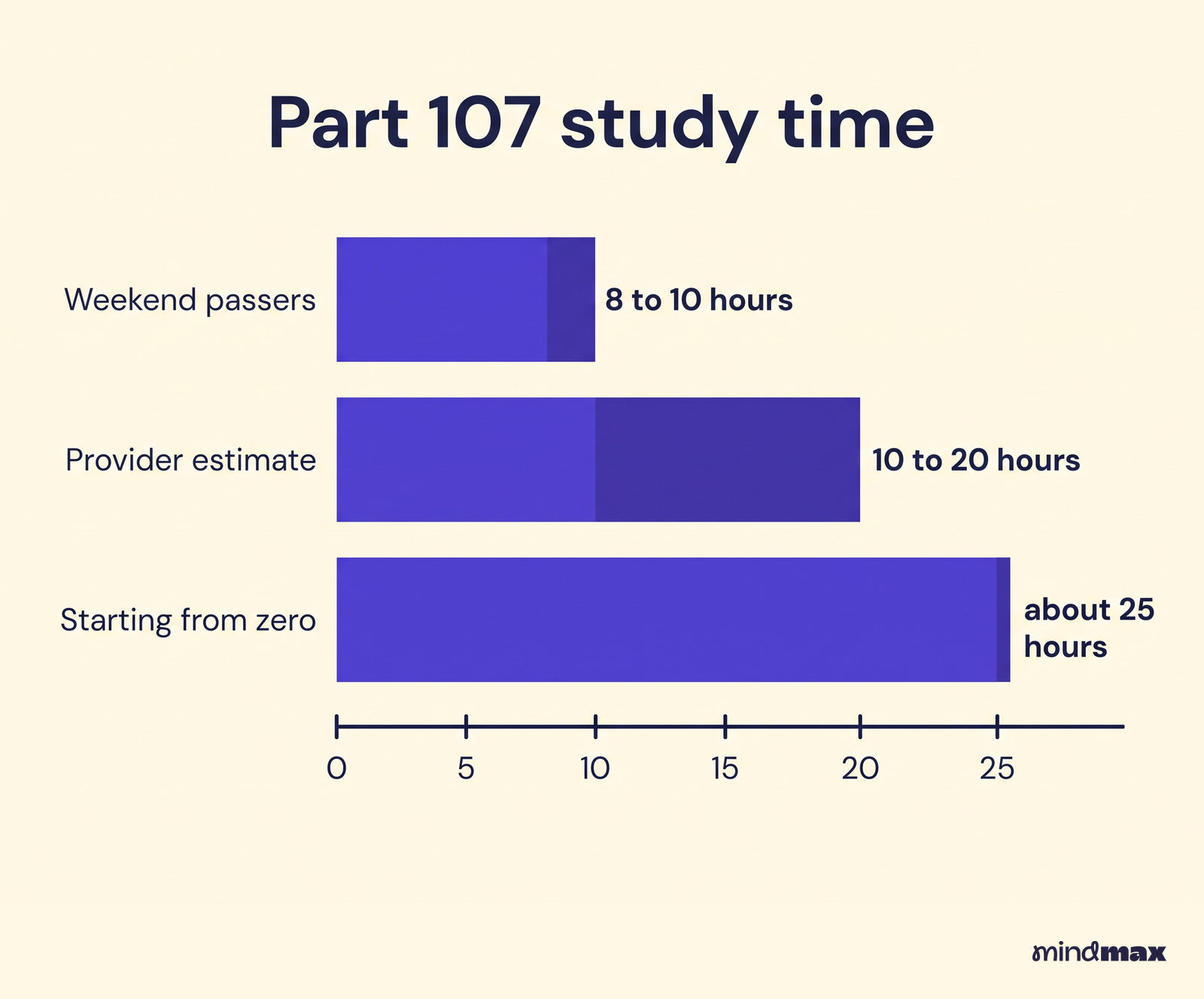
- Drone Pilot Ground School estimates "about 10-20 hours of total butt-in-seat study time", usually over 2 to 3 weeks for working adults.
- Pilot Institute's course runs 15+ hours of video on its own.
- Candidates report anywhere from about 5 hours to about 25 hours. The most common pace is 1 to 2 hours a day for roughly two weeks.
Where you start matters more than any average. One candidate who "knew literally nothing" put in 25 hours the week before and scored 78. Someone who already reads charts for another hobby might need half that. If you work full-time, two weeks of daily evening sessions is a realistic target. If you can study during the day, one solid week can be enough.
Spend the extra time where people lose points. Read real METARs on aviationweather.gov and click around your local sectional on SkyVector until the symbols make sense. With image-based chart questions starting October 26, 2026, practice on live charts matters more than ever.
Can you study for Part 107 in one weekend and still pass?
Yes, people do it, but it's a gamble. Candidates report passing after 8 to 10 hours over a day or two, with scores of 83% to 88%. One wrote "Studied less than 10hrs in 2 days… 83%."
The failures look almost the same on paper. In one widely shared thread, a candidate studied about 8 hours and scored 80% or higher on every online practice test. Then they got 57% on the real exam and said the actual questions "were a lot harder." They also finished in about 50 minutes and left. Replies urged using the full 2 hours to recheck answers.
So a weekend is only reasonable if you meet all of these conditions.
- You already have some aviation or weather background.
- You're scoring well above 80%, ideally 90% or more, on practice tests from more than one source by Sunday night.
- You can accept the downside. A fail means a 14-day wait, paying the fee again and bringing your failed test report to the retake.
If you're starting from zero, book the test 2 weeks out instead. You lose very little time and cut your risk a lot.
How do you know when you're ready to take the Part 107 test?
You're ready when you score 90% or higher, consistently, on practice tests from different sources. This isn't an FAA standard. It's the benchmark that prep providers and candidates keep landing on. In Drone U's words, "If you're scoring 90% or higher on quality quizzes, you're in good shape." Candidates on Reddit say the same thing more bluntly.
Why aim so high when the pass mark is 70? Because practice scores tend to flatter you. Some retakers advise expecting your real score to drop by about 10%. A 90 in practice leaves room for that, while an 80 doesn't. In one detailed review from February 2026, a candidate who averaged about 90% on four full timed mocks went on to pass comfortably.
Use this as your readiness check.
- Consistent 90s, not one lucky run, across at least three full-length tests
- Varied sources. If you've only used one question bank, you may have memorized its answers. Candidates value King Schools' free test because it words questions in confusing ways, like the real thing.
- Timed, full-length runs of 60 questions in 2 hours
- Charts and METARs feel routine, including charts you haven't seen before
- You know the new rules. Remote ID, night operations and operations over people, including the Declaration of Compliance
- You can explain your misses. If you can't say why the right answer is right, you're not done with that topic.
Drone Pilot Ground School uses a lower bar for its guarantee, at least 85% on its practice tests, though its own page is inconsistent on whether that means one test or three. Treat 85 as a minimum and 90 as the goal.
Which prep option suits which candidate
Most people combine one main resource with a free practice test from somewhere else. Here's how the main options compare, based on what each provider says about itself.
| Option | What you get | Price | Best for |
|---|---|---|---|
| Drone U course | Video lessons, FAA-aligned quizzes, study guide, community, lifetime access, 14-day money-back guarantee, free practice test | $147 (regularly $197), per its blog | Learners who want video plus a community |
| Drone Pilot Ground School | Video lessons, 400+ question bank, full practice tests with explanations, flashcards, cram sheet, weekly live webinars, 1:1 support | Not shown on its page. It offers a refund of the course and the $175 test fee if you fail, with conditions | Anyone who wants lots of practice questions and live help |
| Pilot Institute Part 107 Made Easy | 15+ hours of short videos, 20 quizzes with 300+ questions, unlimited practice exams | Candidates mention about $150. Check the page | People who like short, clear video lessons. It's the most-praised course in candidate threads |
| King Schools free practice exam | Free practice tests you can set to 60 or more questions | Free | A second source to test yourself against tricky wording |
| FAA materials and YouTube | FAA study guide and sample test, plus Tony Northrup's free video | Free | Self-starters on a budget, or a final review |
If you want structure without a video course, MindMax is an adaptive tutor app from Ed Cooke and Daniel Zohar, who built Memrise. It builds a plan to pass from the time you have left, delivered as short lessons you can ask questions in as you go.
If you don't pass the first time
A fail isn't the end, and the fix is usually specific. Under the testing matrix you wait 14 days, pay the fee again and bring your failed Airman Knowledge Test Report. You don't need an instructor's sign-off. That's a common worry, but it isn't required.
That report is your study list. For the UAG it prints the ACS codes for the knowledge areas you missed, so you know exactly where to go back. Retakers who succeed usually switch to a structured course, drill charts until they click, and wait for consistent 90s before rebooking. One candidate went from 63% on the first try to 92% on the second.
If you passed but want a higher score on record, you can retest 30 days after your last attempt. The most recent score becomes your official one.
Frequently asked questions
How much does the Part 107 test cost?
Prep providers and candidates report about $175 per attempt, paid to PSI when you book. You pay the full fee again for each retake. The FAA pages don't list the fee, so confirm the current price in your PSI account before booking.
Can I take the Part 107 test online from home?
No official source offers online proctoring for the UAG test. You take it in person at an FAA-approved Knowledge Testing Center booked through PSI. Bring valid government photo ID.
Do I have to retake the Part 107 exam every two years?
No. To stay current you complete a free online recurrent course, ALC-677, every 24 calendar months. There's no second exam.
How soon do I get my drone certificate after passing?
You usually see your score at the testing center right away. You then file Form 8710-13 in IACRA with the 17-digit Exam ID, which can take up to 48 hours to show up. After the TSA background check you can print a temporary certificate, and the plastic card comes by mail later.
I already have a pilot certificate. Do I still need to take the Part 107 test?
If you hold a Part 61 pilot certificate, other than a student pilot certificate, and have a current flight review, you skip the test. You take the free online ALC-451 course instead and then have your identity verified. Everyone else takes the UAG knowledge test.