
How to Study for the EPA 608 Exam and Pass Universal First Try
12 min read ·

Co-founder of MindMax and Memrise, Grand Master of Memory
How do I study for my EPA 608 certification exam?
Start with EPA's official Test Topics list and learn it in four blocks, Core first, then Type I, Type II and Type III. Core comes first because no certification counts without it. Make your own sheets for phaseout dates and evacuation levels, where most people lose points. Drill practice tests from at least two question banks until you score 90% or higher on every section. Review your misses on a spaced schedule, and sit the real test within about a week of finishing. Starting from zero, candidates report roughly 13 to 46 hours of study.
What the EPA 608 exam actually tests
EPA writes the rules and the test topics, but it doesn't give the test or issue cards. As EPA's technician certification page puts it, tests "must be administered by an EPA-approved certifying organization." The credential is federal, so you get the same exam in every state. Any state or local mechanical license is a separate requirement on top.
According to the ESCO Institute preparatory manual's test format page, the exam works like this.
| Item | Detail |
|---|---|
| Sections | Core, Type I, Type II, Type III |
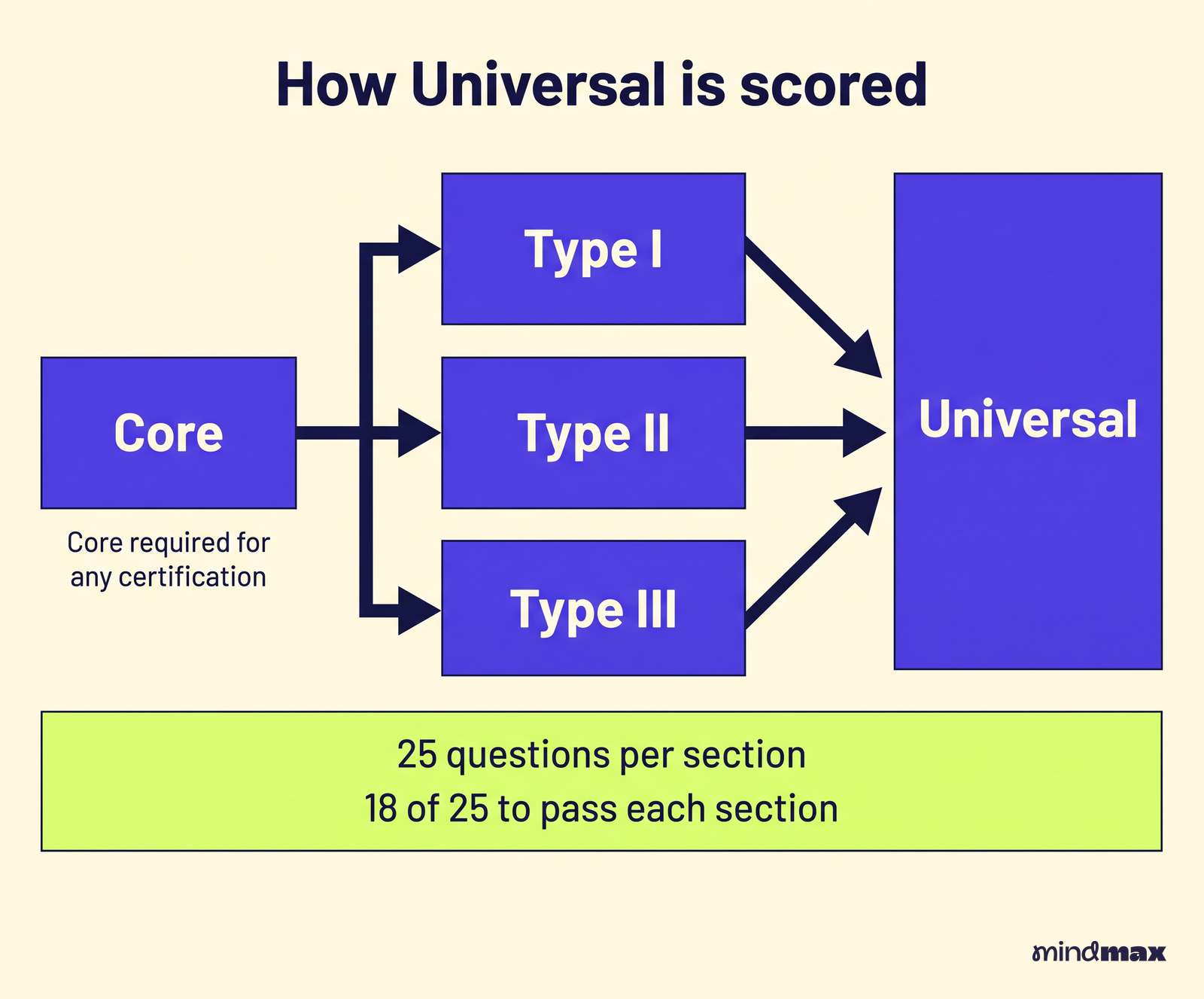
| Questions | 25 multiple choice per section, 100 for Universal |
| Pass mark | 70%, which in practice means 18 of 25 correct in each section |
| Core rule | You must pass Core to receive any certification |
| Retakes | Only the sections you failed |
| Materials | Closed book. ESCO allows a temperature/pressure chart and a calculator |
That 70% figure trips people up. Seventy percent of 25 is 17.5, so the real bar is 18 correct, which is 72%. Some providers quote 70% and some quote 72%, but they mean the same thing.
The rules on materials and timing vary by provider. ESCO allows a calculator. Mainstream Engineering says no calculator is allowed, and gives a maximum of three hours for its online Universal. One candidate reported a two-hour limit for SkillCat's Universal. Check your own provider's rules before test day.
There's also one change to know about. ESCO says it released an updated Section 608 test bank in August 2026 with a 10th Edition manual, and its 2018 exam stays available until January 1, 2027. Whatever you study from, make sure it matches the edition you'll actually sit.
Is it hard to get the universal EPA 608 certification?
Getting the universal EPA 608 certification is hard in one specific way. The ideas aren't hard. Remembering exact facts is. No certifying organization publishes pass rates, so nobody can give you a real failure figure. What candidates describe again and again is missing a section by one or two questions.
In one r/HVAC thread on whether the test is easy, people call it "a history test for the most part" and say the hard part is "remembering dates." Others mention vacuum levels, organization names and refrigerant nomenclature. One person warned that some questions "look similar while requiring obviously different answers."
Universal adds two pressures of its own.
- Four separate pass lines. You need 18 of 25 in Core and in each Type. A great Type II score can't make up for a weak Type III.
- Core is the gate. Pass all three Types but miss Core, and you hold no certification at all.
The good news is that you keep whatever you pass. If you miss Type III by one question, you go back for Type III only. ESCO notes that retakes cost extra, so confirm the fee with your provider.
Why does everyone say the EPA 608 test is so easy?
People who call it easy usually passed it years ago, often after time in the field. To them, "don't vent refrigerant" and "use nitrogen, not oxygen, for leak testing" are just common sense. You don't have that background yet, so being nervous is reasonable, not a sign that something's wrong with you.
"Easy" really means the test doesn't ask you to troubleshoot or do hard math. It asks you to recall facts exactly. That's very learnable, but only if you study the way the test is built. In that same thread, one commenter mentioned someone who studied for months, had serious anxiety, and still passed only Core. Long study time with poor methods doesn't save you. Good methods do.
So take the easy talk as reassurance that the material is finite, and treat it as a memory test.
How long should I study for the EPA 608 universal if I'm starting from zero?
Plan on 15 to 40 hours over one to three weeks if you've never worked in HVAC. Candidate reports cover a wide range.
- One career changer from project management, starting a union job with Local 38, studied 13 hours and finished in 25 minutes. Their advice, from an r/hvacadvice thread on the 608 Universal, was "Take it seriously, review the material thoroughly, and make sure to write things down."
- Others report two weeks to a first-try Universal, or SkillCat coursework spread over three to four days.
- A homeowner spent about 40 hours on a free course plus 6 more on practice questions.
- A few say four hours was enough. Those people usually had field experience.
From zero, aim for the middle of that range. Don't stretch it over months, though. Several commenters say to take the real test within a week of finishing so the facts stay fresh.
Study plan to pass EPA 608 universal in one week while working full time
This plan assumes about 90 minutes on work nights and longer sessions over the weekend, roughly 15 hours in all. Book the exam for day 8 before you start, so the date is fixed.
| Day | Focus | Time |
|---|---|---|
| 1 | Read EPA's Test Topics. Study Core and start your date sheet | 1.5 hours |
| 2 | Finish Core. Take a Core practice test and log every miss | 1.5 hours |
| 3 | Type I. Small-appliance recovery and the November 15, 1993 cutoff | 1.5 hours |
| 4 | Type II. Leak rates, evacuation levels by situation, psig to psia | 2 hours |
| 5 | Type III. Leak-test order, purge units, R-123, charging vapor first | 1.5 hours |
| 6 | Full practice set from bank A. Redraw the recovery chart from memory | 3 to 4 hours |
| 7 | Full practice set from bank B. Review only your miss log | 3 hours |
| 8 | Quick look at your miss log, then the real test | 30 minutes plus the exam |
Two habits make this plan work. Re-check Core every night for two minutes, because commenters say Core-type questions show up across all the sections. And if you're under 90% on any section by day 7, move the test back. That costs less than paying for a retake.
I passed all the practice tests but failed the real EPA 608, why?
This happens a lot, and it usually has a simple cause. Your practice bank was smaller than the real pool. The exam draws questions at random from EPA's bank, and you get a different version each time. If you take one app's quiz six times, you can learn the answers to those exact questions without learning the facts behind them.
One candidate in an r/HVAC thread about the Universal exam studied only one engineering platform's practice exams. The real test "presented unexpected challenges," and they missed Core by one question. Others say the real questions were mostly the same, just reworded. Rewording is exactly what breaks answer memorization.
The 90% rule, done properly
The community rule is to repeat practice tests until you score 90% or higher. That rule works if you add three checks.
- Use at least two banks. ESCO's free site tests, a practice app with 750 to 800 questions, Quizlet sets and your course's own quizzes all phrase things differently.
- Explain every answer out loud. If you can't say why the right answer is right, you don't know it yet.
- Test yourself on fresh questions. Your 90% only counts on a set you haven't already memorized.
Keeping dates and evacuation levels fresh with spaced review
EPA's Test Topics page is literally a list of dates and "evacuation requirements… in each of the following situations." Facts like these fade within days if you read them once. They stick when you recall them at growing intervals, for example after one day, then three days, then the morning of the test.
Here's what to put on your review cards.
- Core. CFC and R-22 phaseout dates, the maximum Clean Air Act penalty, the Montreal Protocol, the AHRI 700-2016 reclaim standard, recover vs recycle vs reclaim, fractionation, the yellow and gray recovery cylinder colors, the 80% fill limit, and DOT labels.
- Type I. Evacuation requirements with and without a working compressor, for recovery equipment made before vs after November 15, 1993, plus passive recovery methods.
- Type II. Leak rates and repair extensions, evacuation levels by situation, no system-dependent recovery above 15 lb, adding 14.7 to convert psig to psia, and ASHRAE 15 equipment-room rules.
- Type III. Hot water or Prevac before nitrogen for leak testing, maximum leak-test pressure, heating oil to 130°F, circulating water to prevent freezing, vapor before liquid, and the R-123 sensor.
You can keep that schedule with paper flash cards or with an app. MindMax, for example, is an adaptive tutor app from Ed Cooke and Daniel Zohar, who built Memrise. It starts from your goal of passing, builds a plan around the days you have left, and runs short lessons as a conversation where you ask questions and the tutor adapts as you go.
One rule is changing in the field. Since January 1, 2026, leak repair rules apply to systems with 15 lb or more of HFCs such as R-410A, down from the old 50 lb threshold, as HVAC School explains. EPA's Test Topics page still says "more than 50 pounds." Learn what your provider's current materials teach, and know that the field rule is now 15 lb.
How do you pass the EPA certification test if you're not good with tests and learn better hands on?
Turn the facts into things you do with your hands. Hands-on learners pass this test all the time.
- Draw the recovery chart. Sketch it from memory every day until it comes out the same each time. One candidate drew the Type II and Type III charts on scratch paper as soon as the test started. Ask your proctor first whether scratch paper is allowed.
- Write, don't just read. One commenter couldn't get through the study guide, so they took a class at a supply house, took notes and did very well.
- Tie facts to equipment. Picture the yellow-topped gray cylinder and the 80% line. Picture nitrogen on a gauge set, never oxygen.
- Watch, then quiz. YouTube walkthroughs from Johnstone or HVAC School, followed right away by a short Quizlet or Kahoot set.
- Screenshot your misses. Keep a folder of the questions you keep getting wrong and go through it daily.
On the day itself, read each question once and answer what it actually asks. Commenters warn against reading too far into a question. If your provider allows a PT chart, use it. Some classification questions, like whether R-22 is an HCFC, can be answered straight from the chart.
Choosing where to study and test
All of these are on EPA's list of approved certification programs.
| Provider | What you get | Cost |
|---|---|---|
| SkillCat | App course plus remote-proctored exam, 4 attempts, instant results | $10 a month or $96 a year, 3-day free trial, physical card $50 extra |
| ESCO Institute | Widely used manual, free practice tests on its site, remote testing | 2026 online exam $85 for all four sections |
| Mainstream Engineering | Study guides, practice exams, online and in-person exams, wallet card included | Check EPATest.com |
| TPC Training | Study guide that commenters describe as a free PDF | Check with TPC |
| Practice apps, Quizlet | Question banks of about 750 to 800 items | About $10, per commenters |
SkillCat's pricing comes from its own page for HVAC beginners. That page also points out that each organization keeps its own database, so a supply house searching ESCO won't find a SkillCat certificate.
Avoid one costly trap. EPA's certification requirements page says a Core taken open book can't count toward Universal. Core must be proctored. One candidate who passed open-book sections had to pay to test again. If you're going for Universal, book a proctored, closed-book exam from the start. Once you pass, the credential never expires.
Frequently asked questions
Does the EPA 608 certification expire or need renewal?
No. EPA says Section 608 technician credentials do not expire, so you test once. EPA keeps the right to add a recertification requirement in the future, but none exists today.
Is the EPA 608 the same as a state HVAC license?
No. The 608 is a federal certification and the exam is the same in every state. Many states and cities require a separate mechanical or contractor license on top of it, so check with your state licensing board.
If I fail one section, do I have to retake it with the same provider?
Usually you retake only the failed section, and many candidates say it should be with the same certifying organization so your passed sections carry over. Policies are not consistent across providers. Ask your provider before you book the retake.
Is it worth paying extra for a physical EPA card?
It depends on your employer. Some providers include a card, and SkillCat charges $50 for one on top of a free digital certificate. Many techs say nobody ever asked to see the plastic card, but keep a copy of your certificate at your place of business as the rules require.
Can I take the EPA 608 exam in Spanish or orally?
Several approved programs, including ESCO, Mainstream and SkillCat, offer the test in Spanish. Programs must offer an oral test if you ask in writing at least 30 days ahead. Contact your chosen provider to set it up.