
NCLEX Shut Off at 85 Questions? What It Means for Pass or Fail
11 min read ·

Principal Engineer at MindMax
My NCLEX shut off at 85 questions, does that mean I passed or failed?
When your NCLEX shut off at 85 questions, the stop point alone does not tell you whether you passed or failed. NCSBN says the number of items does not determine or reveal your result. The NCLEX-RN stops at 85 when the computer is 95% certain your ability is clearly above or clearly below the passing standard, and that can happen in either direction. Many candidates who shut off at 85 pass, and some fail. Your official result comes from your board of nursing.
What NCSBN says about exam length
NCSBN answers this exact question in its official NCLEX FAQ on exam length and results. Its words are "No. The number of items alone does not determine or reveal pass/fail results." The 2026 RN Test Plan says the same thing another way. "A candidate may pass or fail regardless of the length of the examination."
So if you are sitting in your car replaying question 84, you are not alone, and you are not missing a hidden signal. The stop point means something narrower than pass or fail, and the sections below explain what it means and what to do while you wait.
How the 95% confidence rule decides when the NCLEX stops
The NCLEX-RN is a computerized adaptive test. Everyone starts with a fairly easy item. After each answer, the computer updates its estimate of your nursing ability and picks the next item to match it. It is not counting a percentage correct. It is asking one question over and over. Is this person clearly above the line, clearly below it, or still too close to call?
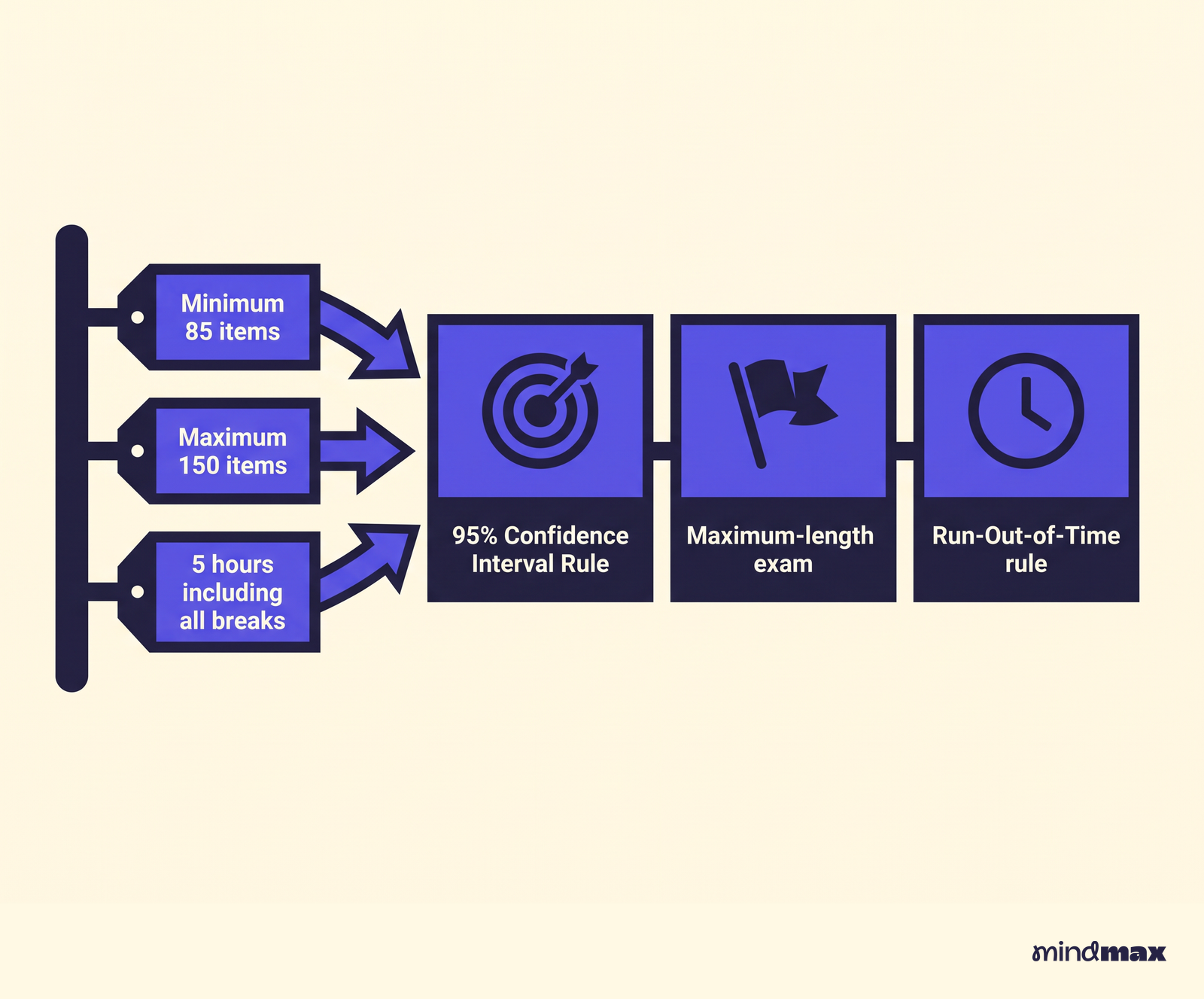
Under the 2026 NCLEX-RN Test Plan, in force from April 1, 2026 through March 31, 2029, the limits are minimum 85 items, maximum 150 items, and 5 hours including all breaks. The line itself is the passing standard of 0.00 logits, which NCSBN's board upheld in December 2022 and which runs through March 31, 2029.
Your exam can end in one of three ways.
- 95% Confidence Interval Rule. NCSBN calls this the most common scenario. The computer stops "when it is 95% certain that the candidate's ability is either clearly above or clearly below the passing standard after reaching the minimum number of items." It cannot stop before item 85.
- Maximum-length exam. If your ability stays close to the passing standard, the exam keeps going to 150. At that point the 95% rule is set aside and only your final ability estimate counts. At or above the standard is a pass. Below it is a fail.
- Run-Out-of-Time rule. If time runs out before you answer 85 items, the result is a fail. If you answered at least 85, you are scored on your final ability estimate from every item you completed.
So stopping at exactly 85 means one thing only. By the minimum point, the computer already had enough evidence to be 95% sure, one way or the other.
Can you fail the NCLEX-RN at 85 questions?
Yes. You can fail at 85, just as you can pass at 85. NCSBN addresses it directly. When a candidate fails after the minimum number of items, "it took only the minimum number of items for the scoring algorithm to determine with 95% certainty that the candidate's nursing ability was below the passing standard."
That is the full official meaning of failing at the minimum. You may see a forum rule of thumb that failing at 85 always means a deep content problem, while failing at 150 means you were nearly there. NCSBN does not frame it that way. A fail at 85 means the evidence was clear early. It does not label you as a hopeless case, and your next attempt starts from scratch.
If it does turn out to be a fail, your Candidate Performance Report shows which content areas pulled you down. That report is a far better guide to your retake than the number of questions you saw.
What are the odds of failing when the NCLEX shuts off at 85?
NCSBN does not publish pass or fail rates by exam length. Any figure you see online claiming a certain percentage of people who stop at 85 pass is not official.
The only solid base rate is the overall one. In 2025, first-time, U.S.-educated RN candidates passed at 86.7%, according to Becker's Hospital Review's account of NCSBN data. Most first-time candidates pass, and your stop point does not move you out of that group. That is a reason for calm, not a guarantee.
Pass rates vary by state. Here are the largest states for 2025, first-time U.S.-educated RN candidates.
| State | Candidates | Pass rate |
|---|---|---|
| Texas | 16,454 | 88.6% |
| California | 16,255 | 89.0% |
| Ohio | 8,529 | 84.0% |
| Pennsylvania | 8,238 | 84.9% |
| Florida | 7,813 | 84.1% |
| New York | 6,951 | 83.7% |
| National | All states | 86.7% |
Other states range from 92.9% in North Dakota to 77.8% in Alaska. These are 2025 figures, the most recent full year available, and they come from secondary reporting because NCSBN's own pass-rate page is an interactive dashboard.
What about your readiness scores?
Many candidates try to guess their result from prep-course scores. Archer Review, for example, sells readiness assessments and CAT exams with a "pass prediction" across all its NCLEX-RN plans, which start at $79 for one month of Q-Bank plus CAT. Those predictions are a prep company's estimate before the exam. They say nothing new once your real exam has ended. Archer's advertised 98.98% pass rate is based on self-reported outcomes from users who completed all Sure PASS requirements, so it does not describe a typical candidate either. NCSBN itself does not endorse any review course.
I had 5 NGN case studies and my NCLEX stopped at 85, is that normal?
Yes, it is very common, and it tells you nothing about your result. A minimum-length exam of 85 items holds 52 scored stand-alone items, 18 case-study items and 15 unscored pretest items. The 18 scored case-study items make up 3 case studies of 6 items each.
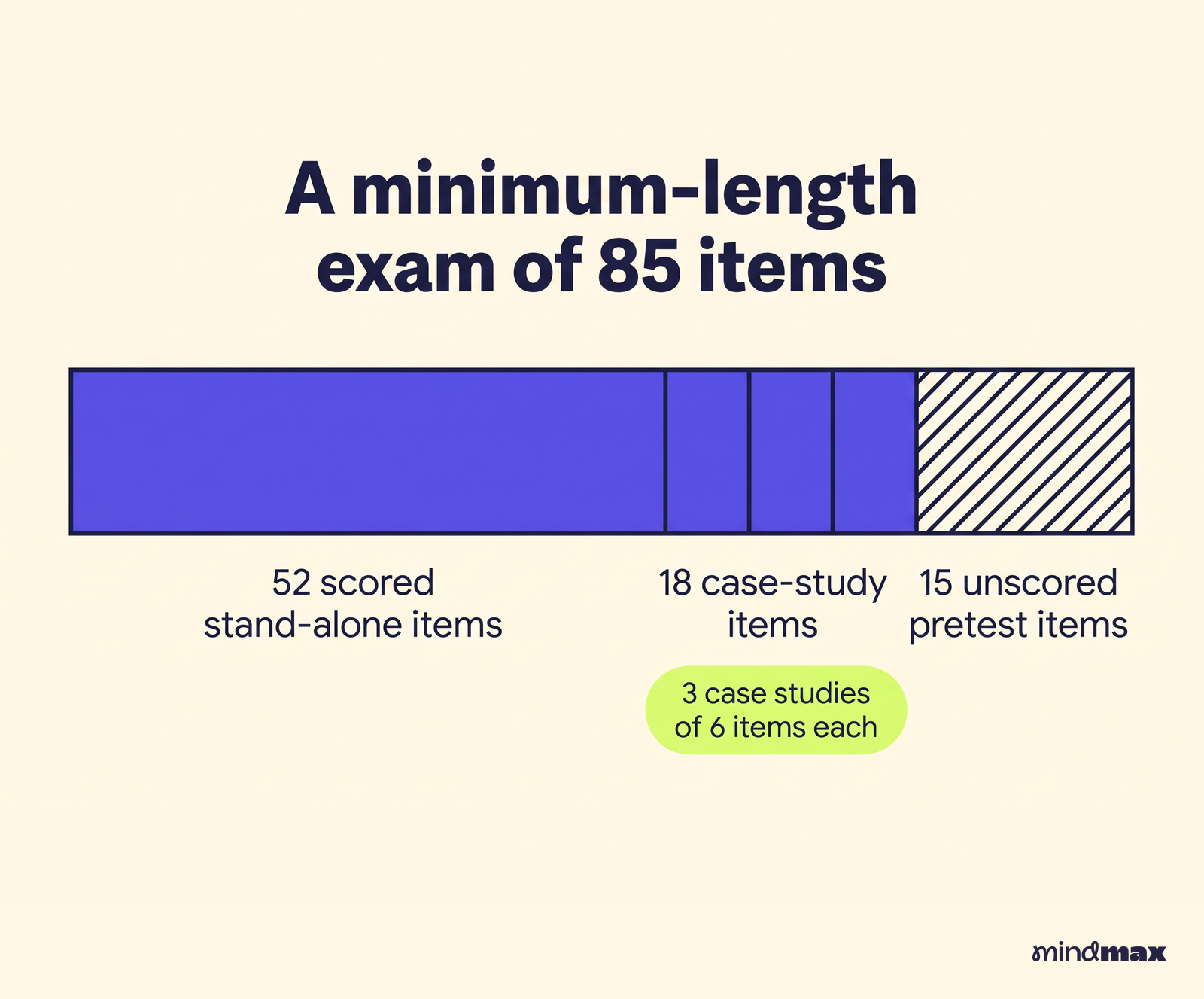
So where did case studies 4 and 5 come from? Every exam includes 15 unscored pretest items, and you cannot tell them apart from scored ones. NCSBN says pretest items "have similar style and format as operational items." It does not state outright that pretest items can be full case studies, but extra case studies being unscored pretest material is the reasonable explanation. Candidates regularly report 4 to 6 case studies on 85-item exams, and they report both passes and fails.
A few other things people read into their exam don't hold up either.
- Lots of SATA. NCSBN says "There is no predetermined percentage of item formats administered to candidates." A heavy run of select-all-that-apply items is not a sign either way.
- Bow-ties and other NGN formats. Some items earn partial credit, scored by plus/minus, zero/one or rationale scoring. You may have earned more points than you think on items that felt shaky.
- A repeated topic. Seeing a second question on the same content does not mean you missed the first one. NCSBN warns candidates not to assume that.
Does getting all 150 questions on the NCLEX mean I was close to passing?
Going to 150 means your ability estimate was close to the passing standard. It does not say which side you were on. NCSBN says the exam continues to the maximum "when the candidate's ability estimate is close to the passing standard." Some of those candidates were hovering just above the line, and some just below.
Think of it as a number line with the passing standard of 0.00 logits in the middle. An estimate that is clearly above the passing standard or clearly below the passing standard can stop at 85. An estimate that stays close to the passing standard goes to 150. At item 150 the computer looks only at where your final estimate sits. At or above passes. Below fails.
So if you failed at 150, it is fair to say you were near the line. If you passed at 150, you were near it too. And if you stopped at 85, the computer simply had a clear answer sooner.
Why the last NCLEX questions felt impossible
Almost everyone walks out feeling they failed, and the design of the test is the reason. NCSBN explains that at the end of an exam, a candidate usually receives items they have "approximately a 50% chance of answering completely correctly." It adds that "both high- and low-ability candidates will think the items at the end of the exam are challenging."
In other words, the exam aims each question right at your edge. Feeling stretched is what a working adaptive test feels like, whether you are well above the standard or below it.
The last question also doesn't decide your result on its own. One r/PassNclex poster stopped at 85 with about three hours left, checked their final question with ChatGPT, was told it was wrong, and panicked. They passed, and later called the last-question theory a myth. Your result rests on your ability estimate built across the whole exam, not one item.
What to do while you wait for your NCLEX results
The wait is the hardest part. Here is how results actually reach you.
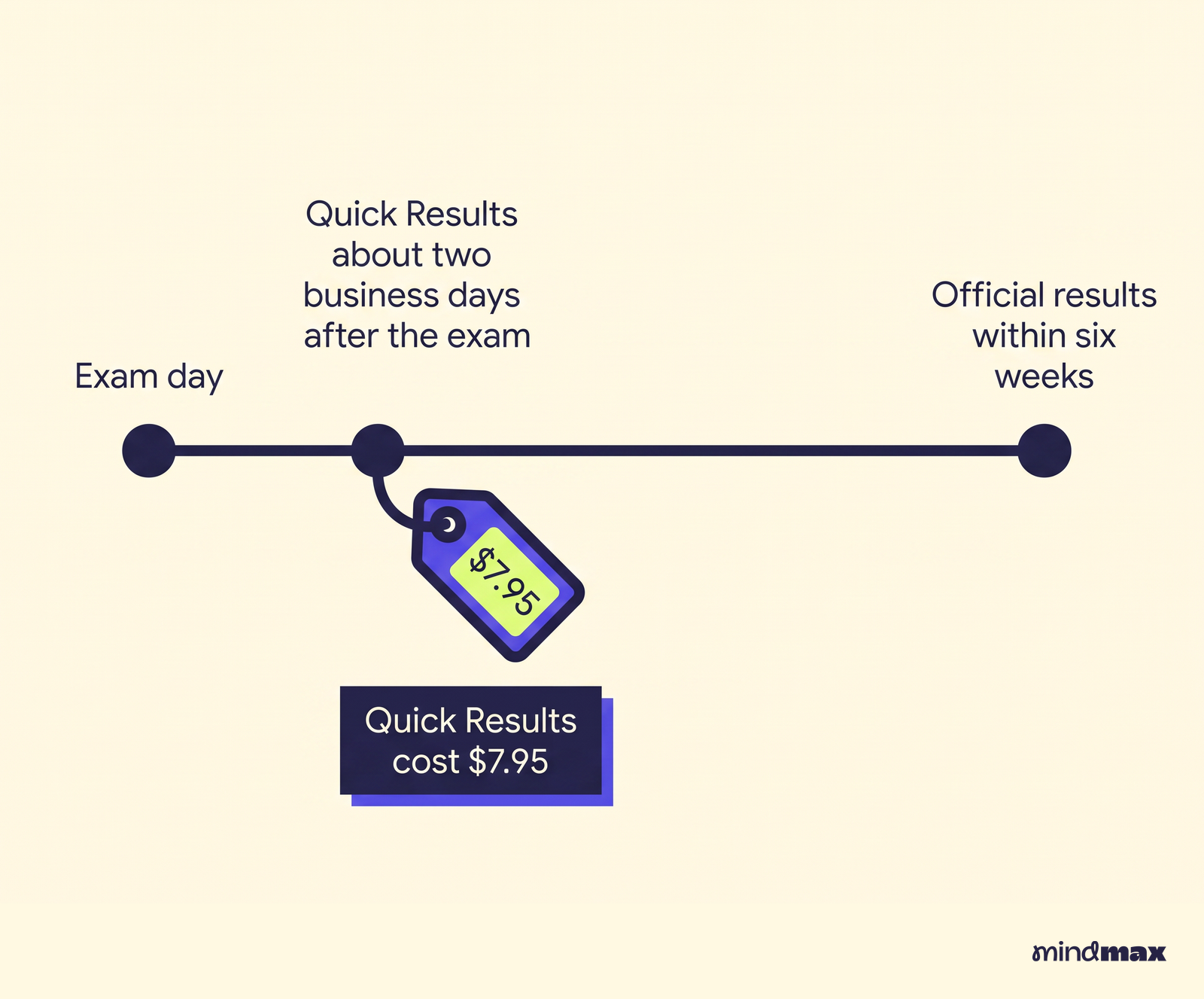
- Quick Results. These are unofficial results available in participating U.S. jurisdictions, which include California, Texas, Florida, New York, Ohio and Pennsylvania. Quick Results cost $7.95, and you are charged only if results are available. NCLEX.com says they arrive about two business days after the exam, and its FAQ says 48 hours after your exam date and time.
- Official results. Your nursing regulatory body sends official results within six weeks. Quick Results do not authorize you to practice.
- Your board's license lookup. Once your board posts your license, that is a reliable answer too.
Then there is the Pearson VUE trick, which candidates call the PVT, with its "good pop-up" and "bad pop-up." It is unofficial. Candidates themselves argue over how reliable it is, and some report a good pop-up followed by a fail or a bad pop-up followed by a pass. Mechanics have changed over time too, and one poster got a registration block instead of a clear pop-up. If you try it, treat it as a guess, not a result.
Timeline in short. Exam day, then Quick Results about two business days after the exam, then official results within six weeks. Try to plan something for those first two days that keeps your hands busy.
If your NCLEX result is a fail
A fail hurts, and it is also a fresh start in a very literal sense. NCSBN says "Each exam attempt is independent." Your next exam begins the adaptive process again, and it does not resume where the last one ended.
What happens next.
- Read your Candidate Performance Report. Only candidates who fail receive one. A content area marked "Near the Passing Standard" means your performance there was not clearly above or below the standard. Areas below it are where to aim your study.
- Check your board's retake rules. The waiting period before a retake is set by each nursing regulatory body, so confirm it on your board's site before you plan dates.
- Re-register and pay again. The same fee applies to retakes. The NCLEX registration fee rises to $350 in the United States and Australia, and $570 CAD in Canada, for registrations completed on or after Feb. 1, 2027. Registrations before then pay the current fee, which NCSBN says has not changed since 2000. If your retake lands near that date, the registration date is what counts.
Retakers often say the fix was fewer resources, used properly. If you want a structured restart, MindMax is an adaptive tutor app from Ed Cooke and Daniel Zohar, the team behind Memrise, that builds a plan to pass from the time you have left, in short lessons where you can ask the tutor questions as you go.
Frequently asked questions
Does the NCLEX give you a score or just pass or fail?
You get pass or fail only. There is no numeric score or percentage. If you fail, the Candidate Performance Report shows how you did in each content area compared with the passing standard.
Will my NCLEX retake have the same questions?
You should not expect the same exam. NCSBN says item pools are rotated regularly, and each attempt starts the adaptive process over. Studying the content areas on your performance report is a better plan than trying to remember old questions.
How long do I have to wait to retake the NCLEX-RN?
The waiting period is set by your nursing regulatory body, not by NCSBN alone. Many candidates talk about a 45-day wait, but check your own board's current rules before you book. You also need a new registration, a new fee and a new Authorization to Test.
Can I start working as a nurse once Quick Results say I passed?
No. Quick Results are unofficial and do not authorize you to practice. You can work as an RN only after your board of nursing issues your license, which also depends on its other requirements such as a background check.
Is Quick Results available in every state?
Quick Results are offered only in participating jurisdictions. Large states such as California, Texas, Florida, New York, Ohio and Pennsylvania take part. Check NCLEX.com for the current list if you tested elsewhere.