
How Hard Is the NMLS SAFE MLO Exam? Pass Rate and Question Style
12 min read ·

Co-founder of MindMax and Memrise, Grand Master of Memory
How hard is the NMLS SAFE MLO exam really?
The NMLS SAFE MLO exam is harder than most people expect. NMLS reports a first-time pass rate of 53% as of December 31, 2024, so nearly half of first-timers fail. You need 75% on 120 multiple-choice questions in 190 minutes. The laws and math are learnable, even with no mortgage background. What trips people up is the wording, especially "except" questions and pairs of answer choices that both look right, plus practice tests that are easier than the real thing. Study past the 20-hour course and you can land in the passing half.
What is the SAFE MLO pass rate on the first try?
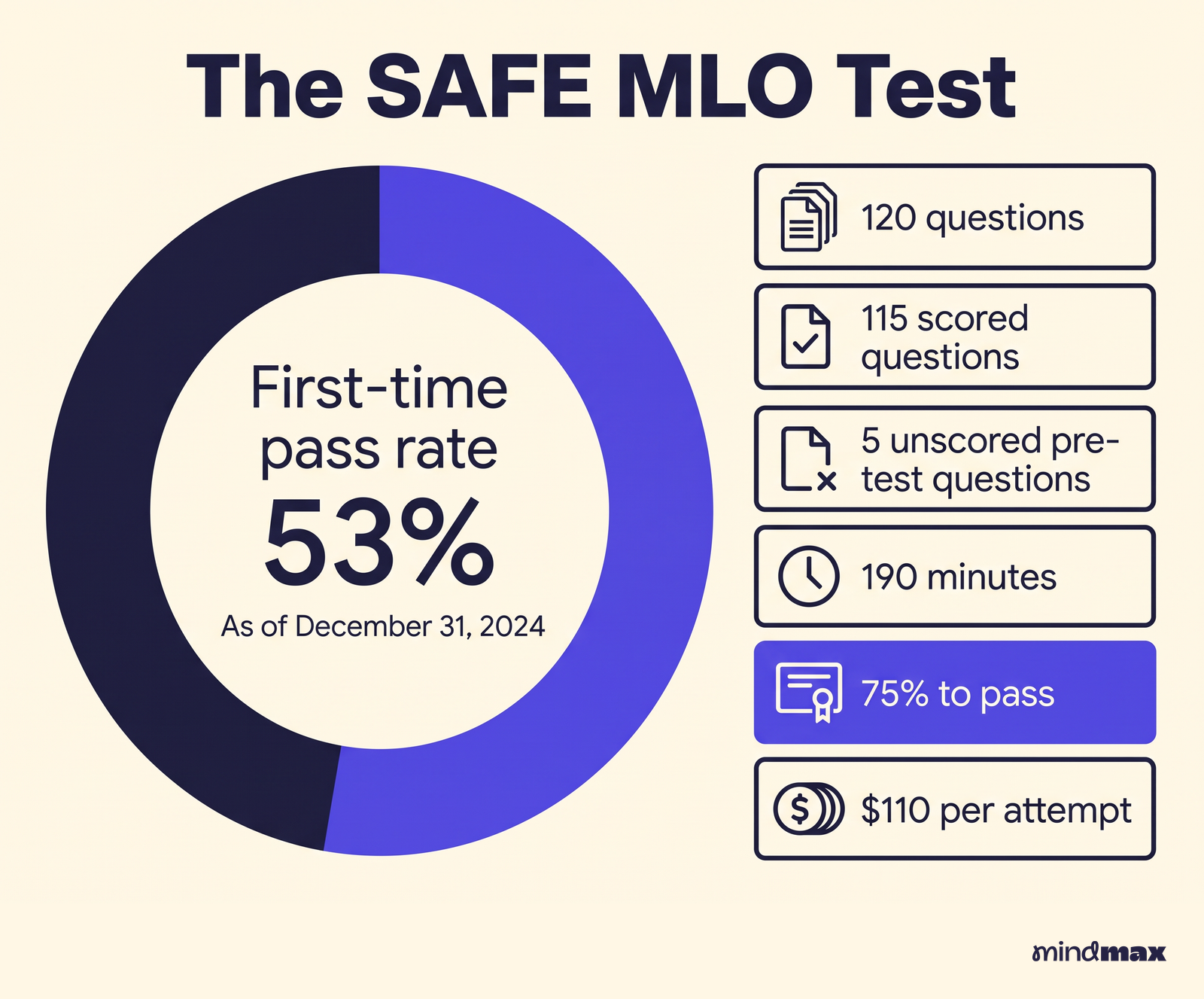
The official number comes from NMLS's Test Performance Information page with the SAFE MLO pass rate, which says "As of December 31, 2024 the first-time pass rate for the SAFE MLO Test is 53%." That is the figure to trust. Prep providers sometimes quote 53% to 58%, but 53% is NMLS's own.
Keep its age in mind. That figure is dated almost two years before today, and NMLS gives one number only. There is no trend line, no rate for repeat takers and no breakdown by state. You'll see claims online that retakers pass at under 50%, but NMLS doesn't publish that, so treat it as rumor.
The rate doesn't vary by state because there is only one test. The SAFE Mortgage Licensing Act of 2008 requires every loan originator seeking a state license to pass the same national test, which has Uniform State Content built in. You pass it once and it counts toward licensing in every state. If you work for a federally insured bank or credit union, you are registered rather than licensed, so you don't have to take it, though you're allowed to.
The test in numbers
The handbook's specifications are dated April 5, 2021. You get 120 questions, and 115 scored questions count toward your result. The other 5 unscored pre-test questions are placed at random, and you won't know which ones they are. You have 190 minutes of test time inside a 225-minute appointment that also covers a tutorial and an optional survey. You need 75% to pass, a mark written into the SAFE Act itself, and you pay $110 per attempt.
If a prep site tells you the test has 125 questions, it's wrong. The official count is 120. NMLS reports your result as a percentage and doesn't publish a fixed number of correct answers.
Is the SAFE MLO exam designed to trip you up with wording?
No, but it is built to reward careful reading, and from the test chair those can feel like the same thing.
Here is how NMLS builds it. Every question is reviewed by a panel of experienced subject matter experts and statistically evaluated before it ever counts toward a score. The test uses Linear on the Fly Testing, so you get your own distinct form. Scores are then statistically equated to a standard form, so a slightly harder version neither helps nor hurts you. If you believe a specific question was flawed, you can file a content challenge within 20 days of your test, and NMLS replies in writing within 20 business days.
Now here is how it feels. One candidate who scored 96% said the score "does not reflect the difficulty of this test… it's difficult because of how the questions are asked and the answer choices." Another expected easy questions like what HMDA stands for and found "the answers were worded oddly, definitely read everything twice or three times." Others mention double negatives, and one put it bluntly. "It is set-up to make quick readers fail."
The official sample questions show the pattern. In the ECOA sample, the right answer is that age can be considered "only if the applicant is too young to enter into a legally binding contract," and it sits next to three alternatives that sound almost as reasonable. You don't beat that with tricks. You beat it by knowing the rule precisely enough that the near misses look wrong.
How to handle the wording
- Read every question twice before you look at the choices.
- When you see "except" or "not," pause and flip what you're hunting for. You want the one choice that doesn't fit.
- Cross out answers that are almost right. Usually one word, a number or a deadline is off.
- Mark a hard question for review and come back to it. Don't burn minutes on one item.
- Other questions sometimes hold clues to earlier ones.
- If a question covers something you've never seen, it may be one of the 5 unscored items. Answer it and move on.
Are NMLS exam questions scenarios or vocab and definitions?
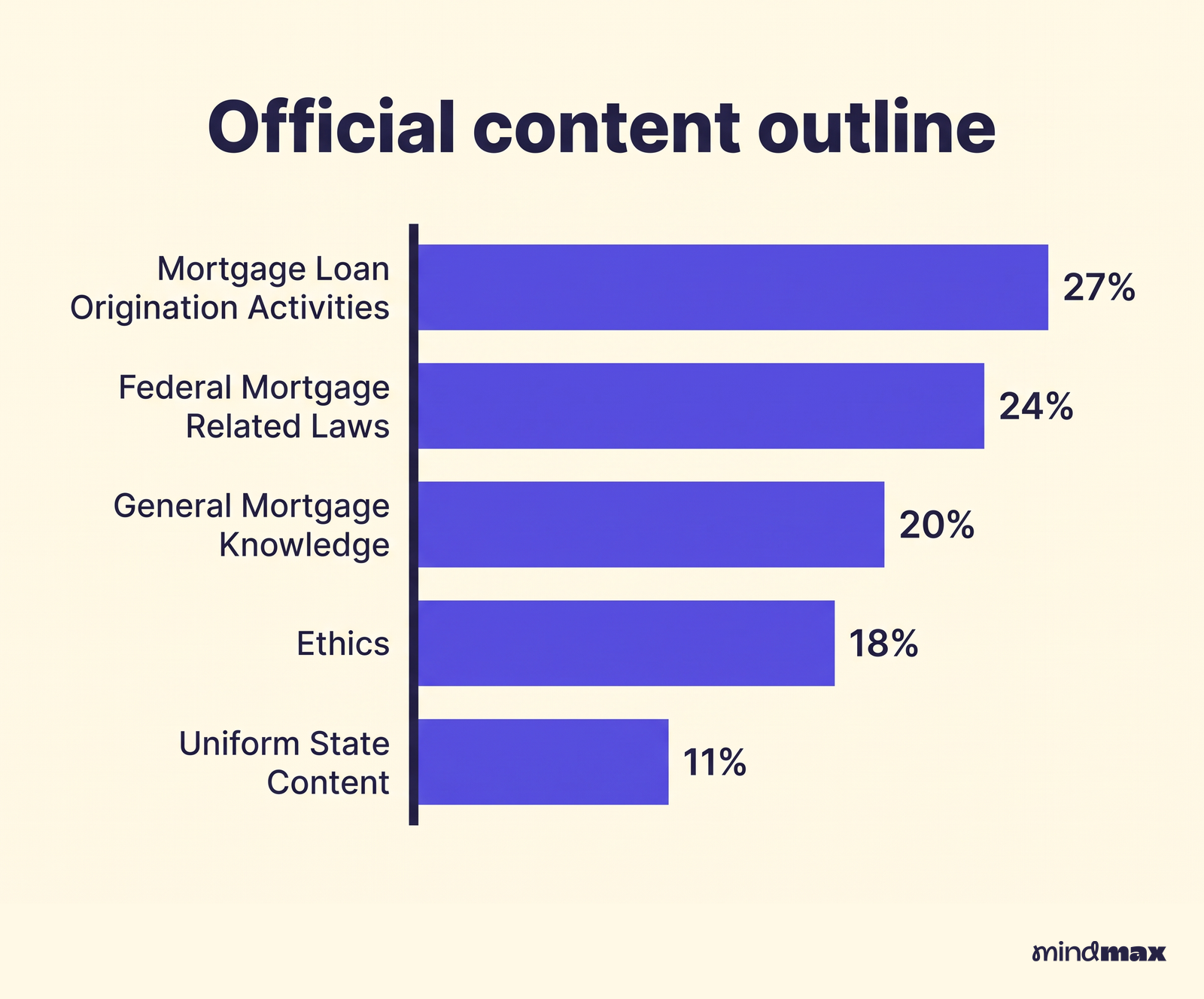
Both, and you need to be ready for both. The official content outline splits the test into five areas. Mortgage Loan Origination Activities is 27%, Federal Mortgage Related Laws 24%, General Mortgage Knowledge 20%, Ethics 18% and Uniform State Content 11%.
The vocabulary side is real. The outline lists definitions such as APR, finance charge, "dwelling" and "loan consummation," plus terms like discount points, 2-1 buy-down, LTV and table funding. The federal law section reads like a list of acronyms, with RESPA, ECOA, TILA, TRID, HMDA, FCRA and FACTA among them.
The applied side is just as real. The outline names refinance rescind scenarios, general loan origination scenarios, violation scenarios on tolerances and closing cost scenarios. It lists calculations for periodic interest, monthly payments, down payments, closing costs and ARM adjustments. Ethics reads like a set of judgment calls about gifts and unexplained deposits, appraiser interactions, multiple applications and falsified information from a borrower or loan officer.
The 10 official sample questions mix both. 3 of the 10 use "except" wording, such as which item is not part of the finance charge. 2 of the 10 are calculations, one a down payment net of earnest and option money, the other monthly income from an hourly wage (multiply by 52 weeks, then divide by 12). The other 5 are definition or rule questions on PMI at 80% LTV, the TILA meaning of "refinance," ECOA age rules and which fees are left out of APR. NMLS says these samples show the types of questions but aren't meant to fully prepare you.
In practice, many definitions arrive wrapped in a short situation, so you have to apply the rule, not just recall it. Disclosure timing under TRID comes up again and again, and the deadlines differ by rule, some in business days and some in calendar days. Skip shortcuts like the "rule of 3" guess that circulate online. Learn each deadline and how its days are counted. Answer every question based on current statutes and rules, even if a recent change isn't in the outline.
Can you pass the NMLS test with no mortgage background?
Yes. Career changers pass it all the time, but they usually put in more hours than people already in the industry.
One candidate summed it up. "If you have had exposure to the mortgage industry and already know the differences between a VA loan, an FHA loan and a conventional loan, then you will have a huge advantage. I personally spent a good 6 weeks studying 8 hrs a day and passed on the first try. All the information was new to me." A former dietitian reported acing it after switching careers. A beginner who failed with about 55% said her class turned "advanced" by day three and seemed aimed at people already working in mortgages, so pick a course that starts at the basics.
What the education rules require
The federal minimum is 20 hours of NMLS-approved pre-licensing education. That's 3 hours of federal law, 3 hours of ethics, 2 hours of nontraditional mortgage lending and 12 hours of electives. Many states add their own hours on top, so check NMLS's state pages for yours. The education must be done before you apply for a license, and it expires if you don't get licensed within 3 years, though not every state enforces that yet. NMLS's testing FAQ says you aren't required to finish a pre-licensure course before taking the test itself.
How long beginners study
Reported timelines run from about a week after the course to 2 months. One person studied about a week, failed with 73, then studied 30 days and passed with 87. If you're new, plan on several weeks beyond the course and build in this order. Learn the loan types first, then the federal laws and their disclosure deadlines, then the math, then timed practice. An adaptive tutor app like MindMax, built by Ed Cooke and Daniel Zohar, who made Memrise, can map that into a plan of short daily lessons that fits your test date, where you ask questions as you go.
Why do so many people fail the NMLS exam?
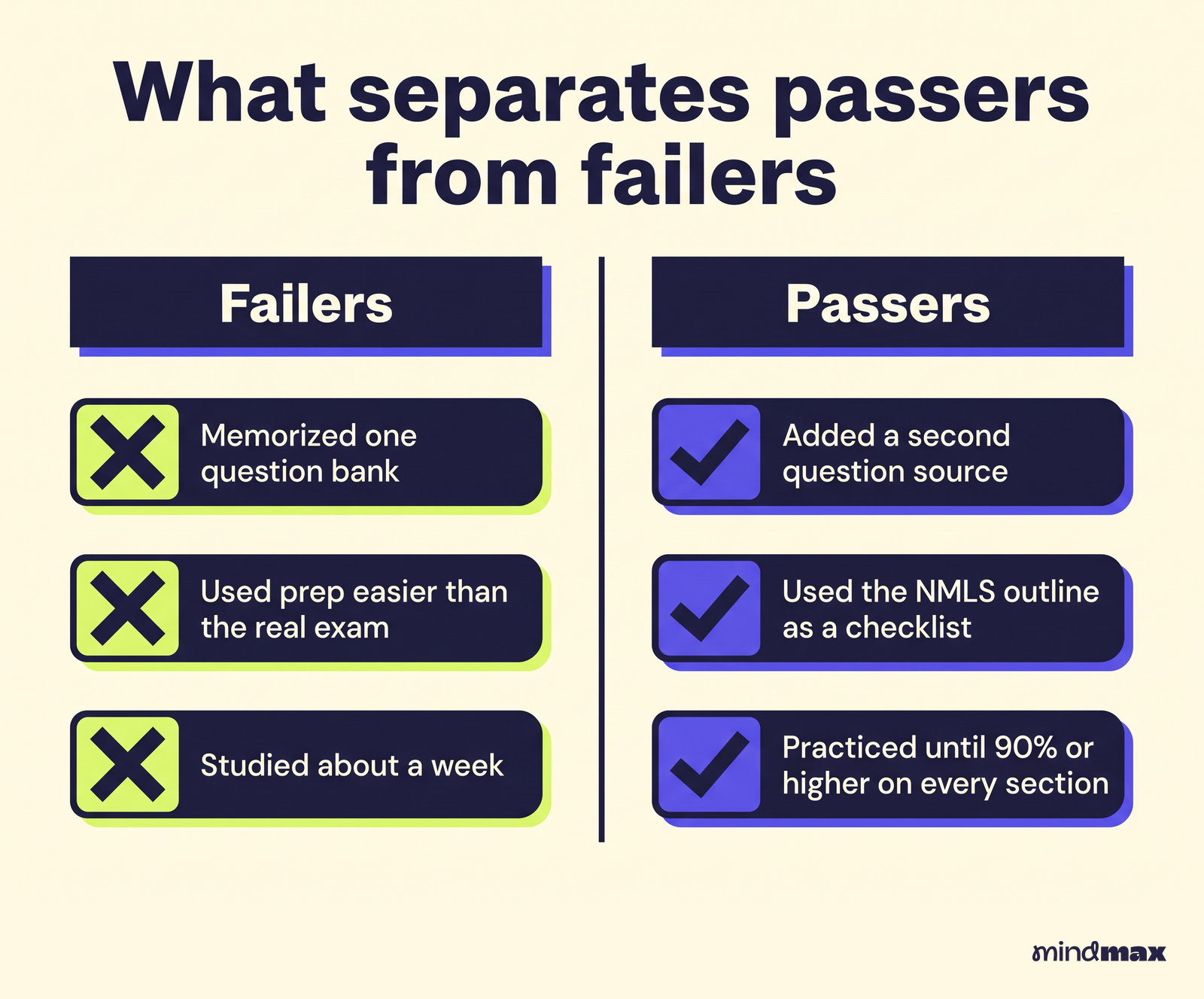
Most failures are near misses. Candidates report scores of 72, 73 and 74, and one failed a third try "only because of one question." That points to fixable habits, not a lack of ability. Here is what separates passers from failers.
They read too fast
Failers often blame the wording. "I have no doubt I would've gotten a passing grade had some of the questions been worded more straightforwardly," one wrote. Passers slowed down and read every line.
They memorized one question bank
One candidate took about 20 practice exams, kept seeing the same questions and failed with 72. Repeating a bank teaches you its questions, not the material, and the real test won't show you identical items. Passers who retook often added a second question source, and one said switching banks broke the patterns in their head.
They used prep easier than the real exam
Some popular banks feel simple. One candidate called CompuCram "significantly easier than the actual exam." Passers often moved on to a harder bank such as PrepXL once the basics stuck.
They studied about a week
Cram-and-go rarely works for a first-timer. Passers usually spent weeks, not days, beyond the 20-hour course.
They met topics they never studied
A candidate who failed with 71% said they "started to see topics I had never recalled reading about." The fix is simple. Passers used the NMLS outline as a checklist and made sure every line on it was covered. Passers also practiced until 90% or higher on every section before booking.
What a failed attempt costs, and how retakes work
The retake waiting periods are set by NMLS. After a first failure or a second failure, you wait 30 calendar days. After a third failure, you wait 180 calendar days, and then the cycle restarts. Each attempt needs its own paid enrollment at $110 per attempt. You can enroll again right away, but you can't schedule a date inside the waiting period. Once you pass, you can't retake the test.
Each enrollment gives you 180 days to schedule and sit the test. If you need to cancel or reschedule, do it by the cutoff two business days before your appointment. A late change or a no-show forfeits the fee.
| Item | Cost |
|---|---|
| SAFE MLO Test fee | $110 per attempt |
| 20-hour pre-licensing course | Varies by provider |
| NMLS credit-banking fee | $1.50 per credit hour, so $30 for 20 hours |
| Optional exam prep | Varies, for example MEC's National Test Prep Ultimate Package at $129.99 |
| Each retake | Another $110 and at least a 30-day wait |
If you do fail, your score report is your best study guide. It shows your overall percentage and a range for how you did on each section. You can't review individual questions afterward, so use those section ranges to decide where to spend your 30 days.
How passers get ready for test day
The pattern in passers' stories is consistent.
- Finish the 20-hour course, then book the test fairly soon. One candidate who waited a few months said they should have taken it sooner.
- Take full timed practice tests at 120 questions in 190 minutes, so the length doesn't surprise you.
- Keep testing until you score 90% or higher on every section. Many passers also wait until they hit 80% or more on timed full-length tests.
- Use at least two question banks, and make one of them hard.
- After each test, write a flashcard for every question you missed that explains why the right answer is right.
- Work through the 10 official sample questions and the content outline line by line.
- Drill TRID disclosure timing and the business day versus calendar day rules until you can recite them.
Results usually appear on screen when you finish, and the official result posts to NMLS within about 72 hours.
Frequently asked questions
How many questions do I need to get right to pass the SAFE MLO test?
NMLS requires a score of 75% and reports your result as a percentage. It doesn't publish a fixed number of correct answers. Straight arithmetic puts 75% of the 115 scored questions at about 87 correct, but NMLS doesn't confirm that, so aim well above it in practice.
Can I take the SAFE MLO exam online from home?
Yes. You can test at a Prometric center or online through Prometric ProProctor. For the online option you submit a request with a reason and attestations, and you should expect a room scan before you start. Online you get an on-screen calculator and a virtual scratchpad, while test centers give you a basic calculator and a whiteboard.
Does a passing SAFE MLO score ever expire?
There is no renewal exam. A passed test only expires if you go 5 consecutive years without holding a state license or an active federal registration. After that you would need to pass it again.
What ID do I need on SAFE MLO test day?
Bring one current, unexpired government-issued ID with your photo and signature. The name must match your NMLS account exactly. At a test center your phone, wallet and other personal items go in a locker, and restroom breaks don't stop the clock.
Do I need a sponsor to take the SAFE MLO exam?
No, you can sit the test without a sponsoring employer. The state license itself generally requires sponsorship by a licensed company, plus a background check and other conditions that vary by state. Many candidates pass the test first so it's on their resume while they job hunt.