
What Is the PTCE? PTCB's Pharmacy Tech Certification Exam
12 min read ·
What is the PTCE?
The PTCE, or Pharmacy Technician Certification Exam, is the national test you pass to become a Certified Pharmacy Technician (CPhT). The Pharmacy Technician Certification Board (PTCB) runs it, and you take it in person at a Pearson test center. Under the outline in effect since January 6, 2026, the PTCE exam has 90 multiple-choice questions, 80 of them scored, in 1 hour 50 minutes. You pass with a scaled score of 1,400 on a 1,000 to 1,600 scale. It costs $129 per attempt, and you qualify through a recognized training program or 500 hours of work experience.
What is the difference between PTCB and PTCE?
Three terms get mixed up constantly, and each means something different.
- PTCB is the Pharmacy Technician Certification Board. It's the organization that runs the exam and awards the credential.
- PTCE is the Pharmacy Technician Certification Exam, the test PTCB gives.
- CPhT is Certified Pharmacy Technician, the credential you hold once you pass the PTCE and meet PTCB's other requirements.
Put simply, you take the PTCE, PTCB scores it, and you walk away a CPhT. You'll hear people call it "the PTCE," "the PTCB exam" and "the CPhT exam." All three mean the same test, so a search for the "pharmacy technician certification board PTCB exam" lands on the PTCE.
PTCB's CPhT program is nationally accredited by the National Commission for Certifying Agencies (NCCA). PTCB also says employers prefer, and many require, their technicians to be PTCB CPhTs.
The other CPhT
PTCB doesn't own the letters CPhT. The National Healthcareer Association (NHA) awards a credential it calls Pharmacy Technician (ExCPT/CPhT) through a separate exam, the ExCPT. When you search for a "pharmacy tech certification test," you'll find both.
A prep provider's comparison puts the ExCPT at 120 questions in 2 hours 10 minutes, offered at PSI centers or by live remote proctoring. The PTCE is 90 questions in 1 hour 50 minutes, in person only. Candidates working in hospitals often say their employer requires the PTCB credential in particular, so ask your employer or target employer which one they want before you pick.
What is the PTCE exam format in 2026?
Here's the format under the outline effective January 6, 2026, as PTCB lists it on its Certified Pharmacy Technician (CPhT) page.
| Item | PTCE figure |
|---|---|
| Questions | 90 multiple choice, 80 scored and 10 unscored |
| Exam time | 1 hour 50 minutes (110 minutes) |
| Full appointment | About 2 hours |
| Delivery | In person at a Pearson test center, with a live proctor |
| Passing score | Scaled score of 1,400, on a 1,000 to 1,600 range |
| Fee | $129 per attempt |
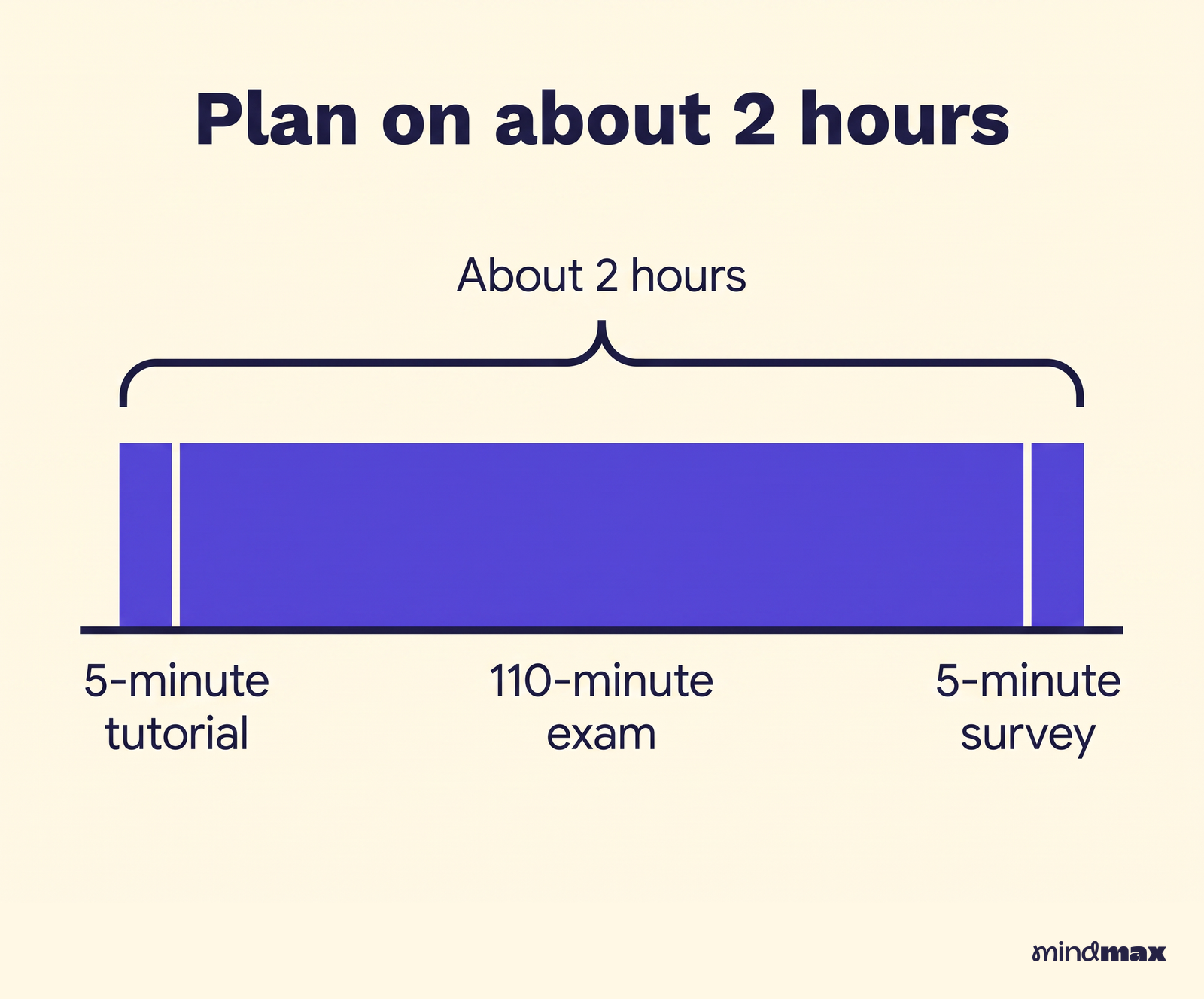
Plan on about 2 hours at the center, a 5-minute tutorial, the 110-minute exam and a 5-minute survey. PTCB lists no scheduled break inside that time.
The 10 unscored questions are placed randomly and aren't identified. You can't tell which ones count, so answer every question as if it does.
Every question is multiple choice. PTCB publishes no select-all-that-apply items, case studies or simulations for this exam.
Can you take the PTCE online?
No. PTCB offers online testing for its other credential exams, but not the PTCE. Some of its help pages still describe online procedures, and those apply to the other exams. You'll test at one of more than 1,400 Pearson test centers nationwide, which include more than 100 military bases.
How much time per question
At 110 minutes for 90 questions, you get about 73 seconds each. A common forum myth says you get 90 minutes for 90 questions. You actually have 20 minutes more than that. One experienced tech on Reddit described the exam as rewarding recognition rather than working things out, which fits that pace.
How is the PTCE scored?
The 1,400 pass mark is a scaled score, not a percentage correct. Scaling adjusts for small differences in difficulty between exam forms, so two candidates on different forms are held to the same standard.
PTCB doesn't publish a raw cutoff. Prep providers estimate you need roughly 70 to 75% correct, but that is their guess, not an official rule. You'll see forum posts saying you "can afford to get 18 wrong" or aiming to cut misses to a set number. Treat that as folk arithmetic.
Results come in two stages.
- Unofficial result. It appears on screen right after the post-exam survey. The test center may be able to print a copy.
- Official result. It's typically in your PTCB Account within three weeks of your exam date, and PTCB can't speed it up.
Many candidates worry a "prelim pass" might flip to a fail during that wait. It's a common fear on forums. The official report is the one that confirms your status, and you can check any certification on PTCB Certification Verification once it posts.
For scale, PTCB gave 49,253 PTCEs in 2025 and reported a 69% CPhT pass rate for that year. It had 313,556 active CPhTs as of December 31, 2025. PTCB hasn't published a national rate for 2026 yet.
What does the PTCE cover under the 2026 outline?
The outline has four domains. PTCB publishes the weights, not question counts. The approximate counts below apply each weight to the 80 scored questions.
| Domain | Share of exam | Approx. scored questions |
|---|---|---|
| 1 Medications | 35% | 28 |
| 2 Federal Requirements | 18.75% | 15 |
| 3 Patient Safety and Quality Assurance | 23.75% | 19 |
| 4 Order Entry and Processing | 22.50% | 18 |
Math isn't a domain of its own. The outline marks calculation-based items with an asterisk, spread across 1.4, 1.7, 2.2, 2.4, 3.3, 3.5, 4.1, 4.2 and 4.3. Area 4.1 covers formulas, ratios, proportions, conversions, Sig codes and abbreviations used for days supply, quantity, dose, concentration and dilutions.
What changed in 2026
PTCB updated the exam after a job analysis that drew on surveys from more than 6,000 people, approved in August 2024. It kept the same four domains and the same test length. The main changes are these.
- Nonsterile compounding is gone, along with alligations.
- Narrow Therapeutic Index (NTI) medications no longer has its own area, though it may still appear elsewhere where relevant.
- A new area, 2.6, covers the Drug Supply Chain Security Act (DSCSA), meaning FDA product serialization, tracking, tracing, handling and quarantining.
- Medications and Patient Safety now carry a smaller share, while Federal Requirements and Order Entry carry a larger one.
Check the date on any study guide you buy. Material written before January 2026 may still teach alligations, nonsterile compounding and NTI as separate topics, and may skip DSCSA. The outline PDF reads "Effective January 6, 2026" at the top but carries a footer saying v1.4, August 2024. That's the current one.
Who can take the pharmacy technician certification board test?
You can't just book a seat. PTCB requires that you live in the US or its territories, fully disclose any criminal and State Board of Pharmacy actions, follow PTCB's policies, and qualify through one of two routes.
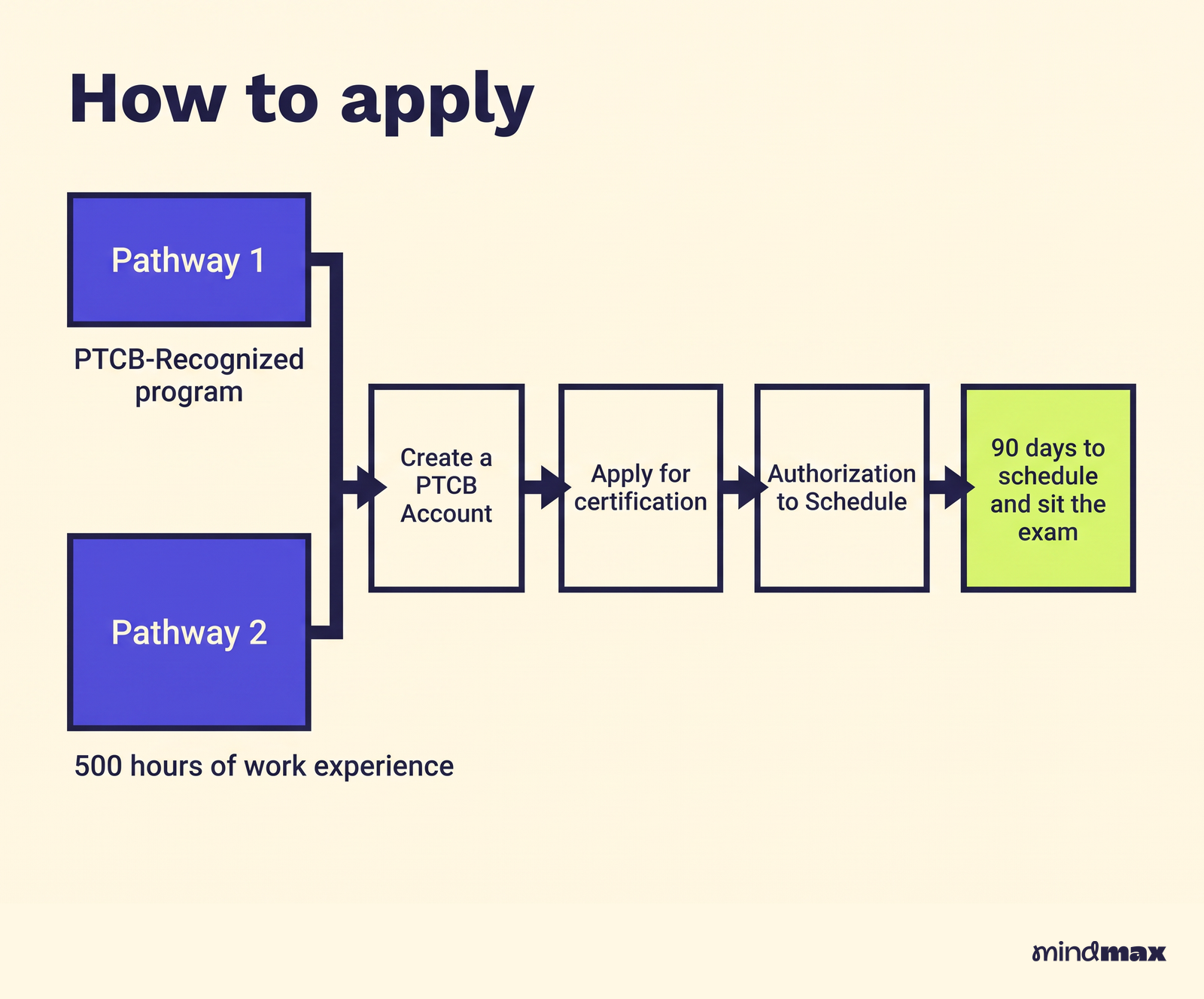
- Pathway 1. Complete a PTCB-Recognized program, or apply within 60 days of finishing one. A pharmacy degree also counts.
- Pathway 2. Have at least 500 hours of work experience as a pharmacy technician, all completed by the time you apply.
Self-study helps you pass, but it doesn't qualify you to sit the exam.
How to apply
First you create a PTCB Account. Next you apply for certification inside that account. Once PTCB approves you, you get an Authorization to Schedule email.
From approval you have 90 days to schedule and sit the exam. You can buy an extension for $20 per 90 days, up to two, as long as you buy it before the window closes. If you withdraw, you get a refund minus a $50 administrative fee. If the window runs out and you never tested, all fees are forfeited and you'll need a new application.
If you need testing accommodations, request them during the application. ADA accommodations come at no extra cost.
How much does the PTCE cost?
The core cost is $129 per attempt. That covers your CPhT application and the exam. There's no discount on a retake, so a second try costs another $129.
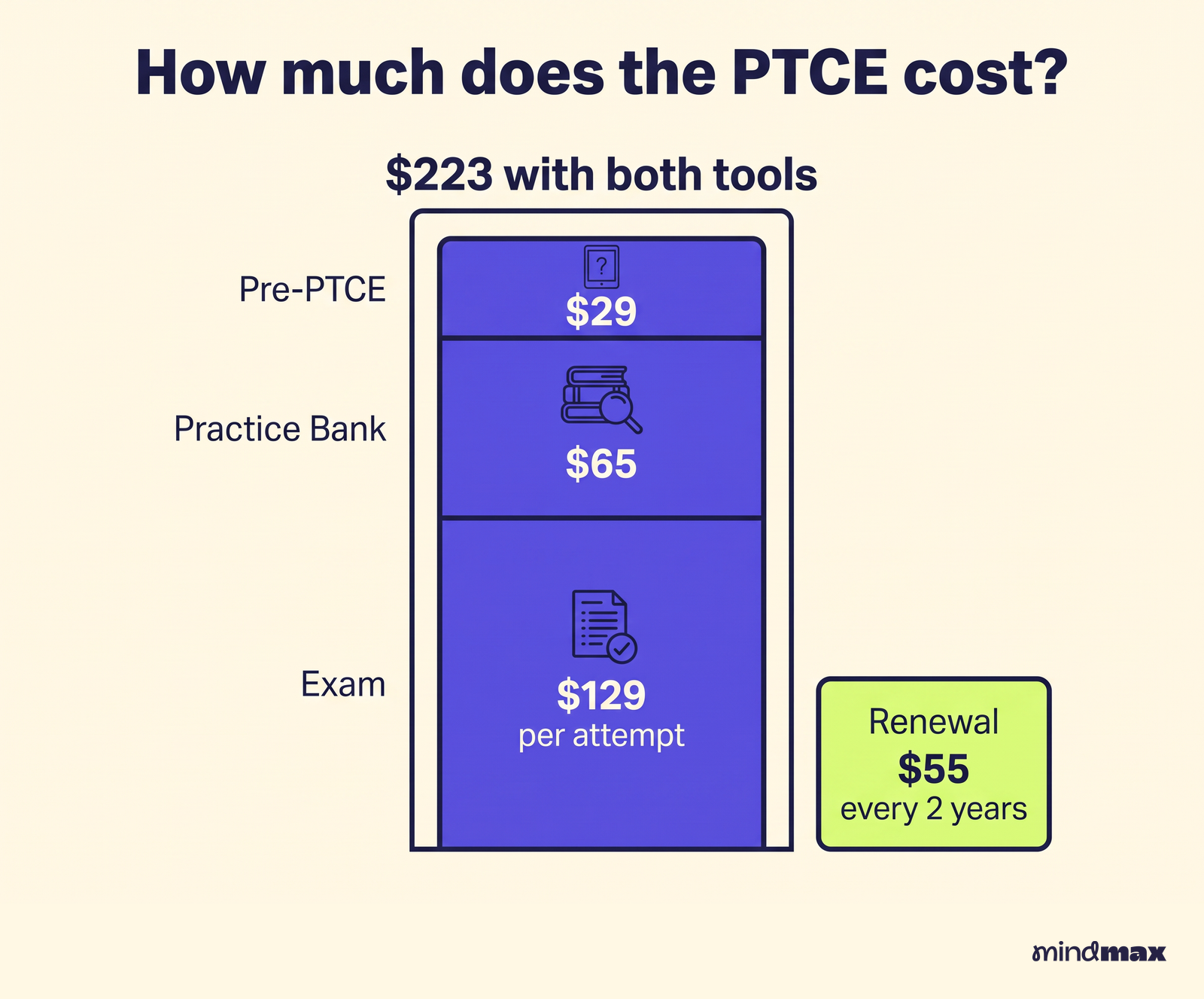
PTCB sells two optional practice tools. The Practice Bank costs $65 and the Pre-PTCE practice exam costs $29, or $10 less when you bundle it with your application. That's $223 with both tools, or $213 with the bundle discount.
After you pass, renewal runs $55 every 2 years. If your certification lapses, reinstatement costs $95. A late application adds $25, and each application returned for corrections costs $10 to reprocess.
What happens on PTCE exam day?
Arrive 30 minutes early. Bring one valid, unexpired, government-issued original photo ID with a signature, such as a passport, driver's license, military ID or Green Card. If your main ID has no signature, bring a signed secondary ID such as a debit card or school ID.
The name on your ID must match your PTCB Account exactly, with a few listed exceptions like hyphens or initials. If you show up without acceptable ID, you won't test and you'll forfeit your fees.
Rescheduling or canceling is free if you do it at least 24 hours ahead. You can change your booking in "My Scheduled Exam" in your account or by calling Pearson at (866) 902-0593.
Candidates describe getting a grease pencil with a notepad or board for scratch work. Several suggest writing your key conversions down at the start, then flagging hard questions to come back to.
What happens if you fail the PTCE?
You can retake it, and there's no set limit on attempts. Each try needs a new application and the full $129 fee, and you must wait for the official score report before you reapply.
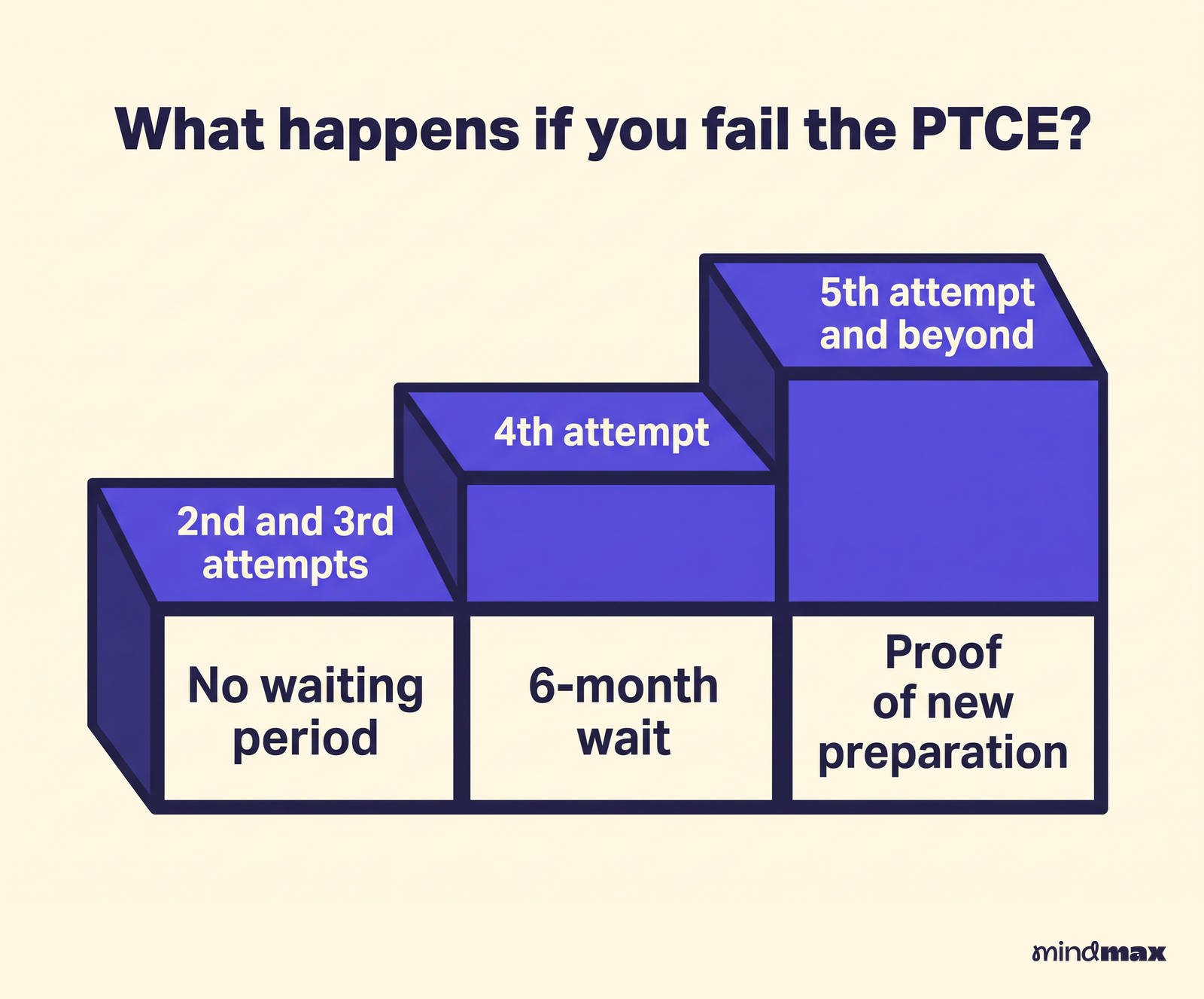
For the 2nd and 3rd attempts, there's no waiting period beyond that report. The 4th attempt comes with a 6-month wait. For the 5th attempt and beyond, PTCB wants proof of new preparation, finished after your last attempt.
Acceptable preparation includes six months or more of tutoring by a pharmacist or CPhT with an attestation form, a formal review course or non-accredited program, an ASHP/ACPE-accredited program, or a pharmacy technician associate degree. Standard job duties don't count as tutoring.
Some older prep content says you must wait 60 days between attempts. PTCB's current policy has no such rule.
Candidates who passed on a retake often say they used the domain feedback on their score report to target weak areas. With a 69% pass rate in 2025, failing once is common and recoverable.
How hard is the PTCE, and how do people study for it?
Medications dominate what candidates remember. The most common report is brand names, generics, indications and adverse reactions. One preceptor ranked where people lose points as brand and generic recall first, look-alike and sound-alike pairs such as hydralazine and hydroxyzine second, and federal law third, because nobody enjoys studying it.
Math tends to be smaller than people fear. Several reports put it around five questions on days supply, conversions, weight-based doses and ratios.
Study time varies a lot. A few people cram for days, but most passers describe 2 to 6 weeks of daily study, often 1 to 2 hours a night. One poster recommended 6 to 8 weeks to understand everything fully.
Official practice tools
PTCB sells two tools, though it doesn't endorse any outside course or book.
- PTCE Practice Bank ($65). More than 300 former PTCE questions, 400 flashcards and custom timed or untimed tests. PTCB says users score 10% higher on average. Candidates often rank it the closest match to the real exam.
- Pre-PTCE ($29). A practice exam built from retired questions. There's only one form, so PTCB advises against retaking it. PTCB says candidates who pass it are 3 times more likely to pass the PTCE, and suggests using it as a final readiness check.
Free options candidates name include AmandaPharmD on YouTube and Top 200 flashcards. If you'd like a guided plan, MindMax has a PTCE course built on the 2026 Content Outline that schedules short tutor-led lessons around your exam date and includes a timed mock of 90 questions in 110 minutes. Its 70% pass mark is the app's own setting, not a PTCB figure.
Does passing the PTCE let you work in any state?
Not by itself. The PTCE is a national exam, so its format, fee and pass mark are the same in every state. What changes by state is whether you need certification, state registration, a license, or a mix of these to work.
PTCB says the legal scope of practice for CPhTs is set by each State Board of Pharmacy. Some states require national certification to register, and some only for advanced roles. Retail chains often hire uncertified trainees who first get a state trainee license, then sit the PTCE within a window set by the state or employer. Walgreens trainees describe 90 days, and others describe a 6-month program.
Check your own State Board of Pharmacy for registration rules. PTCB also keeps a State Regulations and Map page on its site.
Frequently asked questions
Can I take the PTCE in a language other than English?
PTCB doesn't publish any version of the PTCE in a language other than English. If you need a different language, contact PTCB before you apply to ask what's available.
Can I take a bathroom break during the PTCE?
PTCB lists no scheduled break in the 2-hour appointment. Some sources say the clock keeps running during any unscheduled break, but PTCB doesn't confirm this on its main pages. Ask PTCB or Pearson before test day if you think you'll need one.
What does the PTCE score report show?
You'll see your scaled score, with 1,400 needed to pass. Prep sources and candidates say the official report also gives feedback on how you did in each of the four domains, without raw counts per domain. Retakers often use that feedback to decide what to study.
How many continuing education hours do I need to renew my CPhT?
You renew every 2 years for $55. A prep provider says you need 20 CE hours, including 1 hour of pharmacy law and 1 hour of patient safety. Confirm the current requirement on PTCB's Renewal Requirements page before your cycle ends.
Do I need to take the PTCE if I already hold the NHA ExCPT?
The ExCPT and the PTCE are separate exams from different organizations, and passing one doesn't give you the other credential. Whether you need the PTCB credential depends on your state board and your employer. Some hospitals specifically require PTCB certification, so ask before you apply.