
How Hard Is the Real Estate Licensing Exam? Pass Rates by State
11 min read ·

Principal Engineer at MindMax
How hard is the real estate licensing exam really?
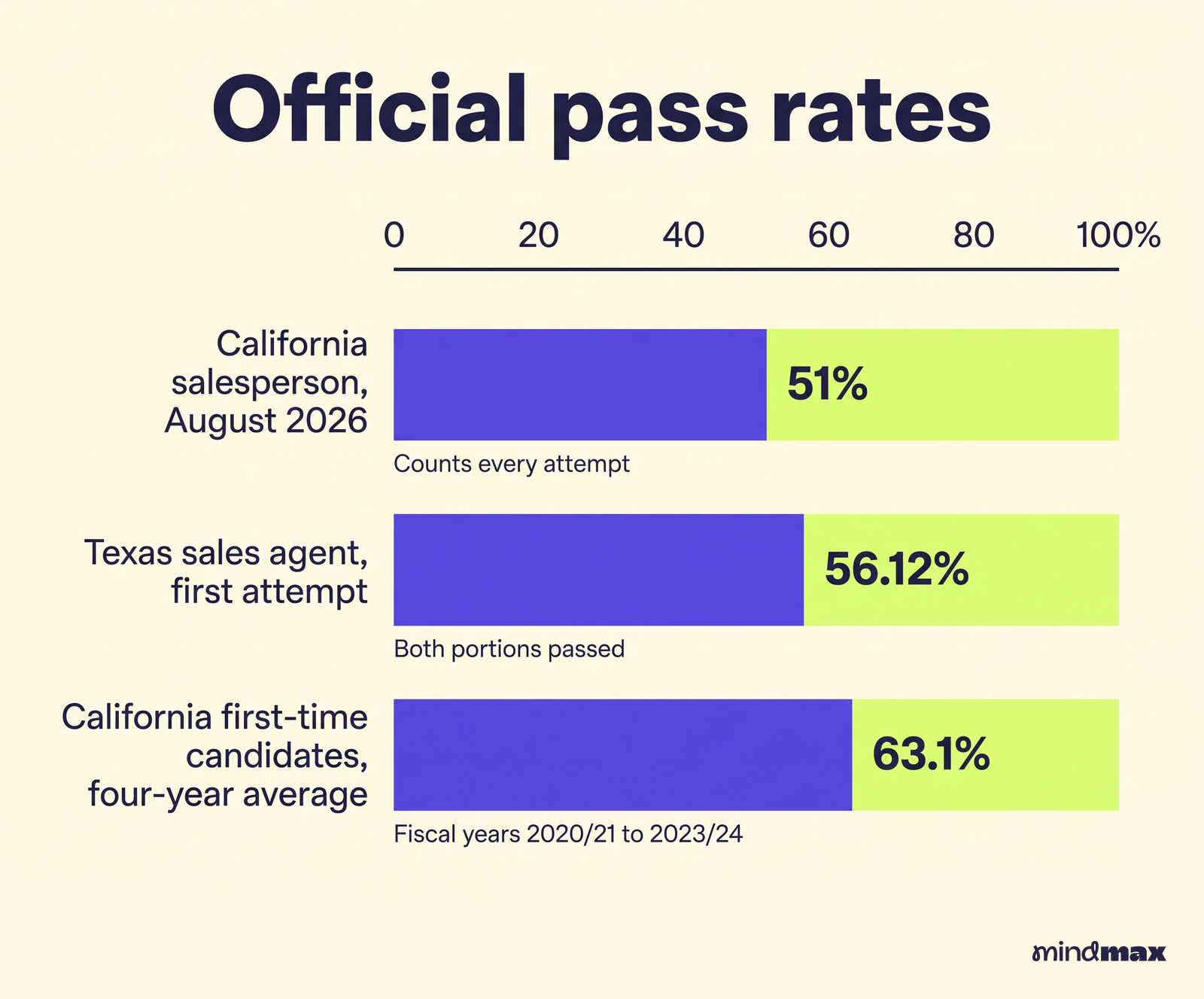
The real estate licensing exam is hard enough that roughly half of attempts fail. In California, 51% of salesperson exams given in August 2026 were passes. In Texas, 56.12% of sales agent candidates passed both portions on the first attempt between December 2023 and November 2025. The content isn't advanced and the math is light. What trips people up is the wording, state law detail, and the gap between school quizzes and the real test. Study concepts, not memorized answers, and you're in good shape.
What percentage of people pass the real estate exam on the first try?
There's no national pass rate, because each state runs its own exam and publishes different data, or none at all. California and Texas both publish official figures, and they're the best examples to learn from. They just measure different things.
| State and exam | What's counted | Pass rate | Period |
|---|---|---|---|
| California salesperson | Every attempt, first timers and retakers together | 51% (2,662 exams) | August 2026 |
| California salesperson | Every attempt, fiscal year to date | 52% (5,510 exams) | July to August 2026 |
| California salesperson | First-time candidates only | 63.1% four-year average | Fiscal years 2020/21 to 2023/24 |
| Texas sales agent | First attempt, both portions passed | 56.12% (16,824 of 29,980) | December 2023 to November 2025 |
| Texas broker | First attempt, both portions passed | 57.01% (1,326 of 2,326) | December 2023 to November 2025 |
How to read California's numbers
The monthly California figure comes from the Department of Real Estate's RE-149 statistics, which count every exam given. A candidate on a third retake counts the same as someone sitting for the first time. That drags the rate down. California's monthly salesperson figure has held near 51% to 53% through 2025 and 2026, and two years earlier the fiscal year to date figure was 46%.
For first timers specifically, the most recent official breakdown is older. The DRE's 2024 Sunset Review, with data through June 2024, put the first-time salesperson pass rate at 65%, 61%, 63% and 64% across four fiscal years, averaging 63.1%. Retakers averaged just 19.6%. That gap is the strongest argument for preparing properly the first time.
How to read the Texas number
Texas counts a pass only if you clear both the national and state portions on your first attempt. You can see the statewide figure and every school's result on the TREC provider exam passage rates page.
So don't read 51% against 56.12% as proof that California is harder. One counts attempts, the other counts first-try candidates who passed two separate tests. If you're in another state, check your licensing agency or exam vendor for what it publishes.
Is the state portion of the real estate exam harder than the national portion?
For many candidates, yes, the state portion feels harder. No official source proves it, though. Texas, for example, publishes only combined first-attempt results, not a pass rate for each portion.
How the two portions differ
In Texas and other states where Pearson VUE delivers the exam, you sit two portions and must pass each one separately.
| National portion | State portion | |
|---|---|---|
| Items on screen | 85 | 50 |
| Scored items | 80 | 40 |
| Time | 150 minutes | 90 minutes |
| Correct answers to pass | 56 | 28 |
The Texas handbook prints a total of 125 items, but 85 plus 50 is 135, and the pass marks fit 80 and 40 scored questions. So expect about 135 questions, 120 of them scored. Both pass marks work out to 70%. The state bar isn't lower, it's just shorter, and a few misses cost you more of the total.
Why the state portion catches people
The national portion comes from a job analysis of what agents do across the country. It tests principles. The state portion reflects the laws, regulations and practice of real estate in that one state. In Texas, that means the Real Estate License Act, TREC Rules, homestead and community property law, and seller disclosure rules.
That's memorization of specific rules, deadlines and numbers, and general principles won't rescue you. Candidates say it plainly. A California candidate in 2026 described the state material as less about principles and more about memorizing the nuances of state regulations. A Kentucky candidate scored 92.5% on the national section and narrowly missed the state part by a few points. That split result is common.
What about California?
California has no separate state portion. Its salesperson exam is one 150-question test, 3 hours long, with four answer choices per question. You need 70%, which is 105 correct. State law runs through the whole exam. Practice of Real Estate and Disclosures alone makes up about 25% of it, by the DRE's content outline.
Why are the real estate exam questions so tricky compared to my course practice tests?
The real exam is built differently from the quizzes in your course, and a few features make it feel unfamiliar even when you know the material.
- Unscored pretest questions. Texas mixes pretest questions in with scored ones and doesn't identify them. Some of the strangest questions you see may not count at all.
- Multiple exam versions. There are several versions of each exam, balanced by a statistical process called equating. The person next to you may get different questions.
- No review afterwards. Neither Texas nor California lets you see the questions after the exam, so no one can publish the real wording.
- Except or not in the question. ADHI Schools, a California prep provider, names misreading "except" or "not" as a common cause of misses.
Recognition versus understanding
The biggest trap is the practice exam memorizer. If you've seen the same 200 questions five times, you learn the answers, not the ideas. ADHI describes students who freeze when the DRE rewords a familiar question.
Candidates say the same. One in New Jersey wrote that the school exams were worded much differently than the state, that the class test "was almost a joke," and that the state exam was difficult. A Real Estate U student in New York noted the course quizzes were worded very similarly to the course content, unlike the state exam.
Some third-party banks swing the other way. Candidates report that CE Shop and PrepAgent practice questions felt harder than the real thing. Difficulty isn't the issue. Variety is. You want to have answered the same idea phrased several ways.
If the vocabulary is what keeps tripping you, our guide to real estate exam terms that trip up first-time test takers walks through the pairs examiners like to confuse.
The official practice tests have limits
Pearson VUE sells official practice tests for $19.95 each. They cover the national portion only, there's one version of each, and they don't explain why an answer is right. They're useful for format, not for state law.
Math is mostly a memory test
The math is lighter than most people fear. Texas proration questions tell you whether to use a 360-day or 365-day year and who owns the closing day. You do need to memorize 43,560 square feet per acre and 5,280 feet per mile, because they aren't given at the test center.
I aced my pre-licensing course final, does that mean I'll pass the state exam?
- A strong final shows you learned the course. It doesn't show you're ready for the state's wording, its unscored questions or its state law detail.
The Texas data makes the point. Candidates generally pass their school's course exams to become eligible, yet about 44% of Texas sales agent candidates failed at least one portion on their first try. First-attempt pass rates by school range from 0% to 86.57%. Here are the largest providers, December 2023 to November 2025.
| Provider | Exams taken | Passed first attempt |
|---|---|---|
| Champions School of Real Estate | 15,547 | 53.24% |
| AceableAgent | 8,516 | 65.81% |
| Kaplan | 1,280 | 53.20% |
| The CE Shop | 1,077 | 56.45% |
| Colibri | 534 | 56.74% |
360training came in at 47.59% and VanEd at 50.85%. Texas schools must stay at or above a minimum pass rate of 44.94%, which is 80% of the statewide rate.
One candidate retook their Kaplan finals until they hit a perfect score, scored 90% on another practice bank, and still failed. The scores measured how well they knew those questions, not the subject.
A better readiness check
- Use at least one question bank you haven't seen before, including state-specific questions.
- Treat a new question you get right by reasoning as worth more than a repeat you got right from memory.
- Many candidates aim to score above 80% on fresh practice tests before booking.
- When you miss a question, explain to yourself why each wrong choice is wrong.
If studying alone has stopped working, MindMax is an adaptive tutor app from Ed Cooke and Daniel Zohar, who built Memrise, used by over 80 million people. It builds a plan to pass around the time you have left, with short lessons where you ask a tutor questions and the lesson adapts as you go. For more on the habits that sink people, see why real estate candidates fail the exam.
What happens if you don't pass the first time?
Failing once is common, and both states make retaking straightforward. The rules differ, so check yours.
Texas
- You retake only the portion you failed, and a passed portion counts for one year.
- Each retake costs $58, and you must wait 24 hours after the failure to book.
- You get three attempts. After a third failure you need 30 more course hours if you failed one portion, or 60 if you failed both.
- If you fail, you get a numeric score and a breakdown by content area. Use it to target your weakest topics.
California
- There's no limit on attempts within 2 years of your original application.
- The re-examination fee is $100.
- Wait for your results before reapplying, or your record gets flagged.
- If you fail, you see your score and your percentage in each subject area. The DRE warns that averaging those percentages won't give your overall score. If you pass, you aren't told your score at all.
For the full rules, including other states, see how many times you can take the real estate exam after failing.
How hard it will be for you
The exam is a fair test of a fairly narrow body of knowledge. It gets hard in specific, predictable ways.
- If you're a careful reader who studies concepts, the national material is very passable, and the state law is a memorization job you can plan for.
- If you lean on one course's question bank, expect the real wording to feel foreign.
- If you're retaking, your score report is your study plan. Drill the areas it flags rather than rereading everything.
- If you test in another state, question counts, time limits and pass marks differ. Read your state's candidate handbook before you build a plan.
Frequently asked questions
Is the real estate broker exam harder than the salesperson exam?
In California, yes. The broker exam has 200 questions in 4 hours and needs 75%, and the 2024 Sunset Review put the first-time broker pass rate at 39.6%. In Texas, broker candidates passed both portions on the first attempt at 57.01%, close to the sales agent rate.
Can I skip the national portion in Texas if I'm licensed in another state?
Possibly. If you hold an active license in another state and passed a national portion that is ARELLO approved, Texas may waive the national portion. You would still take the Texas state portion.
Can I take the California real estate exam in Spanish or another language?
No. The California DRE offers the exam only in English. The Texas handbook also lists only an English edition.
Do I need a calculator for the real estate exam?
Texas allows a financial calculator without letter keys, and the test center doesn't provide one. California's own exam page contradicts itself, listing calculators as not permitted while quoting a regulation that allows silent, non-programmable pocket calculators. Check with the DRE before test day.
How long should I study after finishing my pre-licensing course?
Candidates report anywhere from about five days to a month of focused review, often 2 to 4 hours a day. A more reliable signal than time is scoring above 80% on practice questions you haven't seen before, including state-specific ones.