
How to Get Your Part 107 Drone License, Step by Step
12 min read ·

Principal Engineer at MindMax
How do I get my FAA Part 107 drone license, step by step?
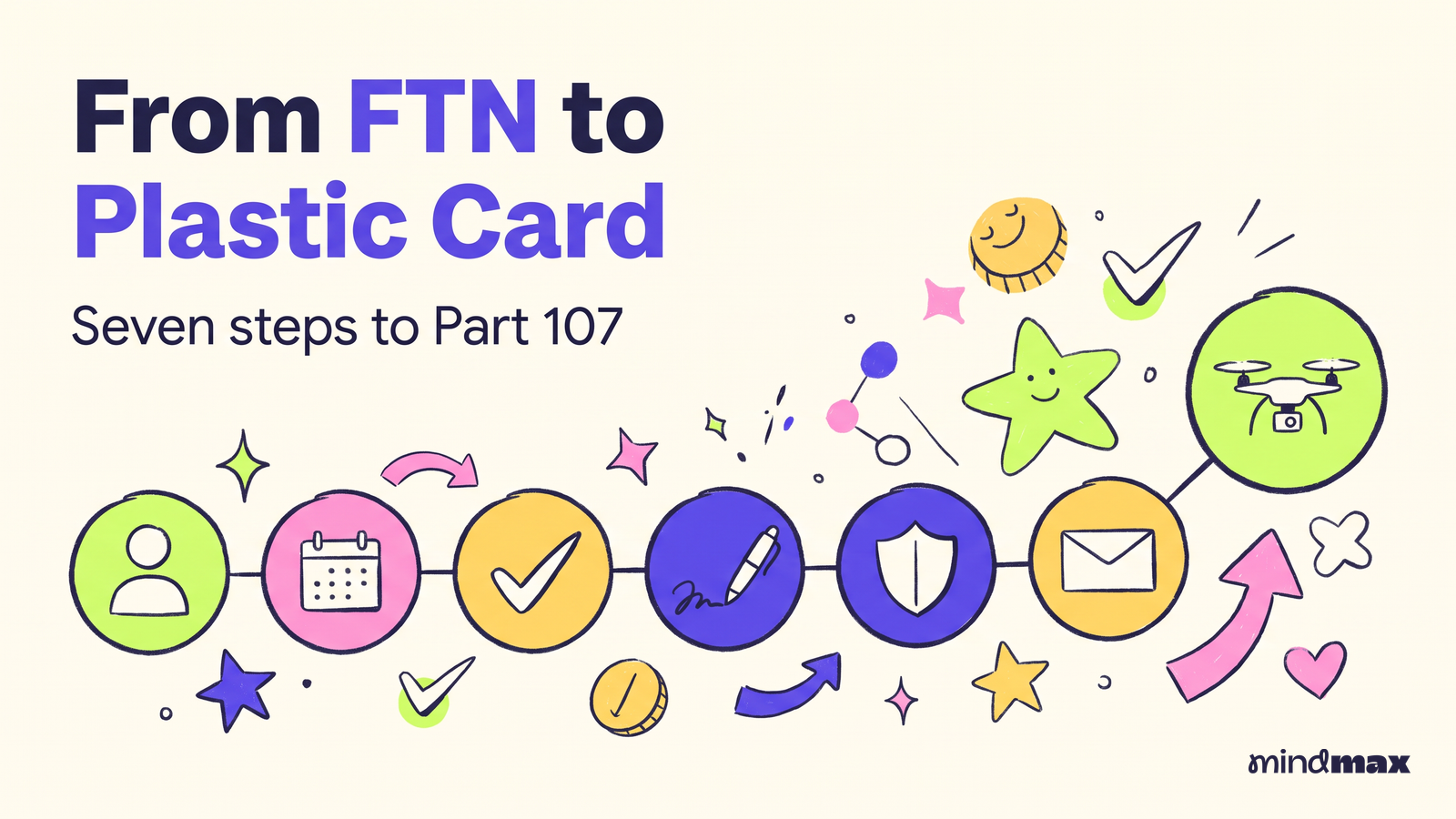
You get your Part 107 drone license in seven steps. Create a free IACRA profile to get your FAA Tracking Number (FTN). Book the Unmanned Aircraft General (UAG) knowledge test with PSI, about $175 per prep providers. Pass it with 70% or better. File Form 8710-13 in IACRA using the 17-digit exam ID from your test report. Clear the TSA background check and print your temporary certificate. Then wait for the plastic card by mail. Most people finish in about one to two months, including 2 to 4 weeks of study.
The seven steps at a glance
The order matters. The FAA wants your FTN in place before you register for the test, and it lists the full sequence on its Become a Certificated Remote Pilot page. The rules are federal, so they are the same in every state.
This guide is for first-time remote pilots. If you already hold a Part 61 pilot certificate with a current flight review, you skip the test, and your route is covered near the end.
| Step | What you do | Cost or time |
|---|---|---|
| 1 | Create an IACRA profile and get your FTN | Free, instant |
| 2 | Book the UAG test with PSI | About $175, per prep providers |
| 3 | Pass the UAG test | 2 hours, 70% to pass |
| 4 | File Form 8710-13 in IACRA | Test appears within 48 hours |
| 5 | Clear the TSA check, print the temporary certificate | About 10 days, per Pilot Institute |
| 6 | Receive the permanent card by mail | A few weeks |
| 7 | Carry your certificate whenever you fly | Ongoing |
Check that you qualify before you start
The FAA's requirements are short. You must be at least 16 years old, be able to read, speak, write and understand English, be in a physical and mental condition to fly a drone safely, and pass the UAG test.
You don't need a medical certificate, a course or an instructor endorsement. The FAA testing matrix says the UAG requires no instructor endorsement or other written authorization.
Age has one wrinkle. The matrix lets you take the UAG at 14, and the regulation allows testing if you will reach the certificate age before your test report expires. In practice, a 14 or 15 year old can sit the test but gets the certificate at 16.
What your ID must show
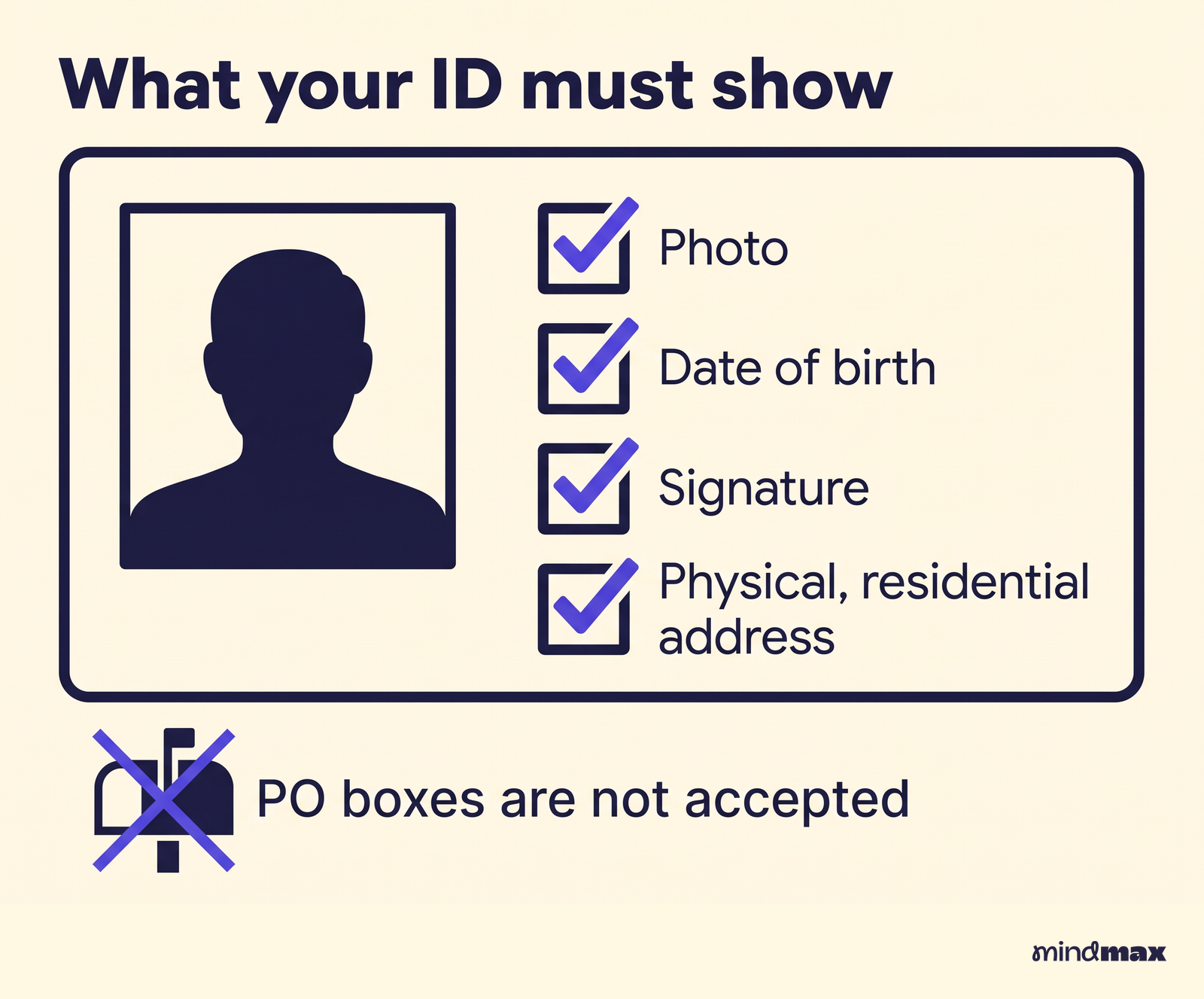
Bring a valid, current government-issued photo ID. It must show a photo, date of birth, signature and physical, residential address.
- US citizens and resident aliens can use a state or government ID, a passport or an alien residency card.
- Non-US citizens need a passport plus a driver license or government ID.
- No address on your ID? Bring proof such as a utility bill, lease, voter registration card or vehicle registration. PO boxes are not accepted, and neither is an employer's address.
- Under 18 without acceptable ID? A parent or guardian can attest to your identity.
How do I get an FTN in IACRA before booking the Part 107 test?
You get an FTN by registering a free profile in IACRA, the FAA's Integrated Airman Certification and Rating Application. It takes a few minutes, and the number appears on screen as soon as you finish.
Pilot Institute, a prep provider, walks through the details this way.
- Register in IACRA as an "Applicant".
- Skip the certificate information sections. You don't have a certificate yet.
- Enter your name and personal details so they exactly match your government-issued ID.
- Save the username and FTN shown on screen. They are also emailed to you.
The matching step is the one people rush. Your FTN prints on your test report and links your PSI booking to your IACRA application later. A middle name in one place and not the other is the kind of mismatch that causes trouble at check-in or in PSI.
Some candidates end up with two FTNs, a temporary one starting with "C" and a permanent one starting with "A". You can't fix that yourself in PSI. One candidate solved it by opening a PSI support ticket that listed both numbers and asked for the records to be corrected or merged, and it was sorted within a few days.
How to schedule the Part 107 test with PSI
PSI is the FAA's testing vendor. You book online through its FAA portal at faa.psiexams.com, and you sit the test in person at an FAA-approved Knowledge Testing Center. No official source offers the UAG online.
Create your PSI account with the same name and FTN you used in IACRA. Setup uses multi-factor authentication, so have your phone handy. You pay the fee when you book. Prep providers put it at about $175, and say it is non-refundable.
PSI's general guidance is that sessions open at least 6 weeks ahead and that booking 4 to 6 weeks early gives you the widest choice of dates. Its general policy allows rebooking without penalty up to 2 business days before, but check the FAA program rule on the portal before you count on it. Test center staff can't book appointments for you.
If your PSI account keeps getting blocked
The most common block is the message "An account associated with this FAA Tracking Number already exists." Candidates who got past it share a few fixes.
- Find your original login. One candidate discovered PSI held two user IDs on the same email. Logging in with the original ID worked. Creating new accounts made it worse.
- Fix weak signal before blaming the code. Authenticator codes have to arrive within a 30-second window. People whose codes were rejected had better luck after moving somewhere with strong cell reception.
- Select "None" for Authorization Category when the form asks.
- Call PSI directly. Candidates found generic email replies that just told them to create an account with their name and FTN. A phone call got further.
- Go to a test center in person if nothing else works, as some commenters suggested.
- Never create a second FTN to get around the block. It adds a record that later needs merging.
What to expect on test day
Arrive 30 minutes early, as PSI advises. Your personal items go into storage and the proctor scans your ID.
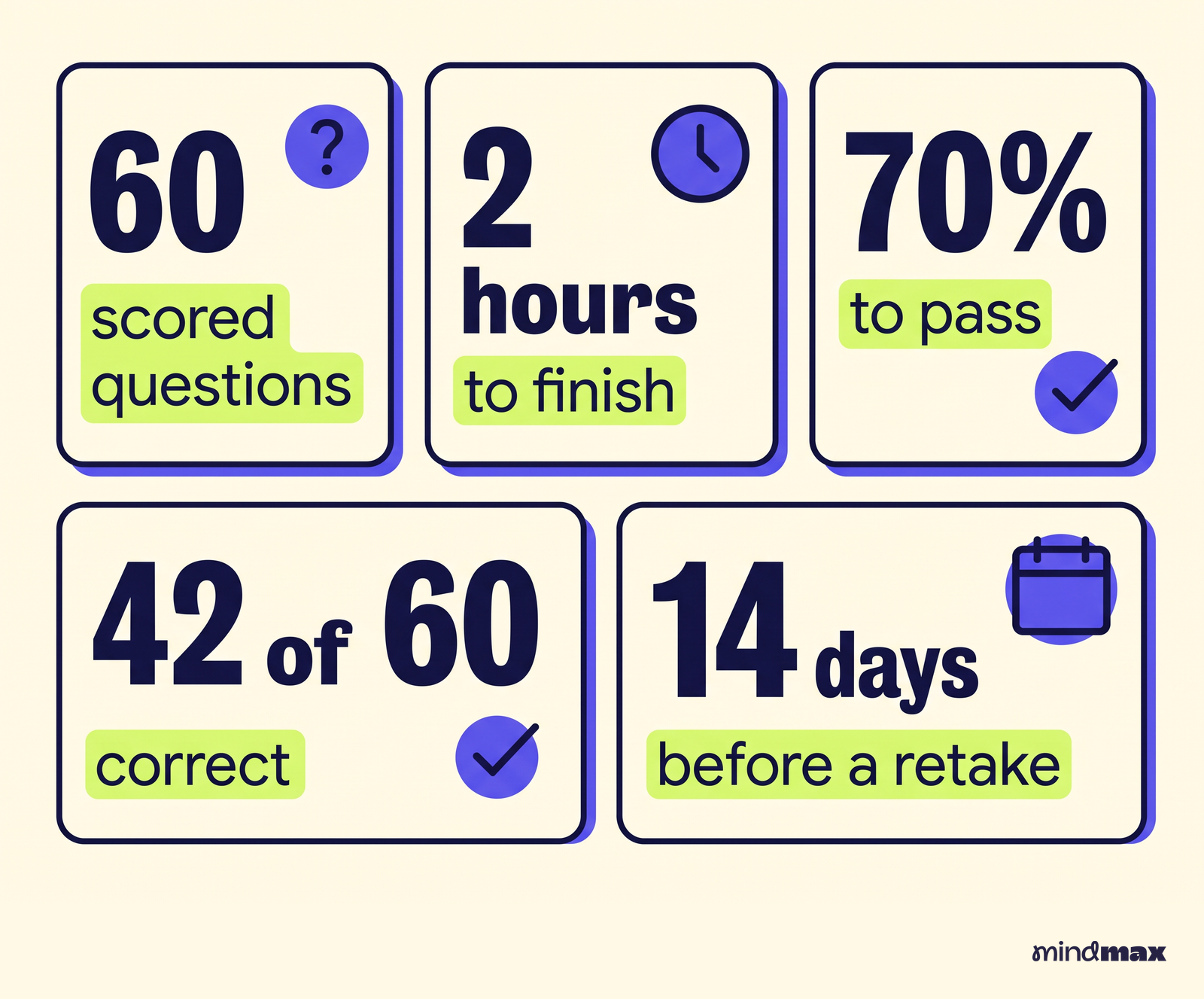
The test has 60 scored questions, each multiple choice with three options. You get 2 hours to finish. The FAA may add unscored validation questions, which don't count for or against you, and the 2 hours covers them too. Some candidates report seeing 65 questions in total for this reason.
You need 70% to pass, which is 42 of 60 correct. Many questions refer to the figures in the testing supplement FAA-CT-8080-2H, such as sectional charts, METARs and a load factor chart. Candidates often say the same thing about it. Find the chart legend early and keep it close.
The test covers 13 areas, from regulations, airspace and weather to night operations, airport operations and drugs and alcohol. The FAA updated the test blueprint on September 29, 2025, but said the topics and subject matter did not change and test time was not reduced.
Airspace and sectional chart reading come up again and again as the hardest part, followed by weather reports (METAR and TAF). One candidate estimated charts at "maybe 40%" of their exam. For a fuller look at difficulty and how many hours people need, see how hard the Part 107 test is, with pass rates and study time.
You get your score when the test ends, along with a printed Airman Knowledge Test Report (AKTR). Keep it safe. It holds the 17-digit exam ID you need next, and lists ACS codes for the areas you missed.
If you fail, you must wait 14 days before a retake. You pay the fee again, bring the failed AKTR and need no instructor sign-off. Use the same PSI login rather than starting over with a new FTN.
How do I fill out Form 8710-13 in IACRA after passing?
You file Form 8710-13 in IACRA with your 17-digit exam ID. Give it time first, because the FAA says your test can take up to 48 hours from the test date to appear in IACRA. Then follow the FAA's sequence.
- Log in with your IACRA username and password.
- Click "Start New Application". Choose Application Type "Pilot", then Certifications "Remote Pilot", then Other Path Information, then Start Application.
- Follow the application prompts.
- When prompted, enter the 17-digit Knowledge Test Exam ID from your AKTR.
- Sign the application electronically and submit it.
If IACRA says it can't find your test, the 48 hours probably hasn't passed yet. Check that your IACRA name matches the name on your test report before contacting anyone.
After you submit, the application status can look confusing. Labels like "Part Complete" and "Ready for Next Action" trip people up. They mean the application is moving through processing, not that you missed a step.
From TSA check to plastic card
Once you submit, the TSA runs a security background check. When it clears, the FAA emails you instructions for printing your temporary certificate from IACRA. The permanent card follows by mail once the FAA finishes its internal processing.
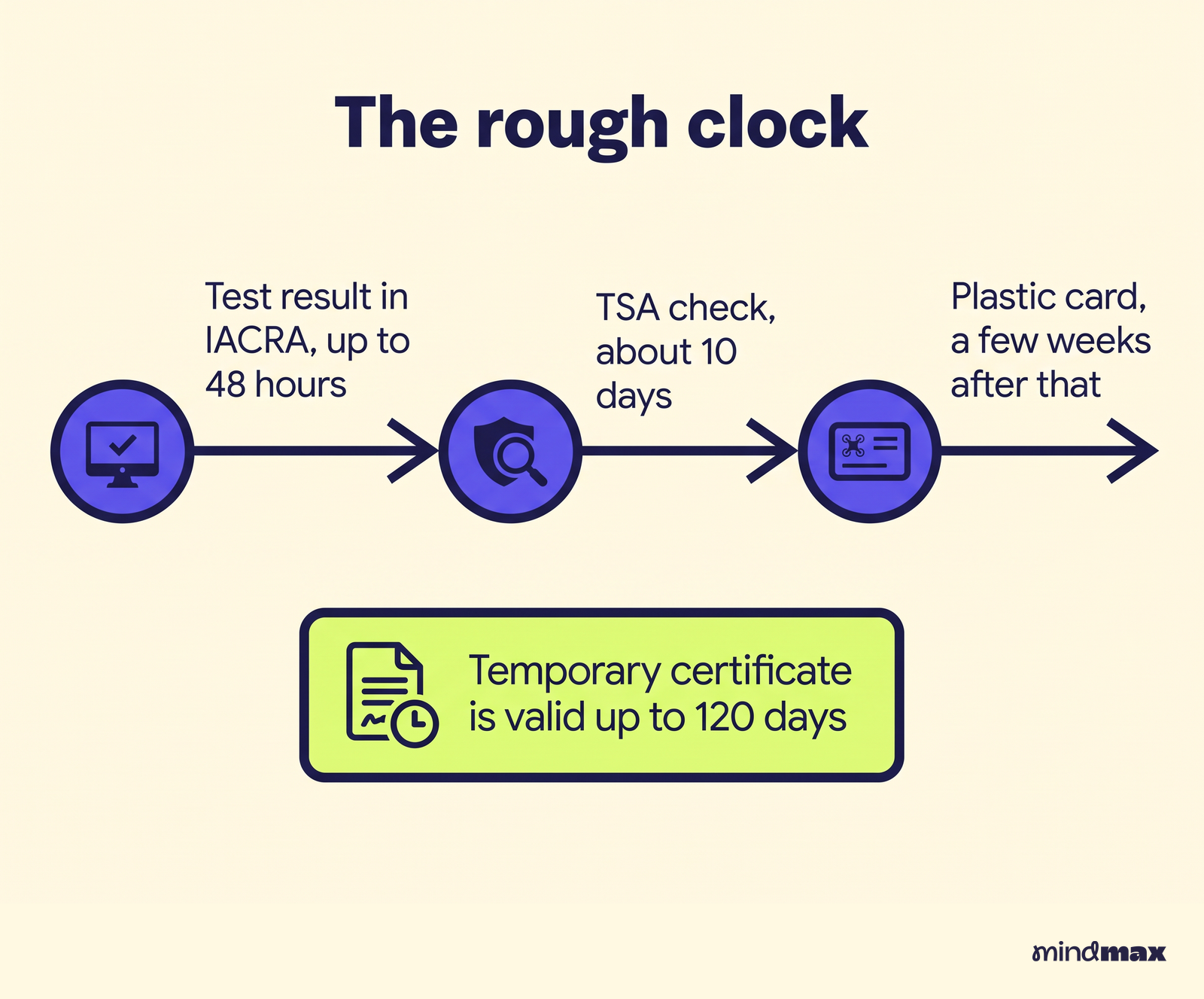
Here's the rough clock. Test result in IACRA, up to 48 hours. TSA check, about 10 days, according to Pilot Institute, which says it shouldn't take more than two weeks. Plastic card, a few weeks after that. The FAA itself publishes no timeframe for either.
Don't wait on the email alone. One candidate found their temporary certificate in IACRA about a day and a half after applying, while the email arrived five days later. Log in and check.
Under the regulation, a temporary certificate is valid up to 120 days, which covers you until the card arrives. The detailed timing, and what to do if it stalls, is in how long it takes to get your temporary certificate after passing Part 107.
One rule catches people out. A passing score doesn't let you fly for pay. Your commercial privileges start when the temporary certificate is issued.
The fastest way to get a Part 107 license while working full time
The fastest route is to do the paperwork immediately and study in short daily sessions against a booked date. The paperwork is quick. Study time and the TSA wait are what take weeks.
Today, create your FTN. It's free and instant, and nothing else can start without it.
Day 2, book a PSI slot 2 to 3 weeks out. Pilot Institute suggests this to give yourself a real deadline. Check the portal early, since the best dates go first.
Then study about 1 hour a day for 14 days. That matches Pilot Institute's "1 Hour of Studying for 14 Days" plan, and Drone Pilot Ground School says most of its students have full-time jobs and need about 10 to 20 hours in total. Spend extra time on airspace and charts. Many candidates wait until they score above 90 on practice tests consistently before sitting the real one.
Within 48 hours, file Form 8710-13. Set a reminder for two days after your test so the TSA check starts as soon as possible.
Study options that fit around a job
- FAA free materials. The Remote Pilot Study Guide (FAA-G-8082-22) and the Airman Certification Standards (FAA-S-ACS-10B) cost nothing.
- Pilot Institute, Part 107 Made Easy. About 15 hours of video in lessons that average 3 minutes, unlimited practice exams and a 14-day plan. Its guide lists a discounted price of $159. If you fail first time, it promises $175 plus a full refund.
- Drone Pilot Ground School. It quotes 15 to 20 hours of study, a bank of 400+ questions and study plans from 1 week to 2 to 6 weeks. Its guarantee covers the course and the $175 test fee, but only if you scored at least 85% on its practice tests first.
If you'd rather have a plan built around your working week, MindMax is an adaptive tutor app from Ed Cooke and Daniel Zohar, who built Memrise, used by over 80 million people. It starts from your goal of passing, maps bite-sized lessons onto your day, and adapts as you ask questions along the way.
What to do once you're certified
Register your drone on FAADroneZone. It costs $5 per drone and lasts 3 years, and Pilot Institute notes this applies even to drones under 250 g flown under Part 107.
Carry your certificate whenever you fly. To stay current, complete free online recurrent training every 24 calendar months. First-time pilots take ALC-677 on FAASafety.gov.
If you hold a Part 61 pilot certificate with a current flight review, your path is different. Complete the free ALC-451 course, fill in Form 8710-13 in IACRA, then have your identity validated by a FSDO, DPE, ACR or CFI. CFIs can't issue temporary certificates, so expect to wait for it to come through the FAA.
Frequently asked questions
Can I take the Part 107 test online from home?
No official source offers the UAG test online. You take it in person at an FAA-approved Knowledge Testing Center booked through PSI. Online proctoring PSI offers applies to other programs.
Do I have to pay anything to file Form 8710-13?
No. Prep providers say there is no certificate fee through IACRA, and creating your FTN is also free. The main cost is the PSI test fee of about $175 per attempt.
Do I need a medical certificate for the Part 107 license?
No medical certificate is required. You only need to have no known physical or mental condition that would stop you flying safely. The English language requirement can be limited for medical reasons, in which case the FAA may add operating limitations.
Can I reschedule my PSI test date if work gets in the way?
PSI's general policy allows rebooking without penalty up to 2 business days before your appointment. The exact rule for FAA tests isn't published on the pages candidates usually see, so check the policy in the PSI FAA portal before you book. Prep providers say the fee itself is non-refundable.
Can I fly my drone commercially right after I pass?
No. Passing the test is only one step. Your commercial privileges begin when your temporary certificate is issued after the TSA background check clears.