
Is Trade School for HVAC Worth It, or Should You Apprentice?
12 min read ·
Is it worth going to trade school for HVAC, or should I just become an apprentice?
For most beginners, start as a paid helper or apprentice before paying $10,000 to $20,000 for a private program. Trade school for HVAC is the typical route, but it isn't required, and employers sometimes hire people with only a high school diploma. School is worth it if local shops or your union local demand it, or a low-cost community college program earns apprenticeship credit. A union apprenticeship suits you if you can pass a math test and wait for yearly selection.
The routes side by side
The federal view backs this up. The BLS outlook for HVAC mechanics and installers says techs "typically need a postsecondary nondegree award, although some enter the occupation with less education," and that once hired they go through "a lengthy period of on-the-job training." So the real question is which route fits your money, your schedule and your area.
| Route | How long | What it costs you | Paid while learning? | Suits you if |
|---|---|---|---|---|
| Private trade school | 7 to 24 months at UTI | Tuition plus separate lab, meter and equipment fees | No, unless you work on the side | You want structure and local shops ask for a certificate |
| Community college | 6 months to 2 years for school programs in general | Varies by college, check the per-credit rate | You can often work part time | You want a cheaper certificate or associate's degree |
| Helper job | Start as soon as you're hired | Little beyond your EPA 608 | Yes | You want to earn now and learn on real jobs |
| UA apprenticeship | About 5 years | The UA describes training as free | Yes | You can wait for selection and pass a math test |
School also makes sense if you learn best in a classroom and want a set schedule before you touch real equipment. Just know what you're buying before you sign.
Can you get into HVAC with no trade school and no experience?
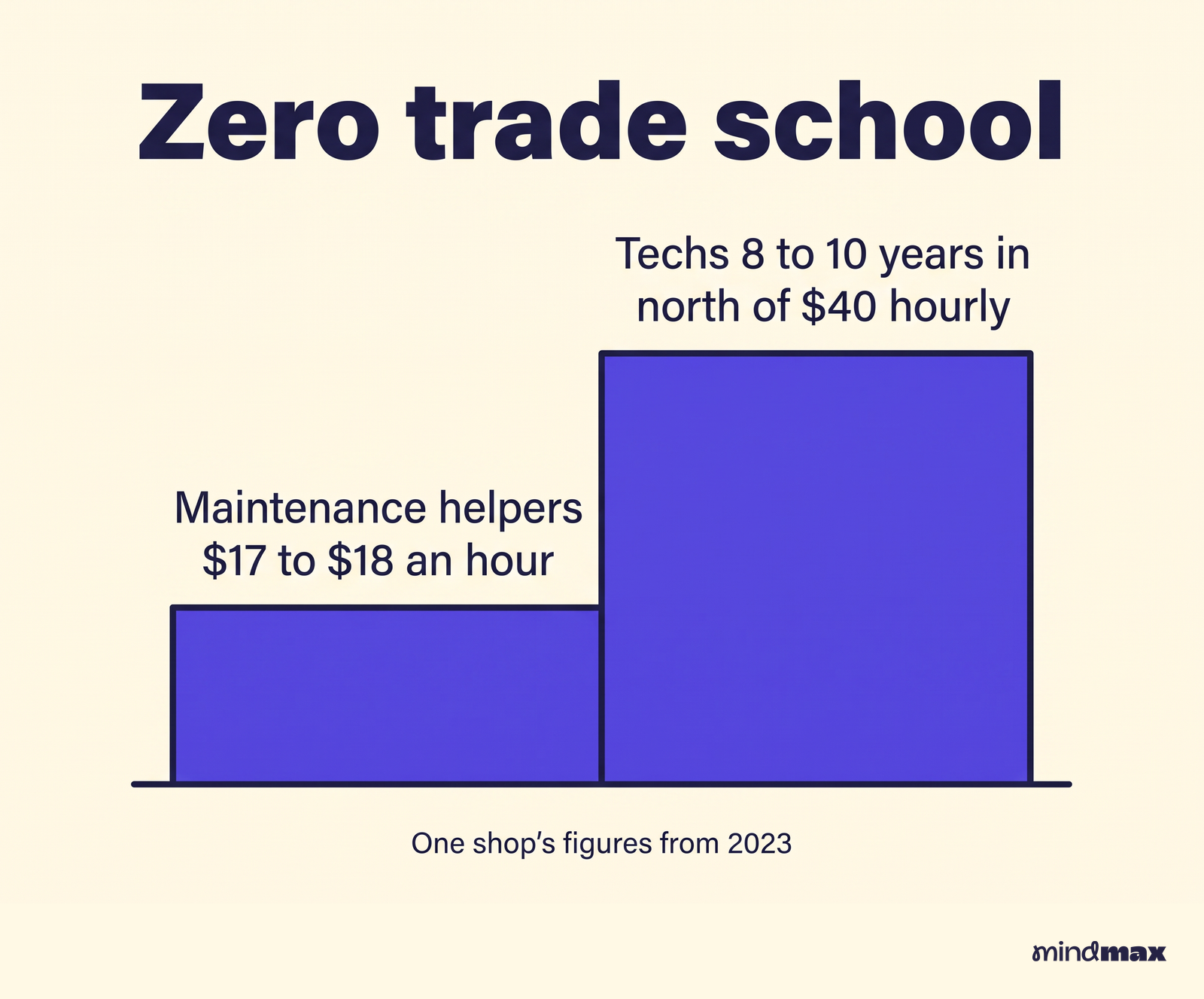
Yes. Working techs say it plainly, and BLS agrees. A commercial refrigeration worker in Dallas and Fort Worth wrote in a 2023 r/HVAC thread that you can get your 608 "without any schooling and drop right in" as a helper, with their shop starting maintenance helpers at $17 to $18 an hour. That same commenter said techs 8 to 10 years in were "north of $40 hourly," most with "zero trade school." Those are one shop's figures from 2023, so treat them as an example, not a promise.
Another student, five weeks from finishing a 10-month program, said they "learned more this 3 months [working] than at school for 9..12k."
Here is a path from zero to helper.
- Get your EPA 608 Universal. It costs little and shows you're serious.
- Have your driver's license ready. BLS notes techs may need one to travel to jobsites.
- Apply broadly and follow up personally. Call or stop by residential and commercial contractors.
- Look at supply houses too. A counter or warehouse job at a place like Johnstone Supply puts you in front of contractors every day.
One thing school can't fix for you is licensing. Some states and cities require an HVAC license on top of the federal refrigerant card, and the rules vary by state. Check your state's rules through CareerOneStop before you plan around them.
Should you get your EPA 608 on your own before applying?
Usually yes, because it is cheap and fast. But you don't legally need it to start. Federal rules exempt apprentices "provided they are closely and continually supervised by a certified technician." That is why the Dallas commenter called the 608 "preferred at hire but not a deal killer."
The card is a federal certification from an EPA-approved testing organization, not from EPA itself. It never expires. There are four types. Type I covers small appliances, Type II high and very high pressure equipment, Type III low pressure equipment such as chillers, and Universal covers all three. Most residential AC work falls under Type II, so a Type I card alone won't get you far.
Every test starts with Core, 25 questions, and each type adds 25 more. Universal is 100 questions. You need 18 of 25 correct in each section, and passed sections stay passed.
What it costs in 2026 depends on the provider.
- SkillCat charges $10 a month or $96 a year, with a 3-day free trial that includes the exam. The physical card is $50.
- ESCO Institute charges $85 for its online exam covering Core and all three types.
Watch for one trap. A Core section taken open book can't count toward Universal, so take a proctored exam. The rules are covered in what is and isn't open book on the EPA 608, and the providers are compared in SkillCat vs ESCO vs Mainstream for 608 practice. ESCO released an updated test bank in August 2026, and its older 2018 exam remains available until January 1, 2027.
Most candidates study a few hours to a week. Many fail by a question or two, often on dates and recovery charts. For a full plan, see how to study for the EPA 608 and pass Universal first try. If you'd like a tutor to map your prep around your shifts, MindMax is an adaptive tutor app from Ed Cooke and Daniel Zohar, who built Memrise. It turns your exam goal into a plan of bite-sized lessons with daily check-ins, and the lessons are conversations that adapt as you ask questions.
If you do enroll in school, ask first. BLS says the exam is typically included in a postsecondary HVACR program, so don't pay for it twice.
Community college vs private trade school for HVAC
Both lead to a certificate or an associate's degree, and BLS lists technical schools and community colleges side by side as standard routes. The difference is mostly price and pace.
What a private school costs
UTI's HVACR programs run 7 to 24 months. Tuition includes course books, a work shirt, two T-shirts and safety glasses, but lab, meter, equipment and laptop fees are charged separately. One course retake is free, and further retakes cost $750 each. UTI lists campus tuition in its catalog addendum, so ask for the exact figure in writing.
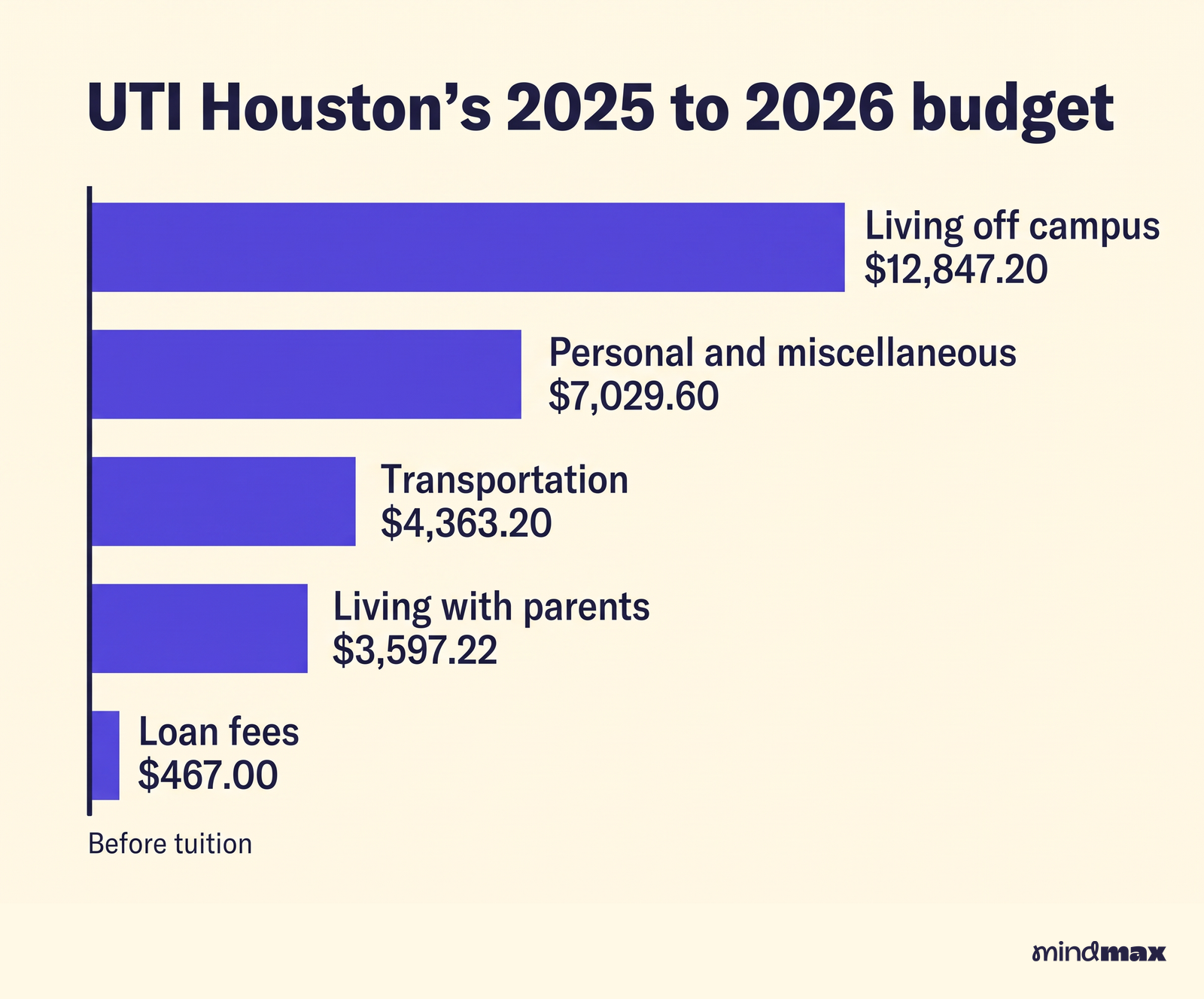
Living costs add up fast. UTI Houston's 2025 to 2026 budget lists these non-tuition costs for a 12-month year, living with parents $3,597.22, living off campus $12,847.20, transportation $4,363.20, personal and miscellaneous $7,029.60 and loan fees $467.00. That is before tuition.
What a community college costs
Community college prices vary by college and by whether you live in the district. Look up your local college's per-credit rate and multiply by the credits in the HVAC certificate, then add tools. One r/HVAC commenter said they earned an accredited associate's degree for about half of what a short private program charged, and called 10-month private programs "for-profit diploma mills." That's one opinion, but it's common among working techs.
School does help some people. One grad wrote, "If I didn't have that schooling I wouldn't have gotten so many interview opportunities."
Questions to ask any school before you sign
- Are tools, the meter and EPA exam fees included?
- Do the credits transfer to a college?
- Do local contractors or the union local give apprenticeship credit for this program? One tech said "the schooling might get you into the second year of apprenticeship."
- What does a retake cost if you fail a course?
How do I get into a union HVAC apprenticeship with the UA?
The United Association runs apprenticeships through its local unions, so you apply to a local, not to the national office. The UA cites more than 300 training centers and describes the training as free while you work for pay. Each local sets its own rules and process.
Many locals ask for the same basics. You must be at least 18 with a high school diploma or GED, pass an aptitude test in math and reading, hold a driver's license and pass a drug screen. Many take applications once a year. Treat that as typical and confirm with the local near you.
Union strength varies a lot by region. One tech warned that some states don't have a union system strong enough to rely on. Another said their local has so many applicants that it makes people finish trade school before applying. Early pay can be low. An Atlanta commenter in 2023 said union apprentices started at $15 an hour and took 3 to 4 years to earn enough to live on their own. Some locals also charge for classes. One union apprentice pays $1,000 a semester and gets reimbursed based on grades.
A real example, UA Local 250 in Southern California
Local 250's HVACR program takes applications in person on Fridays from 8 to 11 a.m. at its San Dimas training center. The minimum age is 18, with no maximum. You need a diploma or GED plus one of three things. That can be a year of high school algebra and geometry or one college semester, a certificate or AS degree in A/C and Refrigeration from a JJATC-approved school, or a pass on the JJATC's own algebra and geometry test, with two tries at most.
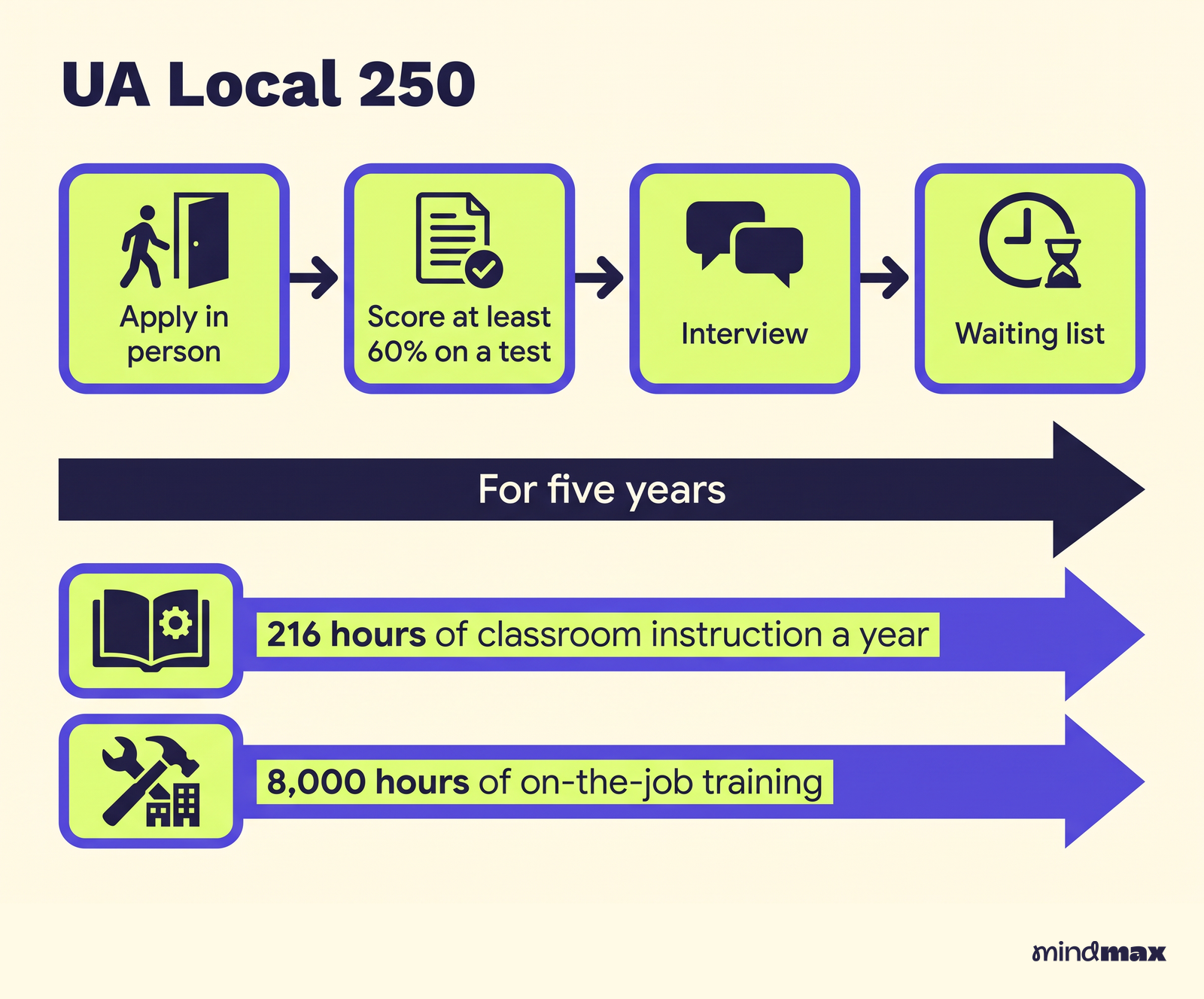
Applications are taken year round, but selection runs once a year. You apply in person, score at least 60% on a test, then interview, then go on a waiting list. Once in, you take 216 hours of classroom instruction a year, two nights a week from 6 to 9 p.m., September to June, for five years. Journeyman status takes 8,000 hours of on-the-job training. Notice that a school certificate can stand in for the math requirement here, which is one case where school pays off.
Veterans should ask about the UA's Veterans in Piping program, which offers free training and guaranteed placement in a UA apprenticeship.
How to get into HVAC with no experience while working a full-time job
You don't have to quit first. Commenters in a March 2026 r/HVACschool thread suggested a few workable moves.
- Earn your 608 on SkillCat on evenings or weekends, then apply broadly and follow up in person.
- Take a semester of part-time refrigeration and electrical classes, or free and low-cost college courses.
- Start as a helper alongside a short classroom program of about 18 to 20 hours.
- Take a job at a supply house to learn the parts and meet contractors.
- Apply to a union local. It's tougher to get in, but wages and training are better.
The union route fits a full-time job well, because selection happens once a year and you'll likely wait. Keep your current paycheck while you apply and study algebra for the test.
I'm 22 with only warehouse experience. Should I pay $20K for HVAC school to land a helper job?
Probably not as your first move. A helper job is the entry point either way, and many shops hire helpers without a certificate. Spending $20,000 to reach the job you could apply for now is a big bet before you know you like the work. As one tech put it, "work before school. find a shop and become a helper so you know what to expect before spending over 10k."
Your warehouse background is more useful than you think. Supply houses need people who can run inventory and load orders, and that puts you next to the techs who hire helpers.
A sensible order looks like this. Get your 608 Universal first. Apply to helper jobs and supply houses, and give that search a real effort. If no one bites, or your local union wants a certificate, look at a community college program before a private one. Pay for private school only if it clearly earns you apprenticeship credit or a job local shops will actually offer.
What HVAC pays and what the work asks of you
BLS puts median pay at $61,010 a year, or $29.33 an hour, as of May 2025. The lowest 10% earned under $40,050 and the highest 10% earned over $95,210. The field had 440,900 jobs in 2025 and is projected to grow 11% from 2025 to 2035, with about 40,600 openings a year. About 68% of techs work for plumbing and HVAC contractors.
The work is hard on the body. BLS says HVAC techs have one of the highest rates of injuries and illnesses of all occupations, and peak seasons bring on-call shifts and overtime. A few months as a helper will tell you whether that life suits you, which is the best reason of all to try the job before you pay for school.
Frequently asked questions
Do I need a state HVAC license on top of the EPA 608?
It depends on where you work. Some states and cities require an HVAC or mechanical license in addition to the federal 608 card, and the rules differ widely. Look up your state through CareerOneStop or your state licensing board before you plan your training.
Can I use VA benefits or federal aid for HVAC school?
UTI says its campus HVACR program accepts federal aid and VA benefits. Many community colleges also accept federal aid, so ask your local college's financial aid office. Veterans can also look at the UA's Veterans in Piping program, which offers free training and placement in a UA apprenticeship.
Should I get NATE certified as a beginner?
Most working techs say no. NATE is a voluntary certification usually taken a few years into a career, and the common advice to newcomers is to get the EPA 608 and not worry about NATE yet. It makes more sense later if your employer pays for it and gives you a raise.
If I fail one section of the EPA 608, do I retake the whole thing?
No. Sections you pass stay passed, and you only retake the ones you failed. Retake fees and whether you must stay with the same testing organization vary, so check with your provider before you book.
Is the $50 physical 608 card worth buying?
Many techs say no. Employers usually verify your certificate number in the issuer's own database rather than asking for the plastic card. A free downloadable certificate is often enough to show you passed.