
Failed the NCLEX-RN at 150? Your CPR and 45-Day Retake Plan
12 min read ·

Co-founder of MindMax and Memrise, Grand Master of Memory
I Failed the NCLEX-RN at 150 Questions, What Should I Do Next?
If you failed the NCLEX-RN at 150 questions, your ability estimate sat very close to the passing standard and ended just below it. Do three things this week. Call your board of nursing to say you plan to retake. Re-register with Pearson, where the fee is $200 if you register before February 1, 2027, and $350 after. Then open your Candidate Performance Report and build a plan that starts with every area rated "Below the Passing Standard." The earliest you can retest is 45 days after your exam date, and the exam starts fresh.
What Failing at 150 Questions Really Means
The NCLEX-RN gives every RN candidate at least 85 items and at most 150, inside a 5-hour limit that includes the tutorial and all breaks. Fifteen of those items are unscored pretest questions, and you can't tell which ones.
Your exam ran to 150 because of the Maximum-Length Exam Rule. When your ability is "very close to the passing standard," the computer keeps giving you items up to the maximum. At that point it drops the 95% confidence rule and looks only at your final ability estimate. At or above the standard is a pass. Below it is a fail.
So a fail at 150 tells you something useful. You were close, not far off. It doesn't tell you which areas let you down, though. That's what your report is for.
It also explains why the last hour felt so hard. NCSBN says that near the end of the exam, candidates usually get items they have about a 50% chance of answering fully correct. Strong and weak candidates both find those final items tough. If you want the full mechanics of the stopping rules, read our guide to what it means when the NCLEX shuts off at 85 questions and what 150 means.
Check which report you received
If time ran out before you answered 85 items, you fail under the Run-out-of-time rule and get an abbreviated report. It shows only how many items you answered and how many were required. That points to a pacing problem, not a content problem. If you reached 150, you cleared the minimum and should have the full two-page report.
How Soon Can I Retake the NCLEX-RN, and How Many Times?
NCSBN lets you retake 45 days after your exam was administered, and you can sit the NCLEX up to eight times a year, with 45 test-free days between attempts. The clock starts on your exam date, not the day your results arrive. Both rules are on the official NCLEX results and retake policy page.
Your state board can be stricter. Some boards make you wait longer, and that shows up in the validity dates on your new Authorization to Test (ATT). Attempt caps, required remedial courses after repeated failures, and deadlines counted from graduation are all set by individual boards, so they differ from state to state. Large states don't share one rule. Check your own board's website before you lock in a plan, especially if this is your second or third attempt.
The retake steps
- Contact your board of nursing and tell them you plan to retake.
- Your board tells you what fees or materials it needs.
- Re-register with Pearson and pay the registration fee.
- Wait for your new ATT.
- Schedule your appointment.
What a retake costs
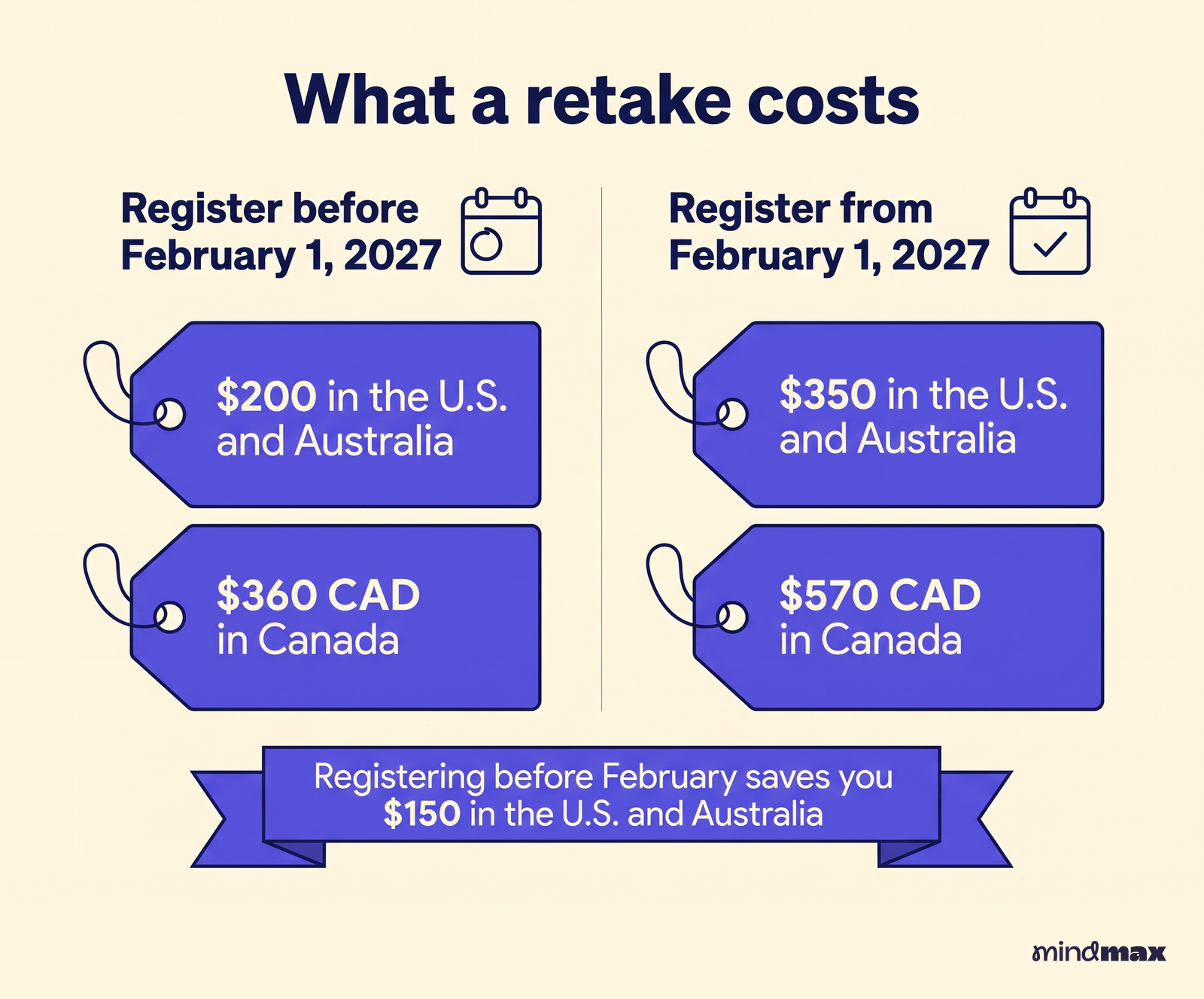
Every retake needs a new registration and the same fee as a first attempt. The fee is set by the date you register, not the date you test. If you register before February 1, 2027, it's $200 in the U.S. and Australia and $360 CAD in Canada. If you register from February 1, 2027, it's $350 in the U.S. and Australia and $570 CAD in Canada. Registering before February saves you $150 in the U.S. and Australia.
A few more money rules matter here.
- Your state licensure or application fee is separate, and your board sets it.
- NCLEX fees aren't refunded for any reason.
- Testing outside the U.S. adds a $150 international scheduling fee.
- Qualifying veterans can be reimbursed by the VA, with no limit on the number of attempts.
ATT rules that catch retakers
- Most ATTs are valid for about 90 days, and that window can't be extended for any reason.
- You can't hold two open registrations for the same exam. A duplicate is denied and the fee is kept.
- Cancelling within 24 business hours of your appointment, or not showing up, loses the fee.
Does the NCLEX Retake Start Where You Left Off?
No. Every attempt is independent. The adaptive process begins again, and everyone starts with a relatively low-difficulty item. What comes next depends only on your answers in the new attempt. Your old ability estimate doesn't carry over.
You also won't get the same questions. NCSBN rotates its item pools regularly so repeat candidates don't see items from a previous attempt. You'll hear on forums that retakers get similar material. Don't build a plan on that. Prepare for the whole test plan again.
Item formats aren't fixed either. There's no set percentage of each format, but every exam follows the test plan's content percentages. NCSBN can also cancel results that show unusual score jumps from one attempt to the next, so your best protection is honest, broad preparation.
How to Read Your NCLEX Candidate Performance Report
Only failing candidates get a Candidate Performance Report, or CPR. It's two pages and rates you two ways. First by the eight Client Needs areas of the test plan, then by six Clinical Judgment steps, plus an overall Clinical Judgment rating.
Each area gets one of three ratings. Below the Passing Standard, Near the Passing Standard, or Above the Passing Standard.
What "Near the Passing Standard" means
Near means your score in that area was not clearly above or clearly below the standard. It does not mean you performed at or above it. The report itself warns that you could be Near in every area and still be below the standard in all of them.
Two more rules shape how you read it. Each rating is based only on your answers to items from that area. And the NCLEX isn't graded in sections, so the pass or fail decision isn't made by adding areas together. A page full of Near ratings isn't reassuring. It means nearly everything needs work.
What the report covers
| Client Needs area | Share of the 2026 RN test plan |
|---|---|
| Management of Care | 18% |
| Pharmacological and Parenteral Therapies | 16% |
| Physiological Adaptation | 14% |
| Safety and Infection Prevention and Control | 13% |
| Reduction of Risk Potential | 12% |
| Health Promotion and Maintenance | 9% |
| Psychosocial Integrity | 9% |
| Basic Care and Comfort | 9% |
The six Clinical Judgment steps are Recognize Cues, Analyze Cues, Prioritize Hypotheses, Generate Solutions, Take Actions and Evaluate Outcomes.
The official study order
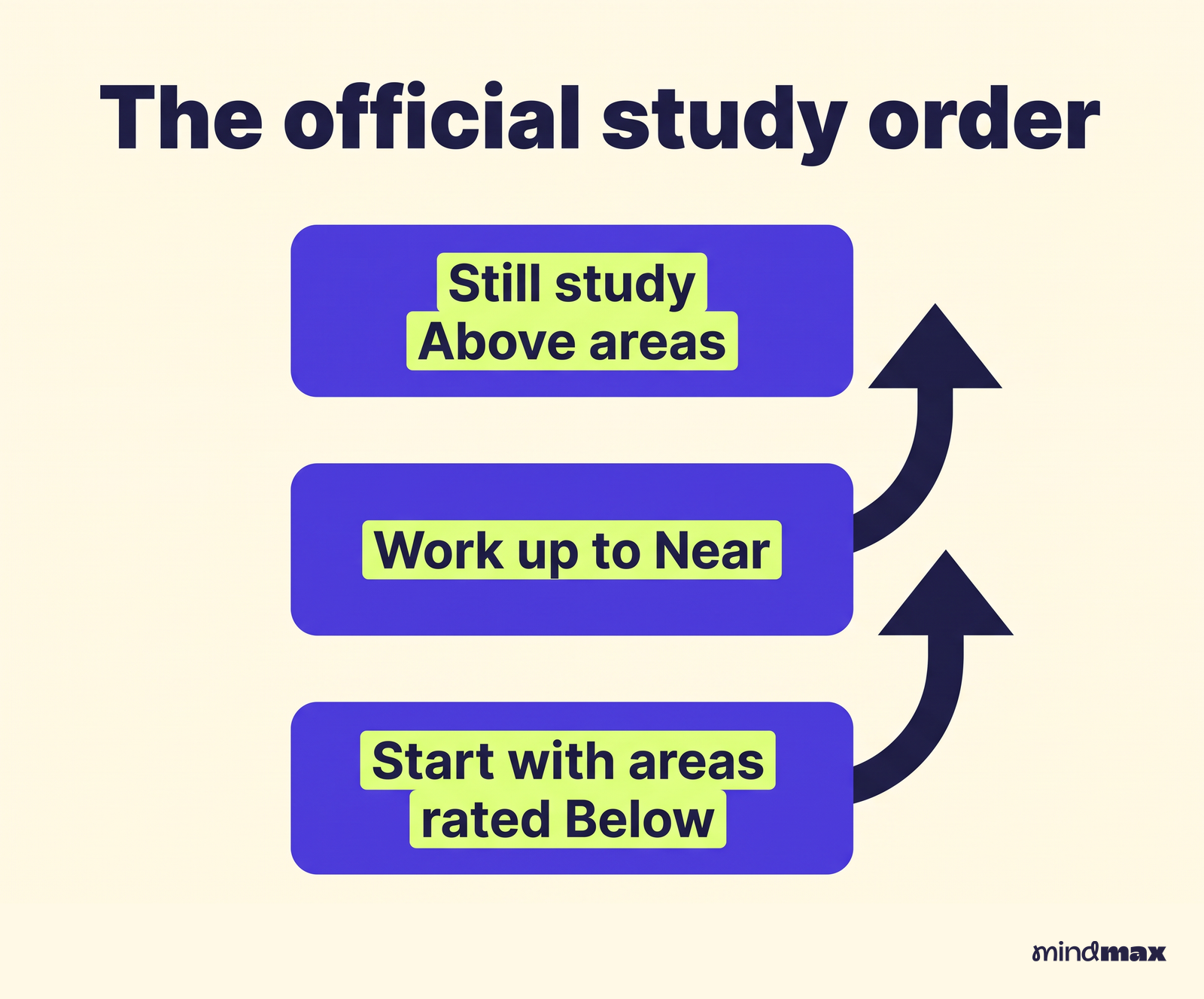
NCSBN's advice is simple. Start with areas rated Below, work up to Near, and still study Above areas so they stay sharp.
Within each rating, give the bigger areas more time. A Below in Management of Care, at 18% of the exam, matters more than a Below in Basic Care and Comfort at 9%. And don't skip the Clinical Judgment half of the page. A Below on Prioritize Hypotheses or Take Actions calls for case-study practice, not more reading.
Is 45 Days Enough to Study for the NCLEX Retake?
For most people who failed at 150, yes, if the days are focused. NCSBN publishes no recommended study length. Forty-five days is only the minimum wait. Retakers who pass often describe how they study 3 to 4 hours a day aimed at their CPR weak spots, with one day a week off.
You don't have to test on day 45. Your ATT usually runs about 90 days, so you can choose a later date inside it. Give yourself more time if most of your ratings are Below, if you've been out of school for years, or if you're exhausted. One candidate who was 8 years out of school suggested 5 to 6 months of study.
A 45-day retake plan
- Days 1 to 3, set up. Do the paperwork, read your CPR, pick one question bank and take a baseline practice test.
- Days 4 to 17, Below areas. Aim for 60 questions a day in tutor mode. Write a note on every rationale you miss and review the content behind it.
- Days 18 to 31, Near areas and case studies. Build toward 85 questions a day and add case studies for your weakest Clinical Judgment steps.
- Days 32 to 40, timed mixed practice. Switch to random, timed sets and full-length adaptive tests. Practice taking breaks inside the 5-hour limit.
- Days 41 to 45, taper and rest. Light review of Above areas, sleep and logistics.
Treat practice percentages as a rough guide only. One candidate scored 65 to 75% on UWorld, finished 95% of the bank at 68%, and still failed at 150. Your CPR ratings tell you more than your bank average.
Best Study Plan for an NCLEX Retake After Failing Twice
If this is your third attempt, more of the same won't help. Retakers who finally pass say the fix was fewer resources, done properly. "Start again as if you haven't taken the test before" is common advice.
- Check your board first. After repeated failures some boards require a remedial course or set other conditions. Find out before you register.
- Use one question bank. Finish it with full rationales instead of sampling four.
- Work on strategy, not just content. One retaker said the struggle "wasn't with the content itself but rather with the strategy for answering questions." Drill priority frameworks like the ABCs, Maslow's hierarchy and ADPIE, and don't overthink select-all-that-apply items.
- Learn the exam's conventions. Key words like first, priority and immediately appear in bold. Drugs use generic names. Lab values come with their normal ranges. Many items award partial credit.
- Plan for nerves and pacing. One candidate panicked when the exam went past 85, skipped every break and failed. Rehearse full-length sessions so 150 items feels normal.
- Protect your health. One person who failed twice couldn't study for six months before restarting. A day off each week is part of the plan, not a lapse.
A tutor can help if strategy is your gap. If you'd rather have a personal tutor in your pocket, MindMax is an adaptive tutor app from Ed Cooke and Daniel Zohar, the team behind Memrise, which more than 80 million people have used. You tell it your goal and how many days you have, and it builds a plan to pass from bite-sized lessons with daily check-ins. Each lesson is a conversation with a tutor you choose. You can ask questions as you go, and the lesson adapts to you in real time.
Should You Switch From Archer to UWorld After Failing the NCLEX?
Switching platforms alone is rarely the fix. Candidates have failed again after moving from UWorld to Archer, and passed on attempt two with Archer by "thoroughly reviewing the rationales." Others passed with the same tools used a different way. How you use the bank matters more than whose it is. NCSBN doesn't endorse any review course, and its tutorial, exam preview and test plans are free.
| UWorld NCLEX-RN | Archer Review NCLEX-RN | |
|---|---|---|
| Question bank | 3,100+ (600+ NGN) | 3,100+ NGN |
| Practice tests | Adaptive tests, up to 6 self-assessments | 30+ readiness assessments and CAT exams |
| 30 days or 1 month | $139 | $79 (Q-Bank + CAT) |
| 60 days or 2 months | $169 | $99 (Q-Bank + CAT) |
| Retaker option | Dynamic study planner, UAsk AI tutor | Intense PREP, 6 weeks, $399 for 3 months |
Prices are from each provider's page in 2026.
Which suits whom
- Stay with Archer if you used it only partly and your CPR shows content gaps. It costs less for a 45-day window. Its Sure PASS guarantee requires you to be a first-time user of the Archer Q-Bank, so a repeat user likely won't qualify.
- Choose Archer Intense PREP if you want live lectures and weekly small-group tutoring. It's billed for repeat test takers and runs over 6 weeks.
- Switch to UWorld if you've worked through Archer's questions so often you recognize them. Fresh items show whether you can reason or just remember. The 60-day plan covers a 45-day wait.
Whichever you pick, a 1- or 2-month plan fits the wait, and one bank finished well beats two half done.
Frequently asked questions
Can I retake the NCLEX in a different state after failing?
Yes, but the new state's board sets its own eligibility rules, so contact that board first. If you change boards after registering with Pearson, there's a $50 fee in the U.S. The new board's waiting period and attempt rules then apply to you.
Should I book my NCLEX retake for exactly day 45?
Only if your CPR shows you're close in most areas and you feel ready. Your ATT usually lasts about 90 days, so you can pick a later date inside that window. Just don't let the ATT expire, because it can't be extended.
How many practice questions should I do before my NCLEX retake?
NCSBN gives no official number. Candidates who pass often report 1,500 to 2,000 questions with full rationale review, at around 60 to 85 a day. Depth of review counts more than the total.
What UWorld or Archer score means I'm ready to retake?
There's no official cutoff. Candidates often treat about 65% on RN question banks as a rough sign of readiness, but some who scored that high still failed at 150. Use your readiness exams and your CPR ratings together, not one percentage.
Do I get my results faster on a retake?
No, the process is the same. Official results come from your board of nursing, usually within 6 weeks. Many states also offer paid Quick Results through the NCLEX site, typically about 48 hours after your exam.