
How to Study for the NMLS Exam and How Long It Really Takes
12 min read ·

Co-founder of MindMax and Memrise, Grand Master of Memory
How did people study for the NMLS exam, and how long did it take?
Most people who pass the NMLS SAFE exam study for 1 to 4 weeks after finishing the 20-hour course, and a few take 6. The usual pattern is a quick read through the material, then a heavy block of practice tests where you review every miss. Time alone doesn't decide the result. Candidates scoring in the mid-80s on practice tests have still failed with a 74. Passers usually describe 90% or better on every section before they test. If you work full time, plan on about 4 weeks. If you can study most of the day, 2 weeks can work.
What the SAFE MLO test looks like
Before you build a plan, know the target. These figures come from the NMLS MLO Testing Handbook, whose test specs are dated April 5, 2021 and are still current.
| Item | Official figure |
|---|---|
| Questions | 120 total, 115 scored, 5 unscored pre-test items you can't identify |
| Test time | 190 minutes (the appointment runs 225 minutes with the tutorial and survey) |
| Passing score | 75%, set by the SAFE Act |
| Fee | $110 per attempt, non-refundable and non-transferable |
| Enrollment window | 180 days from payment to schedule and sit the test |
| Retake wait | 30 days after a 1st or 2nd failure, 180 days after a 3rd |
The number that should shape your plan is the pass rate. NMLS reports that the first-time pass rate for the SAFE MLO Test was 53% as of December 31, 2024. Every one of those first-timers was expected to have the 20 hours behind them, and nearly half still failed.
The questions are also built to be read carefully. Each candidate gets a different form, equated to a standard one, and NMLS never releases questions for review. If you want more on why the wording catches people, see why the NMLS exam is hard and how its questions are written.
Is the 20-hour course enough to pass the NMLS test?
For most people, no. The course is the legal minimum for a license, not a study plan for the test. NMLS doesn't say whether it's enough, but look at how the 20 hours split up.
- 3 hours of federal law
- 3 hours of ethics, covering fraud, consumer protection and fair lending
- 2 hours on nontraditional mortgage lending
- 12 hours of general instruction on mortgage origination
Three hours of federal law has to cover RESPA, TILA, TRID, ECOA, HMDA, FCRA, BSA/AML, GLBA and more. That is a fast tour, and federal law alone is 24% of your test. Candidates on Reddit say the same thing in blunter words, and the 53% pass rate backs them up.
Two official rules are useful here.
- You don't have to finish your pre-licensing education (PE) before you test. It has to be done before you apply for the license.
- PE expires. If you don't get licensed within 3 years, you retake the 20 hours.
Many states also add their own PE hours on top of the national 20. One Florida candidate, for example, mentioned 2 extra hours. Check your state's page on NMLS's state-specific requirements list before you apply, since these hours vary by state and the test itself does not. There is one national exam, and its Uniform State Content applies everywhere.
How long should you study after the 20-hour course?
NMLS publishes no recommended study time. What exists comes from people who took it. Here is what candidates on r/loanoriginators reported.
| Study time after the course | Practice scores | Result |
|---|---|---|
| 5 days of prep | Not given | Passed with 80% |
| 3 weeks at 5+ hours a day, no industry experience | Not given | Passed with 80 |
| 4 weeks, 50+ practice exams | 77 to 95% | Passed with 92 |
| 60+ hours total, flashcards from every miss | About 97% by the 15th test | Passed |
| 6 weeks at 8 hours a day | Not given | Passed |
| About 20 practice exams | Mid-80s | Failed with 74 |
| 4 weeks at 2 to 3 hours a day | Not given | Failed with 73 |
The advice online looks contradictory. Some people say a week is plenty, others say 60 hours or 6 weeks. The way to reconcile it is to stop counting days and start counting readiness. The people who failed after a month didn't lack time. Several were scoring in the mid-80s and tested anyway, or drilled the same small question bank until the scores meant little.
A sensible default is 40 to 70 hours of focused work after the course. One commenter said 60 hours is advised, though without a source. Spread that over whatever calendar your life allows.
Can you pass the SAFE MLO test with 2 weeks of studying?
Yes, if you can give it most of each day. One candidate did a one-week course plus an exam-prep course and passed with a 75, all within 2 weeks. That shows it's possible, and also how close to the line it can be. Two weeks suits you if you already know mortgage terms or can put in 4 to 6 hours a day. If you're new to the industry and working full time, 2 weeks is a gamble.
How should you split your study time by topic?
Weight your hours the way NMLS weights the test. The official content outline, which NMLS calls the only study material it publishes, breaks the exam into five areas. Mortgage Loan Origination Activities is 27%, about 31 of the 115 scored items. Federal Mortgage Related Laws is 24%, about 28 items. General Mortgage Knowledge is 20%, Ethics is 18% and Uniform State Content is 11%.
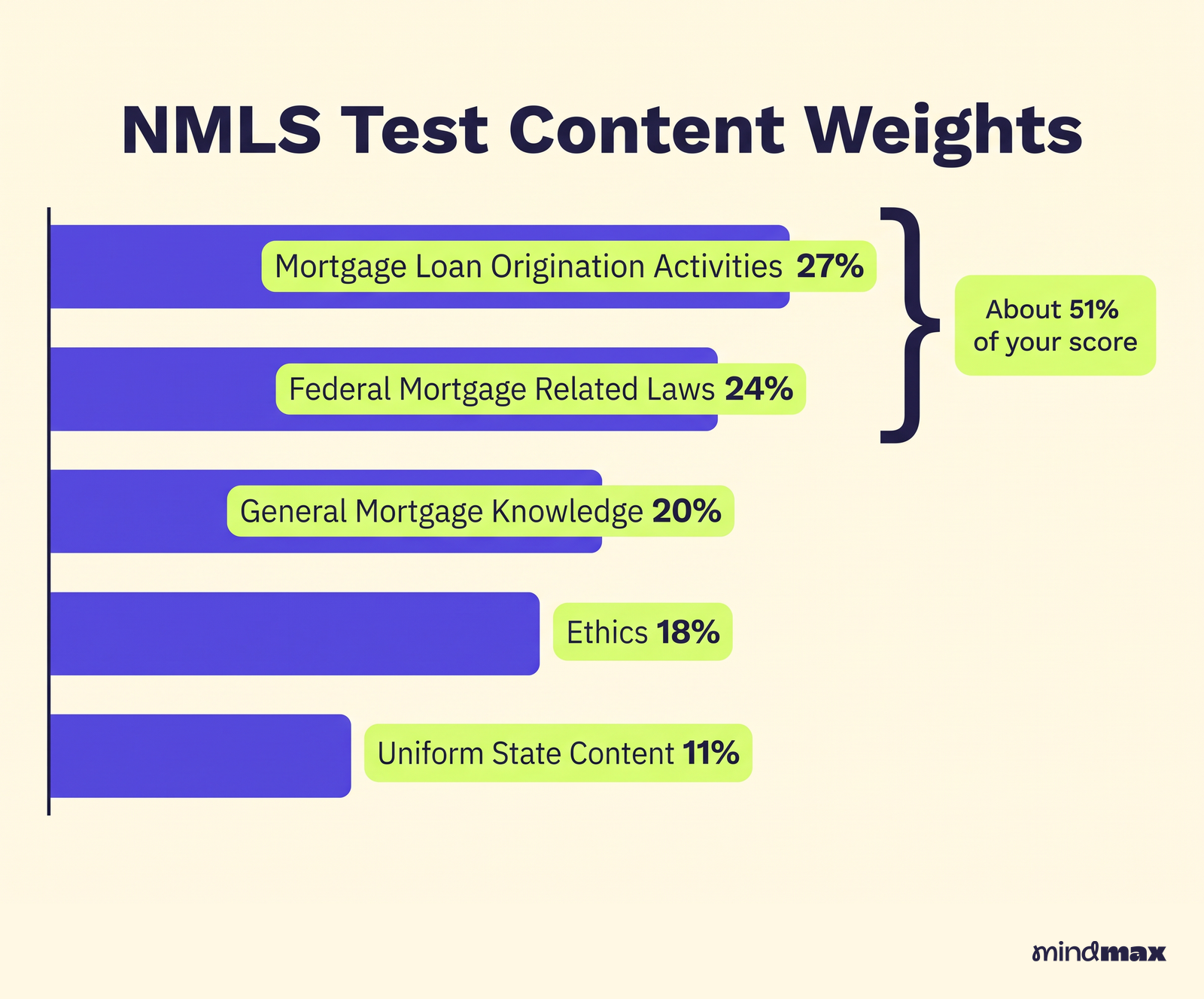
That means about 51% of your score comes from origination activities and federal law. Give those two areas half your time.
Inside those areas, a few topics deserve extra hours.
- TRID timing. Loan Estimate and Closing Disclosure deadlines, and the zero and 10% tolerances.
- Math. Periodic interest, monthly payments, down payments, closing costs and prepaids, ARM adjustments and qualifying ratios all sit under origination activities.
- Numbers and dates in the laws. Highlight every specific figure, deadline and agency as you read.
Answer based on current law. NMLS says candidates must keep up with changes whether or not they appear on the outline.
A 2, 4 and 6 week NMLS study plan
Pick the plan that fits your hours, not the one that sounds fastest. Each follows the same three phases. First you review, then you test and fix, then you confirm you're ready.
| Plan | Daily time | Rough total | Suits |
|---|---|---|---|
| 2 weeks | 4 to 6 hours | 50 to 70 hours | Between jobs or in a company training program |
| 4 weeks | 1.5 to 2 hours weekdays, 4 hours weekend days | 55 to 70 hours | Working full time |
| 6 weeks | 1 to 1.5 hours, 6 days a week | 40 to 55 hours | Busy schedules, family, slower pace |
The 2-week plan
Days 1 to 4, reread your course material by content area, starting with federal law and origination activities. Make short notes of every number and deadline. Days 5 to 11, take one full practice test a day and spend as long reviewing it as taking it. Days 12 to 14, take fresh tests you haven't seen. If you aren't at 90% across sections, push the date.
The 4-week plan while working full time
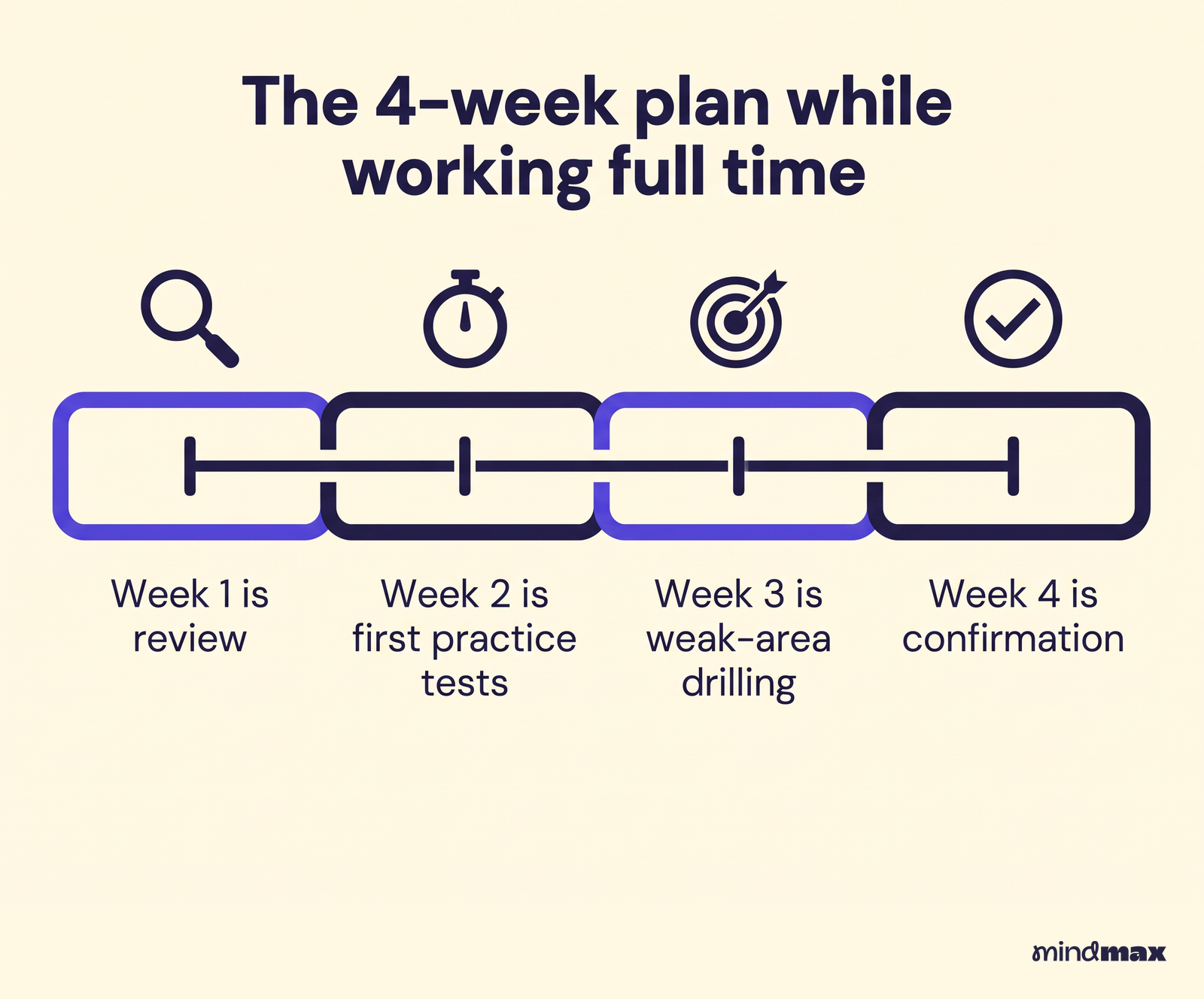
Week 1 is review. Go through federal law and TRID on weekdays and do the math on the weekend. Week 2 is first practice tests. Take one full test each weekend day and topic quizzes on weekday evenings. Week 3 is weak-area drilling. Spend weekdays only on the sections where you score lowest. Week 4 is confirmation. Take two or three full tests from a question source you haven't used, then sit the exam.
The 6-week plan
Use weeks 1 and 2 for review, one content area every few days. Weeks 3 to 5 are for practice tests twice a week and drilling in between. Week 6 is fresh full tests and light review the day before.
What practice test score should you get before the NMLS exam?
Aim for 90% or better on every section, on questions you haven't memorized. One passer put it simply, take the practice tests until you can get 90%+ on all the sections.
The reason for the high bar is the gap people report between practice and the real test. Candidates averaging in the mid-80s have still failed with 73 and 74. Your practice percentage isn't a direct prediction, since NMLS equates scores across forms and your practice bank isn't the real one.
Three rules keep your score honest.
- Don't count a memorized score. If you've seen a question three times, getting it right proves little. Add a second question source in your last week.
- Look at sections, not just the total. A 90% overall can hide a 70% in federal law.
- Treat practice tests as practice, not study. As one candidate put it, the practice tests alone are not sufficient study material. Every miss should send you back to the rule behind it.
Providers set their own bars too. Mortgage Educators and Compliance, for example, requires 80% on its own final for its pass guarantee. That's the provider's threshold, not an NMLS one, and it sits below the 90% that passers describe.
How to study for the NMLS exam while working full time
You don't need long sessions. You need regular ones and a plan for the dead time in your day.
- Protect one weekday block. 90 minutes after dinner, five nights a week, adds up to more than most people expect.
- Save full tests for weekends. A full test runs 190 minutes, so give it a morning when you're fresh.
- Use your ears. One candidate turned YouTube lessons into an audio playlist for chores, mowing, driving and the gym. Free channels such as Affinity Mortgage Training get mentioned often.
- Make tiny reviews count. Flashcards built from your misses fit into a lunch break.
Weak-area drilling is the step most people skip when they're tired, because it's easier to take another full test. An adaptive tutor helps here. MindMax builds a plan to your exam date, sequences short lessons around your day, and adapts as you ask questions out loud or by typing. You can listen to lessons on a commute, and its own timed mock exam runs 100 questions in 190 minutes with a 75% pass mark.
Feeling discouraged studying for the NMLS test? How to stay on track
Almost everyone hits a week where scores stall or slip. That's normal, especially once you move from familiar questions to new ones. A drop when you switch question banks usually means you're finally measuring what you know.
What helped other candidates get through it.
- Be patient and read every question twice. The test rewards slow readers, and many misses are misreads.
- Rewrite your notes shorter. Condensing a chapter onto one page forces you to understand it.
- Handwrite the explanation for every miss. A third-time taker was given this advice, and it turns a wrong answer into a lesson.
- Track sections, not moods. Watching your federal law score climb from 70% to 88% is more encouraging than a flat total.
Keep the stakes in proportion too. Near misses of 72 to 74 are common, and a fail costs time and money but not your future in the industry.
When to book your NMLS test date
Book with the rules in mind, because they make a borderline attempt expensive. Paying the $110 opens a 180-day window to schedule and sit the test, and if the window lapses you lose the fee. You can reschedule or cancel up to two business days before your appointment. A late change or no-show forfeits the fee.
If you fail, you wait at least 30 days and pay another $110. A third failure means 180 days. That's the practical case for not testing on a mid-80s practice score just because the date is close. Moving the appointment costs nothing if you do it in time. Failing costs a month.
If it does happen, your score report shows section-by-section ranges meant to help you prepare for the next attempt. Here is a 30-day retake plan built around that report.
On the day, arrive or log in 30 minutes early with an unexpired government photo ID that has your signature and matches your NMLS name exactly. You can test at a Prometric center or online, and you can't pay at the center.
Frequently asked questions
Is there a separate state exam I need to pass for the NMLS license?
No. The SAFE MLO Test is one national exam, and its Uniform State Content section makes up 11% of it. Passing it once meets the testing requirement for every state. States can still require extra pre-licensing education hours, so check your state's page on NMLS.
Do the unscored questions on the NMLS exam count against me?
No. Five of the 120 questions are pre-test items that don't affect your score or your pass or fail result. They are mixed in at random and you can't tell which ones they are, so answer every question as if it counts.
Can I use a calculator on the SAFE MLO test?
Yes. At a test center you get a basic four-function calculator and a whiteboard. If you test online, you get an on-screen calculator and a virtual scratchpad. Practice your math with a simple calculator so the tool feels familiar on test day.
Does a passing NMLS score ever expire?
A passed test stays valid unless you go five consecutive years without holding a state license or an active federal registration. Your pre-licensing education is different. If you don't get licensed within 3 years of finishing it, you have to retake the 20 hours.
Can I take breaks during the NMLS exam?
You can take restroom breaks, but the test clock keeps running. At a test center you also can't get into your locker during a break. Plan your time so a short break doesn't leave you rushing the last questions.