
I Passed the Real Estate Exam, Now What? Brokers and Timelines
11 min read ·

Co-founder of MindMax and Memrise, Grand Master of Memory
I passed the real estate exam, now what do I do?
Passing the real estate exam makes you eligible for a license, but it doesn't let you start selling. Next, get the license issued, then tie it to a sponsoring broker, which agents call hanging your license. In California, Texas and Florida, a license with no broker attached can't be used for licensed work. So pick a brokerage, have them sponsor or activate you, confirm your status on the state lookup, and note your education deadlines. Joining a REALTOR® association is optional and comes later. Other states set their own rules, so check with your regulator.
The steps after you pass, in order
Here is the order most new agents follow in the three biggest states.
- Make sure your license application and fingerprints have cleared, if they haven't already.
- Interview brokerages and pick one.
- Have that broker sponsor or activate your license through the state system.
- Look yourself up on the state's public license search before you do any licensed work.
- Put your education deadlines on the calendar.
- Decide whether to join a local REALTOR® association.
Step 4 matters more than it sounds. Florida's real estate division puts it bluntly. "NEVER ASSUME YOUR LICENSE IS WITH THE APPROPRIATE BROKER/BROKERAGE." Use the DRE public license lookup in California, the TREC license holder search in Texas, or the DBPR lookup in Florida.
Do I need a sponsoring broker to get my real estate license after passing?
Yes, but only to practice. In California and Texas the state can issue your license without a broker. In Florida the license is issued too, but it stays inactive until a broker activates it. In all three, you can't do licensed work until a broker is attached.
Texas says it plainly on its TREC page on becoming a sales agent. "You will be issued an inactive license. You must be sponsored by a broker to move to active status and be able to practice brokerage activity."
| State | Your status with no broker | How you go active |
|---|---|---|
| California (DRE) | Licensed NBA, meaning No Broker Affiliation | Affiliate with a responsible broker through the DRE |
| Texas (TREC) | Inactive license | You or your broker submit a sponsorship request in TREC's online portal |
| Florida (DBPR) | Issued but inactive | Your broker files the request to make you active, then approves it in their DBPR account |
California
The DRE describes a Licensed NBA license as being "in a non-working status." The holder "may not perform acts for which a real estate license is required in California." Many guides say affiliation is done in eLicensing or on form RE 214, the Salesperson Change Application. Confirm the current method on the DRE site before you file.
Texas
Texas adds a few rules you should know from day one.
- A sales agent must be sponsored by a licensed broker to perform any act of real estate services.
- Doing brokerage work on an inactive license is a violation subject to sanctions.
- All commissions must be paid through your sponsoring broker.
- A sales agent may not hold an escrow account.
In practice, once you choose a broker, they send you an invitation through the TREC portal and you accept it.
Florida
Florida's status glossary, dated 2011, defines inactive as having met the requirements for licensure but not being allowed to work under the license. You can't activate it yourself. Your broker files form RE 11 online or by mail, then approves the request in their own DBPR account.
How long after passing the real estate exam do you get your license?
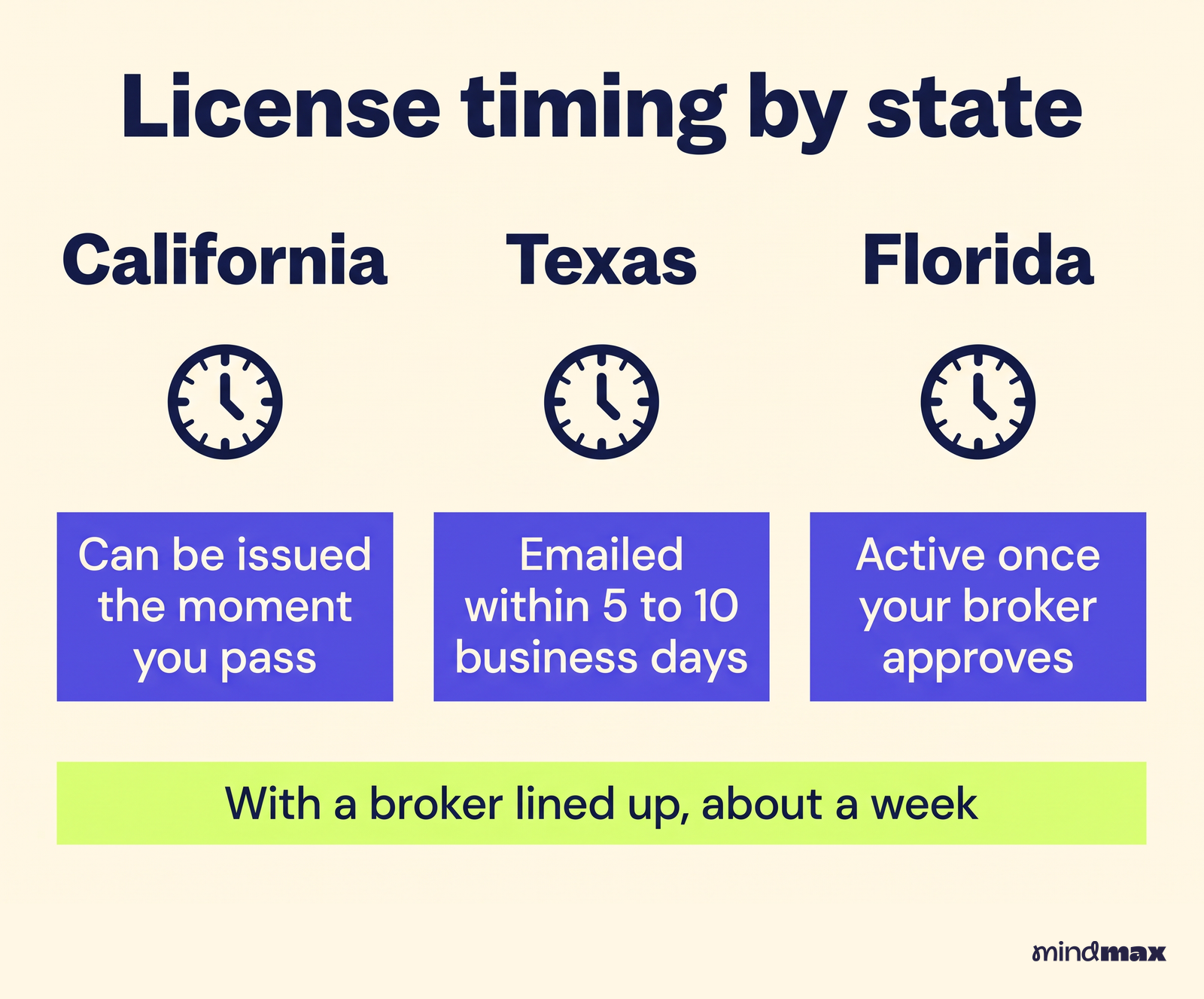
It depends on your state and how you filed. In California a license can be issued the moment you pass, if you filed the combined application and it has no problems. In Texas the license is emailed within 5 to 10 business days after you pass and clear the background check. In Florida the license is issued after you pass and becomes active once your broker approves. With a broker lined up, about a week from exam to working is a common report.
California
California has two ways to apply, and the one you chose sets your wait.
- Combined exam and license application (RE 435). This costs $450 in total, $100 for the exam and $350 for the license. If the file has no deficiencies, the license can be issued as soon as you pass. Prep schools report recent waits of about 8 to 17 calendar days once Live Scan fingerprints clear.
- Exam-only application (RE 400A). After you pass, you file the license application, RE 202, and wait several more weeks.
One California candidate put it simply. "My application was submitted before taking the exam so as soon as I passed, I went to work."
The DRE warns that its processing times "may be longer than usual" because of staffing limits, and it updates them weekly on its processing timeframes page. Fingerprint reports from the DOJ and FBI must come back first, and the DRE says that part "is not within the DRE's control."
Texas
In Texas you file your application before you test, and it expires one year from the date you filed it. Fingerprints are scheduled once the application moves to "In Review." The September 2026 candidate handbook says that after you pass and clear the background check, your license is emailed within 5 to 10 business days. It arrives inactive, so sponsorship is the last step. TREC posts a Processing Dates page with its current backlog.
Florida
Florida publishes no official timeline. Once your broker approves the activation, the active status shows on the DBPR lookup and you get an email confirmation. The speed mostly comes down to how quickly your broker acts.
What candidates report
Agents who already had a brokerage picked out describe a fast finish. "My license was hung with them about a week after the exam." Another said it "took less than a week." Not everyone is that lucky. One Nevada agent said it took 6 weeks from passing.
When should I start applying to brokerages, before or after the exam?
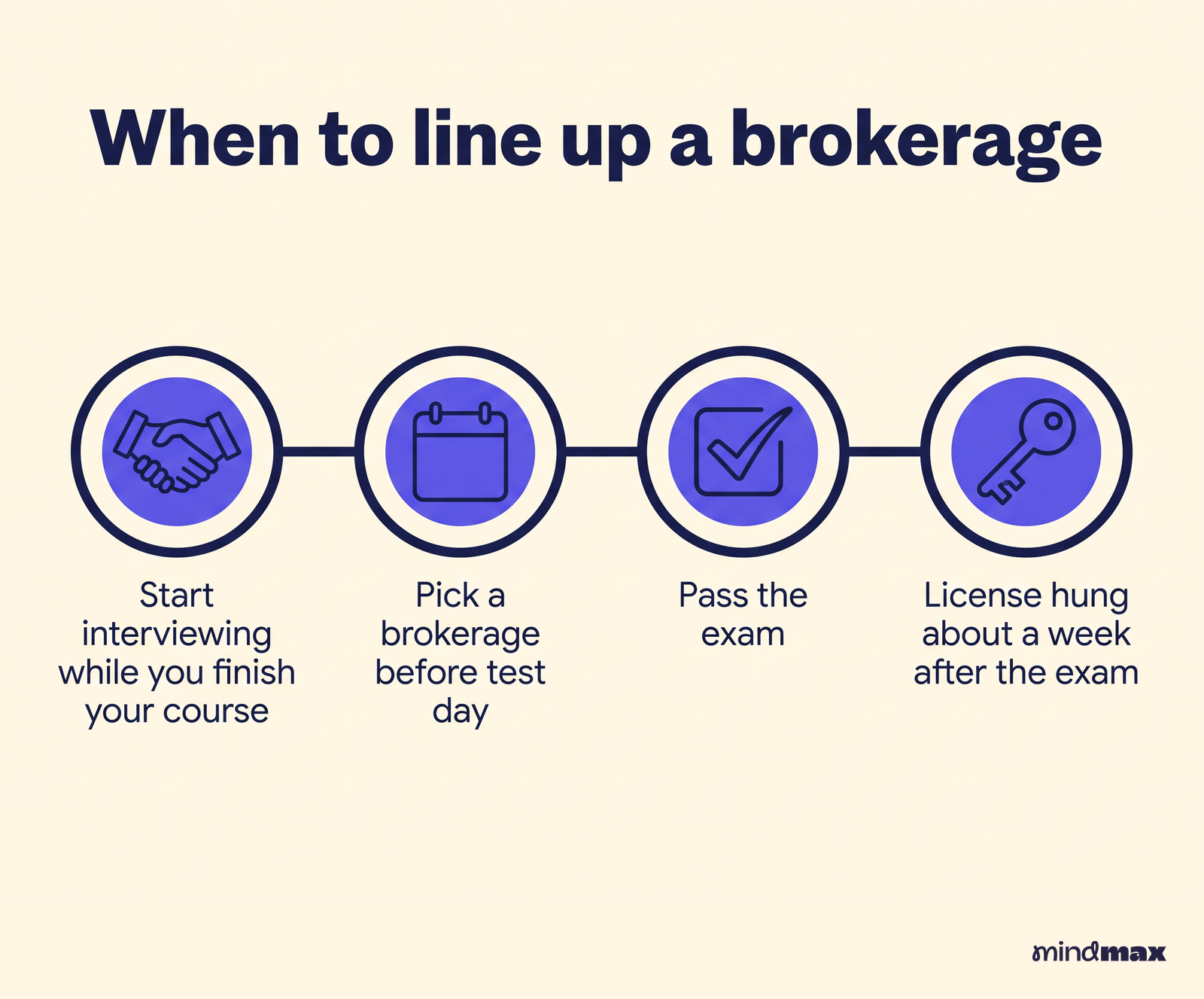
Before. Start interviewing while you finish your course, and pick a brokerage before test day. The new agents who start work fastest had their office lined up before they ever sat the exam. A brokerage interview isn't a commitment, so talking early costs you nothing.
Waiting, on the other hand, has real costs.
The first is money. Every week between passing and sponsorship is a week you can't do licensed work, so you can't earn a commission.
The second is the clock. In Florida, your renewal clock starts when the license is issued, not when it goes active. Sit on an inactive license and you've shortened the time you have to finish post-licensing.
The third is that rushed choices stick. Agents who pick in a hurry often switch later, and switching isn't free. As one agent warned, "Everyone will tell you that you can change brokerages easily, which is true… But every change will cost you clients and money." That same agent stressed how important it is "to get started in a newbie friendly office."
How do I choose a brokerage as a brand new real estate agent?
Pick the office that will train you, not the one with the flashiest pitch. Your first year is about learning the job, so support matters more than a split or a brand name.
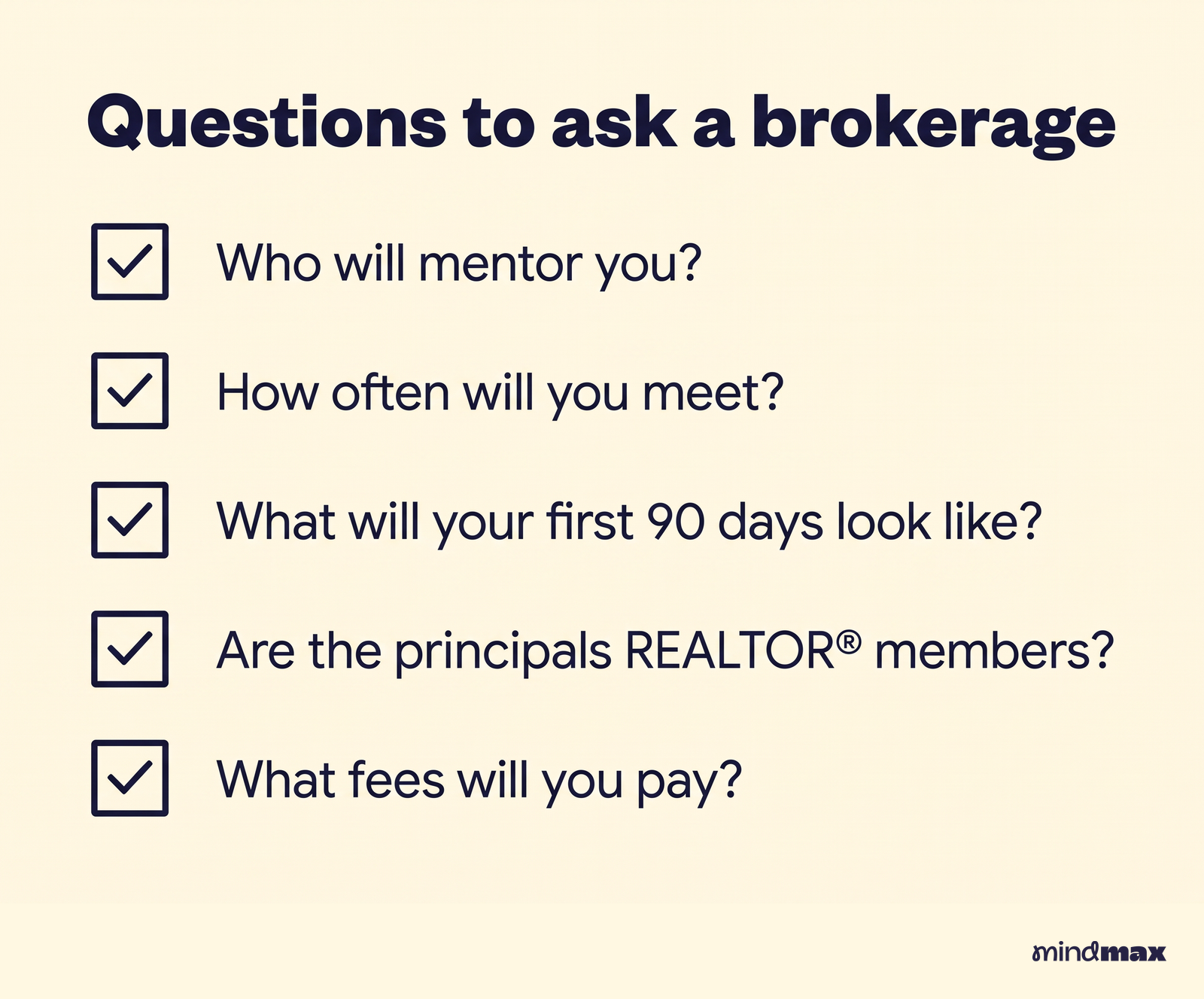
Start with mentorship. Ask the manager, who will mentor you? You want a name, not a vague promise of support. Then ask, how often will you meet? A standing weekly check-in is worth far more than an open-door policy you never use. Finally, ask what will your first 90 days look like? A good answer is specific, with a plan for training, shadowing and your first leads.
Next, ask a question most new agents skip. Are the principals REALTOR® members? If they aren't, you can't become a REALTOR® while you work there, for reasons covered below.
Then talk money. What fees will you pay? Desk or tech fees, MLS fees and E&O insurance all come on top of your license, and they vary widely between offices. Get the numbers in writing so you can compare offers side by side. To see how these costs stack up against what new agents earn, read our guide to whether a real estate license is worth it, with costs and real pay.
Last, ask how they handle advertising rules, because those apply from your first day. In Texas, every ad must show your broker's name at least half the size of the largest agent contact information. You can't advertise under your own business name unless it's a registered team name. A brokerage that explains rules like these clearly is one that will keep you out of trouble.
What's the difference between a real estate agent and a REALTOR®, and how do I become one?
A real estate agent is anyone holding a license. A REALTOR® is a licensee who has joined the National Association of REALTORS® and agreed to follow its Code of Ethics. Only NAR members may use the title.
NAR lists three steps.
- Get licensed.
- Join a local REALTOR® association, which also gives you state and national membership.
- Pay dues.
The brokerage rule that decides it
The principals of your firm must join first. NAR says that if any principal decides not to join, none of the people affiliated with the firm can be REALTOR® members. So your choice of brokerage decides whether you can become a REALTOR® at all.
What it costs for 2027
| Item | Amount |
|---|---|
| NAR national dues | $156 a year |
| Special assessment | $45, not prorated |
| Local and state dues | Vary by association |
In the year you join, the $156 is prorated by month, so joining late in the year costs less. The $45 is charged in full. Ask your local association for its own dues before you budget.
Membership also comes with training. NAR requires Fair Housing training every three years, on the same cycle as Code of Ethics training.
Education deadlines that start once you're licensed
Your license comes with homework. Miss these deadlines and you can lose it.
- Texas. You need 270 total qualifying hours, plus Legal Update I and II, before your first renewal. That includes the 180 pre-license hours you already did. After that, each two-year renewal needs 18 hours of continuing education.
- Florida. You must complete the 45-hour post-licensing course before your first renewal, or the license becomes "null and void." The clock starts when the license is issued, not when it goes active.
- California. Licenses run for four years, and renewal needs 45 clock-hours of continuing education. The DRE also describes a conditional license for anyone licensed with only Real Estate Principles, who must submit two more courses within 18 months or face suspension.
Put your first renewal date on your calendar the day your license arrives, then work backward to plan your courses.
Frequently asked questions
Can I keep my real estate license inactive if I'm not ready to work yet?
Yes. In Texas and Florida the license is issued inactive, and in California it shows as Licensed NBA until you affiliate with a broker. You just can't do any licensed work in that state. Your education and renewal deadlines keep running, so plan for them even while you wait.
Do I have to become a REALTOR to work as a real estate agent?
No. Your state license and a sponsoring broker are what let you practice. REALTOR membership is a separate, optional step through a local association, and it depends on your brokerage's principals joining first.
Can I switch brokerages after I hang my license?
Yes, changing brokerages is allowed and agents do it often. The catch is the cost, since experienced agents say each move tends to lose you clients and money. That is why it pays to choose a newbie friendly office the first time.
Does my California real estate license work in other states?
No. The California DRE has no reciprocity with any other state or country, so the license is valid only in California. To work elsewhere you follow that state's own licensing process.
I passed the Texas national portion but not the state portion. How long do I have?
Each passed section stays valid for one year, and your application expires one year from the date you filed it. You retake only the portion you failed. After three failed attempts you need 30 more education hours if you failed one portion, or 60 if you failed both.