
Best Online Course to Pass the Part 107 Exam, Paid vs Free
12 min read ·

Co-founder of MindMax and Memrise, Grand Master of Memory
What is the best online course to pass the FAA Part 107 exam?
No single Part 107 course is best for everyone. Pilot Institute suits you if you want depth, offline videos and the strongest fail guarantee. Drone Pilot Ground School (DPGS) suits you if you want shorter videos and a set study plan. King Schools is the cheapest paid course at $129. DartDrones fits if you want a live or in-person class. If you're disciplined, free FAA material plus YouTube is enough for many people. Whatever you pick, it should cover the image-based chart questions that began October 26, 2026.
Prices, practice questions and guarantees at a glance
The test is the same in every state because it's a federal FAA exam. You get 60 scored multiple-choice questions in 2 hours and need 70%, which is 42 correct. Prep providers put the fee at about $175 per attempt, paid to the PSI test center and not refundable, so confirm the amount when you book. If you fail, you wait 14 days and pay again. For pass rates and realistic study hours, see how hard the Part 107 test is and how long to study.
Here's how the main options line up, using each provider's own page.
| Option | Price | Practice questions | If you fail |
|---|---|---|---|
| Pilot Institute, Part 107 Made Easy | Not listed on the course page. Candidates report about $150 to $175 | More than 300 in quizzes, plus unlimited practice exams | $175 plus a full refund on a first-try fail |
| Drone Pilot Ground School (UAV Coach) | No base price shown, frequent sales | 400+ | Course fee and $175 test fee refunded, with an 85% practice condition |
| DartDrones | $150 online (regularly $200), $375 live virtual, $670 in person | 600+ | Retest fee paid, course price not refunded |
| King Schools | $129 | FAA-style questions by subject | Pass guarantee |
| Free route | $0 | PSI sample tests, King Schools free tests | You pay the test fee again |
The pass rates these courses advertise are their own claims. Pilot Institute says 99.9% of its students pass, DPGS says 99%+, and DartDrones says 99.9%. A third-party compilation of FAA figures puts the national pass rate at about 83% for 2025, counting every attempt.
How the four paid courses compare
Pilot Institute, Part 107 Made Easy
This is the deepest course. You get about 15 hours of video in 210+ lessons that average about 3 minutes each, unlimited practice exams, 20 quizzes with more than 300 questions, a 14-page cheatsheet, 13 audio lessons, weekly live office hours and lifetime access. Videos download for offline viewing. A flashcard app for iPhone and Android with 110 cards comes free with the course. The instructor is CFI Greg Reverdiau.
Drone Pilot Ground School (UAV Coach)
DPGS offers video lessons organized by subject, quizzes and 400+ multiple-choice questions with explanations. After each practice test it emails you a performance report. You also get flash cards, a cram sheet, a weekly live webinar with Mike McGuirt, Spanish subtitles, lifetime access and study plans from 1 week to 6 weeks. The home page shows rotating sale banners, such as $140 off and 50% off, and payment plans, but no base price.
DartDrones
DartDrones is the one to look at for live teaching. Online costs $150 (regularly $200), Live Virtual costs $375, and In-Person plus Online, an 8-hour class, costs $670. Affirm financing starts from $59 a month. You get 600+ practice questions, a 50-page study guide, weekly live review sessions, access to the Chief Pilot and 13 lessons, including chart study and night operations.
King Schools
King Schools is an online ground school with FAA-style questions sorted by subject, free lifetime access with automatic updates and a pass guarantee. It also runs a free LAANC course, and candidates often mention its free practice tests, which present questions in a deliberately tricky way.
Pilot Institute vs Drone Pilot Ground School, which one is better?
Both are solid, and the real difference is style. Pick Pilot Institute if you want to understand the material rather than memorize it, and you like studying offline. Pick DPGS if you want shorter, subject-by-subject videos and a fixed plan to follow.
Candidates split along those lines. One 2024 poster called Pilot Institute "Always up to date." Two 2026 posters found it "overwhelming" or "way too much info" if you just want the license. Fans of its depth point out that the instructor warns you'll probably fail if you only memorize practice-test answers. DPGS gets praise for concise videos organized by subject, regular updates and lifetime access.
Both guarantees refund more than the course. Pilot Institute adds a 30-day money-back guarantee on top of its fail guarantee. DPGS refunds the course fee and the $175 test fee, but its page gives two versions of the condition. One section asks for at least 85% on 3 practice tests, and the FAQ says 85% on one. Read the current terms before you count on it.
Pilot Institute vs DartDrones, is either worth the money?
For most self-study candidates, Pilot Institute is the better value. DartDrones is worth paying for mainly if you learn best with a live instructor and the $375 or $670 class fits your budget.
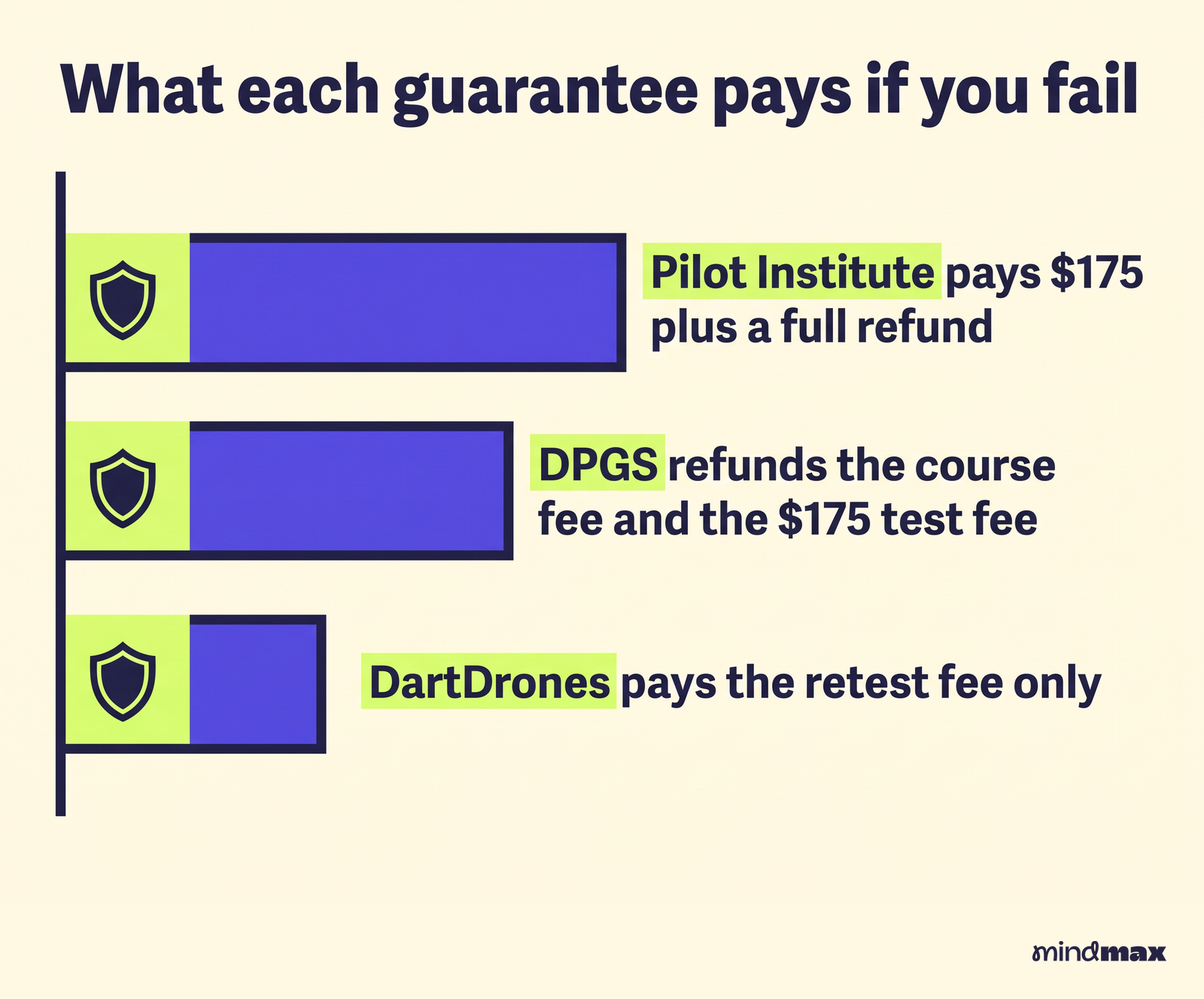
The gap is clearest in what each guarantee pays if you fail. Pilot Institute pays $175 plus a full refund. DPGS refunds the course fee and the $175 test fee. DartDrones pays the retest fee only. Its Exam Retest Guarantee adds live prep but never refunds the course price, and it requires you to finish every module within 90 days and score at least 85% on three practice exams.
One candidate's story sums up the trade. They paid $190 for DartDrones, found the videos weren't available offline and still felt underprepared. They then bought Pilot Institute for about $150, liked the offline downloads and scored 95%. Others in the same thread spent nothing at all. So either course can be worth it if you need structure, but neither is required.
Can you pass Part 107 with only free resources?
Yes. Plenty of candidates pass without paying for a course. "Free YouTube videos were all I needed to pass with a 90 something percent," wrote one in 2024. A December 2025 test-taker passed with no paid course and called three or four full practice exams crucial.
A complete free kit looks like this.
- The FAA Remote Pilot Small UAS Study Guide, a PDF on faa.gov. A 2026 candidate said many questions on their exam were verbatim from passages in it.
- The FAA test topics and ACS, linked from the FAA's remote pilot page.
- Current sectional charts and the FAA Chart Users' Guide, for the new chart images.
- PSI True Talent sample tests, which the FAA points candidates to.
- King Schools free practice tests.
- YouTube, where candidates name Tony Northrup, Mr Migs, Mike Sytes and Matt Kendall.
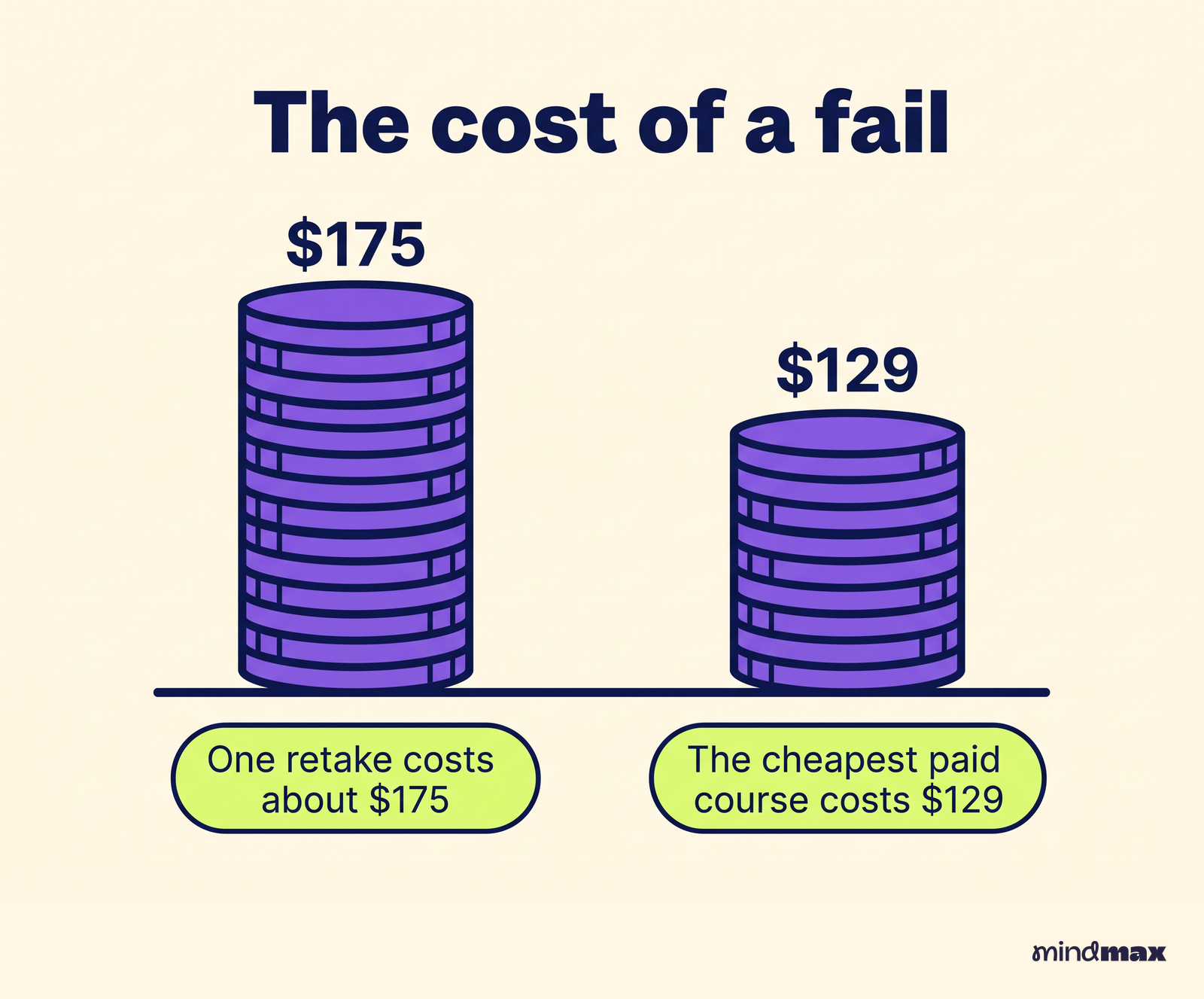
The free route asks more of you. Nobody sequences it, nobody updates it for you and there's no guarantee. The cost of a fail is the real argument for paying. One retake costs about $175. The cheapest paid course costs $129. If a course with a refund guarantee is what gets you through on the first try, it pays for itself. If you're confident with self-study, it doesn't.
Is Tony Northrup's Part 107 video still current enough to pass?
It's current enough for an overview, but not on its own. The video runs about 1 hour 43 to 45 minutes, and a 2026 poster asked whether it's "still applicable since it's eight years old." It predates the 2021 rule changes on night operations and online recurrent training, and it predates Remote ID. It also can't prepare you for the new image-based chart questions.
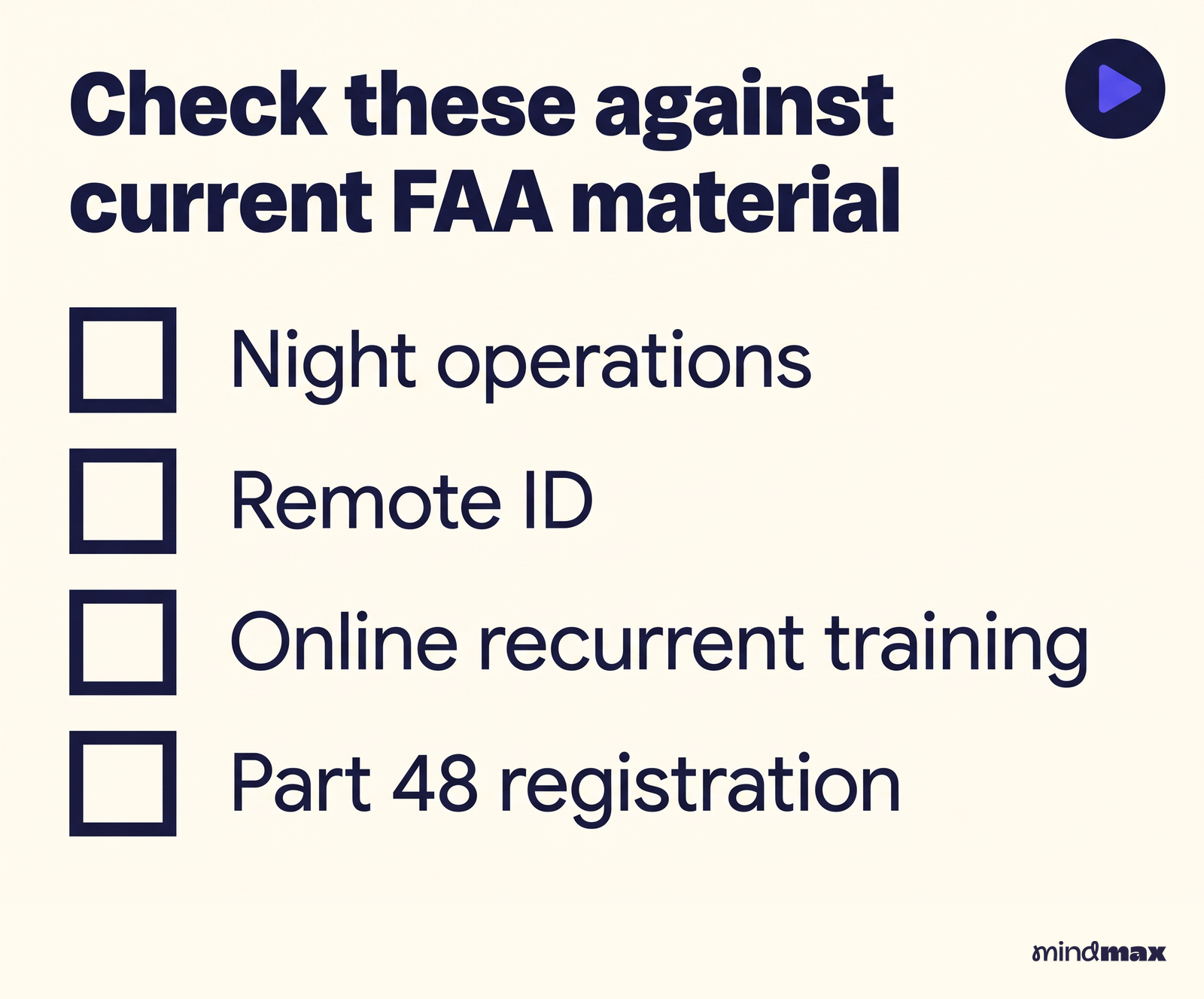
A 2026 candidate who scored 92% used it "to get a general grasp," then moved on to Mr Migs and the FAA study guide. They didn't find it outdated overall, yet still got about 5 questions on night operations and missed most of them, plus 5 or 6 questions on Part 48 registration. An older thread put it bluntly. If you're sharp you could possibly get by with just this video, but that poster didn't recommend it.
Watch it first for the big picture, then fill the gaps. Check these against current FAA material. Night operations, Remote ID, online recurrent training and Part 48 registration.
What's the best Part 107 study app for iPhone that doesn't repeat questions?
No app has published proof that it avoids repeats, so judge apps by what you can see. Complaints from candidates are specific. One kept getting "the same eight questions repeatedly." App reviews mention an app that "has not been updated for current tests" and another where charts couldn't be zoomed enough to read. One reviewer liked an app because its questions were harder than the real test and showed their weak areas.
The apps candidates name most often are these.
- Pilot Institute flashcards, free with the course, with 110 cards. Good for review, too small to be a question bank.
- Part 107 App by Easy Prep, which one candidate used on Android. Another reported an iOS Part 107 app on a 10 dollar subscription without saying if it was the same one.
- Command, Part 107 Exam Prep, whose developer claims 744+ questions and a weak-spot study engine on iOS and Android. Those are the developer's own claims.
When you test an app, look for a bank in the hundreds (the courses have 300+, 400+ and 600+), questions picked by your weak areas rather than at random, charts you can zoom into, and updates dated after October 26, 2026. Keep DartDrones' warning in mind too. FAA questions aren't published, so memorizing any bank isn't enough.
If you want a tutor rather than a question bank, MindMax is an adaptive tutor app from Ed Cooke and Daniel Zohar, who built Memrise, used by over 80 million people. It starts from your goal of passing and builds a plan of bite-sized lessons timed for your day, with daily check-ins, and each lesson is a conversation with a tutor you choose that adapts as you ask questions, whether you have months or days left.
What's the best Part 107 study material for a high school student on a budget?
The free kit above is the best budget answer, and it's what most passers use anyway. Your real cost is the test fee, so budget about $175 and spend nothing else until you've tried the free route.
A few rules matter for students.
- Age. You must be 16 to hold the certificate. The FAA's testing matrix lists 14 as the minimum age to take the UAG, and the rules let you test early if you'll turn 16 before your test report expires. Check that expiration date against your birthday before you book early.
- ID. You need a valid government photo ID. If you're under 18 without acceptable ID, a parent or guardian may attest to your identity.
- School programs. DartDrones sells high school and career and technical education curricula to schools, so ask whether your school has a drone program.
If you'd rather pay for structure, King Schools at $129 is the cheapest paid course. If your family wants a safety net against paying the test fee twice, Pilot Institute's fail guarantee is the most generous. The full path from tracking number to card is in how to get your Part 107 drone license, step by step.
Make sure your material reflects the 2025 and 2026 changes
Two changes decide whether older material still works.
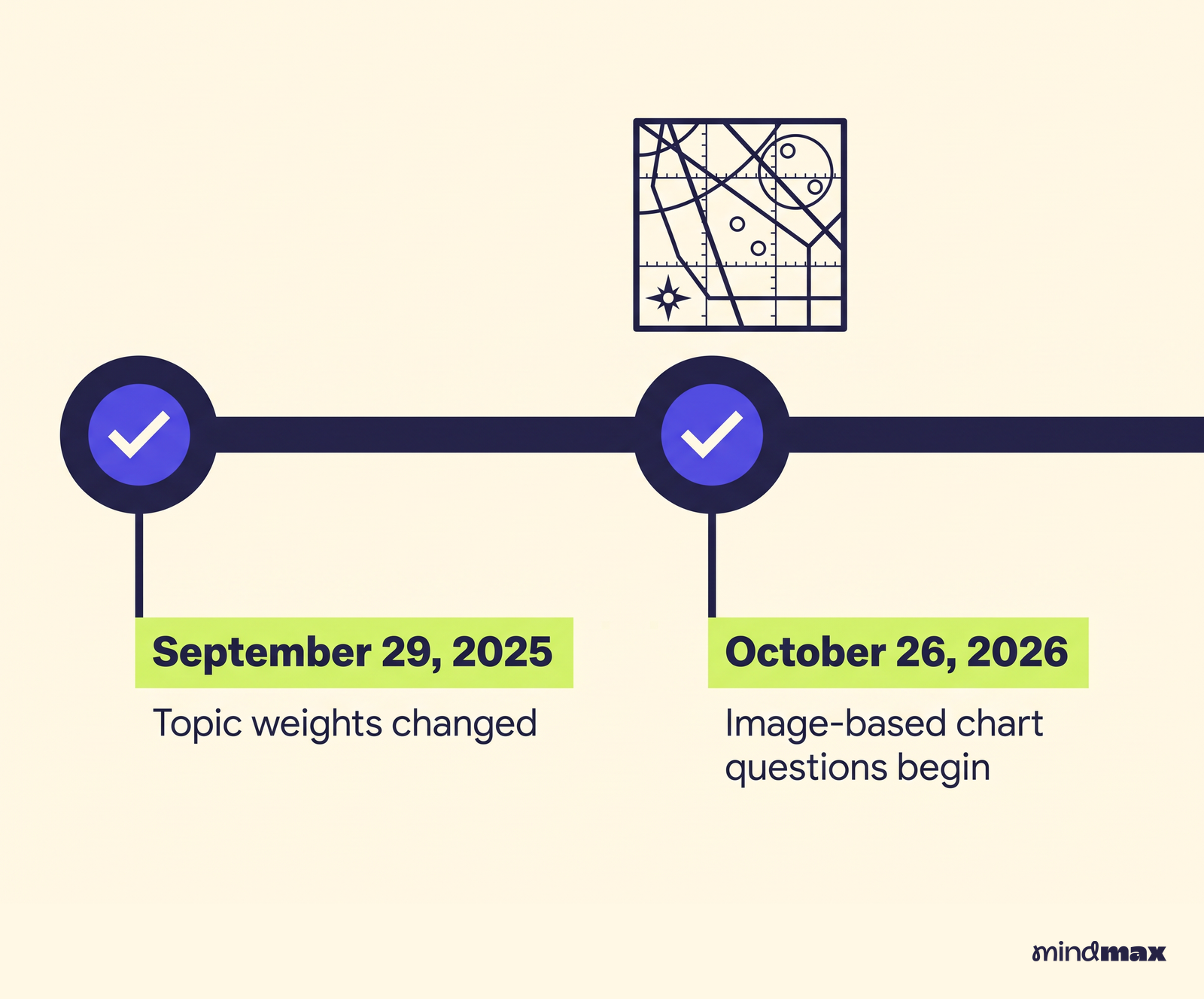
First, the topic weights changed on September 29, 2025. The FAA said this made the blueprint in the ACS obsolete, though the topics and test time stayed the same. Prep sites report the new weights as Regulations 48%, Operations 25%, Airspace 20%, Weather 5% and Loading and Performance 2%. Check those against the FAA's UAG information bulletin. Plenty of free pages still show the old blueprint. Pilot Institute's own free practice-test page lists Operations at 35 to 45% and Weather at 11 to 16%, and it still mentions a recurrent knowledge test, which no longer exists. Recurrent training is now free and online every 24 calendar months. A February 2026 candidate said the large majority of their questions were rules and regulations.
Second, image-based chart questions begin October 26, 2026. The FAA's August 2026 Airman Testing Community Advisory announcing image-based UAG questions says these images come from current sectional charts and aren't in the test supplements. They can't be previewed. The printed supplement stays for now, and no removal date has been set. The format is unchanged at 60 questions, 2 hours and 70%. Some older notices said October 27, which is outdated.
Memorizing supplement figures no longer works, so practise reading real sectionals with the free Chart Users' Guide. Beyond question banks, candidates also flag METAR and TAF reports, airport signage and drone categories 1 to 4. "The METARs hit hard," wrote one February 2026 test-taker.
Frequently asked questions
Do I need an instructor endorsement to retake Part 107 after failing?
No. The FAA testing matrix says the UAG needs no instructor endorsement. Bring your failed test report, wait 14 calendar days and pay the test fee again.
How many hours should I study for Part 107?
DPGS and DartDrones both suggest 15 to 20 hours. Most candidates judge readiness by practice scores instead, and many wait until they score above 90% consistently before booking.
Can I take the Part 107 test online from home?
The UAG is taken in person at an FAA-approved Knowledge Testing Center booked through PSI. No official source offers online proctoring for this test.
Will I still get the testing supplement on test day?
Yes, for now. The FAA says the printed supplement stays and no removal date has been set. Some chart questions now show images on screen that aren't in the supplement.
Does a Part 107 course help with recurrent training later?
You don't need one. Recurrent training is the FAA's free online course ALC-677, required every 24 calendar months, and there's no recurrent test.