
Do I Need a Part 107 License? YouTube, Real Estate and More
11 min read ·

Co-founder of MindMax and Memrise, Grand Master of Memory
Do I need a Part 107 license if my YouTube channel is monetized?
Yes, plan on it. If your channel earns ad money and you fly to make videos for it, those flights aren't "purely for fun or personal enjoyment," which is all the recreational exception covers. FAA guidance in AC 91-57D says recreational flying can't include flights "for any compensation, monetary or otherwise" or flights "in furtherance of a business." No FAA rule names YouTube, so this is a reading of the rule, but it's the one training providers give. The FAA's tie-breaker is "When in doubt, assume Part 107."
Why YouTube income counts as compensation
Pilot Institute puts it plainly in its course FAQ. You should be certified if you make money from drones, including ad income from YouTube. Some drone forum posters argue the rules never mention monetized channels by name. That's true, and it doesn't help you much. The FAA judges each flight by its purpose, and a flight made to feed a money-earning channel has a business purpose.
The same logic covers sponsorships, affiliate links and free gear in exchange for reviews. The AC says compensation can be "monetary or otherwise," so a free drone counts as much as a check.
How the FAA decides whether your flight is recreational
Most people assume the line is money. It isn't. The FAA's recreational flyers page explains that compensation is not the deciding factor, and says "Compensation, or the lack of it, is not what determines if a flight was recreational or not."
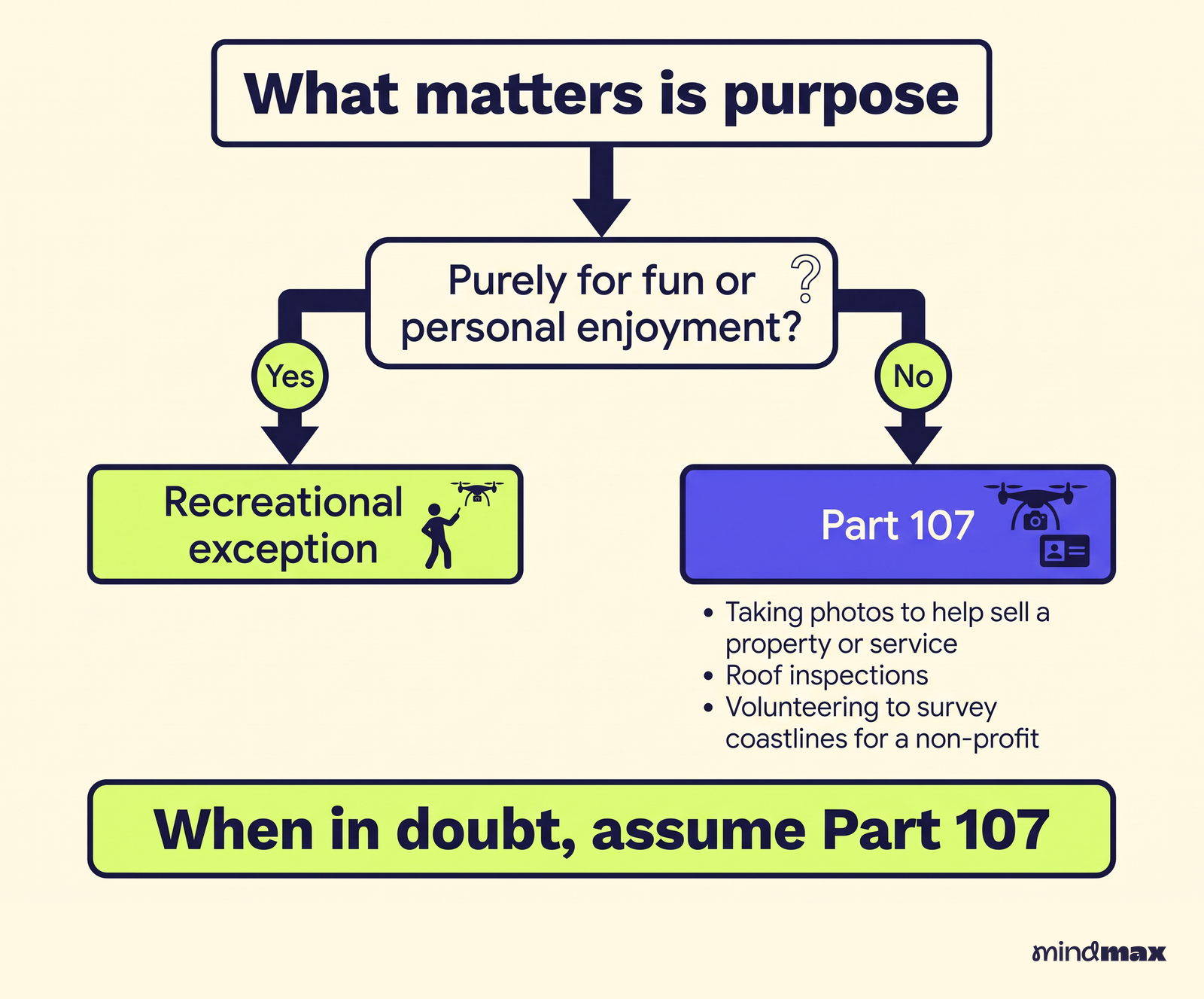
What matters is purpose. Flights made purely for fun or personal enjoyment fall under the recreational exception in 49 U.S.C. § 44809. Almost everything else falls under Part 107, which the FAA calls the default for "almost all non-recreational drone flying."
AC 91-57D, issued June 24, 2025, adds three points you should know.
- Whether a flight is recreational is decided case by case, for each operation.
- "A person may not combine recreational and commercial purposes in a single flight."
- The AC is guidance and "not legally binding in its own right," but it's how the FAA reads the law.
The FAA gives its own examples of non-recreational flights that need Part 107.
- Taking photos to help sell a property or service
- Roof inspections
- Taking pictures of a high school football game for the school's website
- Volunteering to survey coastlines for a non-profit
If you're still unsure, the FAA's recreational page links a short "What Kind of Drone Flyer Are You?" tool.
Flying recreationally doesn't mean flying with no rules. Recreational flyers must pass the free TRUST test and carry proof, register drones of 250 grams or more, follow a community-based organization's safety guidelines, keep the drone within visual line of sight, stay at or below 400 feet in Class G airspace, and get LAANC or DroneZone authorization for controlled airspace.
Edge cases at a glance
| Situation | Recreational or Part 107? | Why |
|---|---|---|
| Monetized YouTube channel | Part 107 | Ad revenue is compensation and the flight furthers a business |
| Real estate photos for a friend, unpaid | Part 107 | Helping sell a property is the FAA's own first example |
| Footage shot to sell on stock sites | Part 107 | Flying to produce footage for sale has a business purpose |
| Selling a clip from a purely fun flight later | Unsettled | No FAA guidance covers it |
| Volunteer filming for a non-profit | Part 107 | The FAA says goodwill can be non-recreational |
| School or JROTC flights for education or research | Recreational | The AC treats these as recreational |
| Paid job with a drone under 250 grams | Part 107 | Weight doesn't change the purpose test |
Real estate photos, even for free
This one is the clearest case on the list. You need Part 107 to shoot drone photos for a real estate listing, and doing it for free for an agent friend doesn't change that. The FAA's first example of a non-recreational flight is "taking photos to help sell a property," and it says outright that payment isn't what decides the category.
Think about what the flight is for. The photos exist to market a listing, which earns your friend a commission. That's a business purpose whether or not you see a dollar. Forum regulars land in the same place. As one put it, there are many forms of compensation.
The same goes for roof shots for a contractor, photos of a friend's Airbnb, or aerials for a wedding venue's website.
Selling drone footage to stock sites
If you go out and fly so you can upload clips to a stock site, you need Part 107. Under the AC, that flight is for compensation or in furtherance of a business, and you can't mix that purpose with a recreational one on the same flight.
The harder question is footage you shot purely for fun and only later decided to sell. The FAA hasn't published guidance on this. Many drone pilots argue the commercial requirement doesn't apply backward. In their view, if you fly strictly for fun and happen to catch a great shot, you aren't barred from selling it someday. That's community opinion, not FAA text.
Two practical points. First, once you start selling regularly, it gets hard to claim your flights are purely for fun. Second, the FAA evaluates each flight, so a pattern of shooting the kind of clips that sell will look like a business. If stock sales are part of your plan, get certified.
Non-profit and volunteer filming
Volunteering doesn't make a flight recreational. The FAA says "Goodwill can also be considered non-recreational," and its example is volunteering your drone to survey coastlines for a non-profit. So filming a charity run, a church event or a shelter's promo video for free should be treated as Part 107 work.
There is one carve-out. The AC treats flights by schools, colleges and JROTC programs "for educational or research purposes" as recreational. That covers students learning in a program, not a parent filming the school's football game for its website, which the FAA lists as needing Part 107.
Paid flights with a drone under 250 grams
A small drone doesn't get you out of Part 107. Weight doesn't change the purpose test, so a paid flight with a drone under 250 grams still needs a Remote Pilot Certificate.
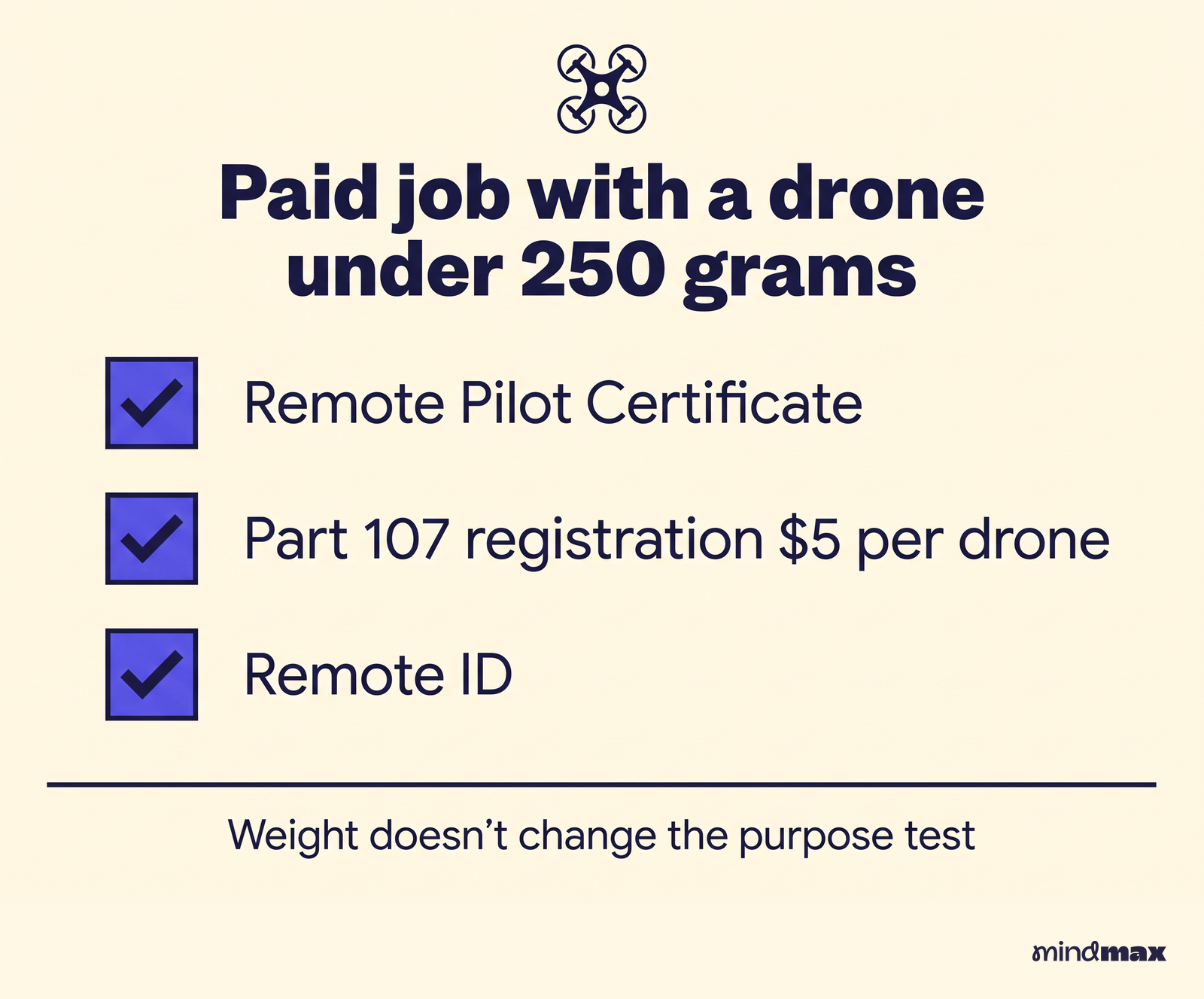
It also needs registration, which surprises a lot of people. The FAA exempts drones of 0.55 pounds or less (under 250 grams) from registration only when they're flown under the recreational exception. The AC says any small drone flown under Part 107, "regardless of weight," must have a unique registration number. Registered drones must also meet Remote ID rules.
Watch for the registration trap too. Recreational registration is $5 for all your drones for 3 years. Part 107 registration is $5 per drone for 3 years. You can't move a registration between the two, and drones registered as recreational "cannot be flown under Part 107." Before your first paid job, register each drone you'll use under Part 107.
Does anyone get in trouble for flying without Part 107?
Yes, people do get fined, though the published cases are about unsafe flying, not simply working without a certificate. In its February 6, 2026 release on 2025 enforcement, the FAA said it can fine drone operators "up to $75,000 per violation." It also said "Even if they don't have a license, the FAA can still fine them or their company."
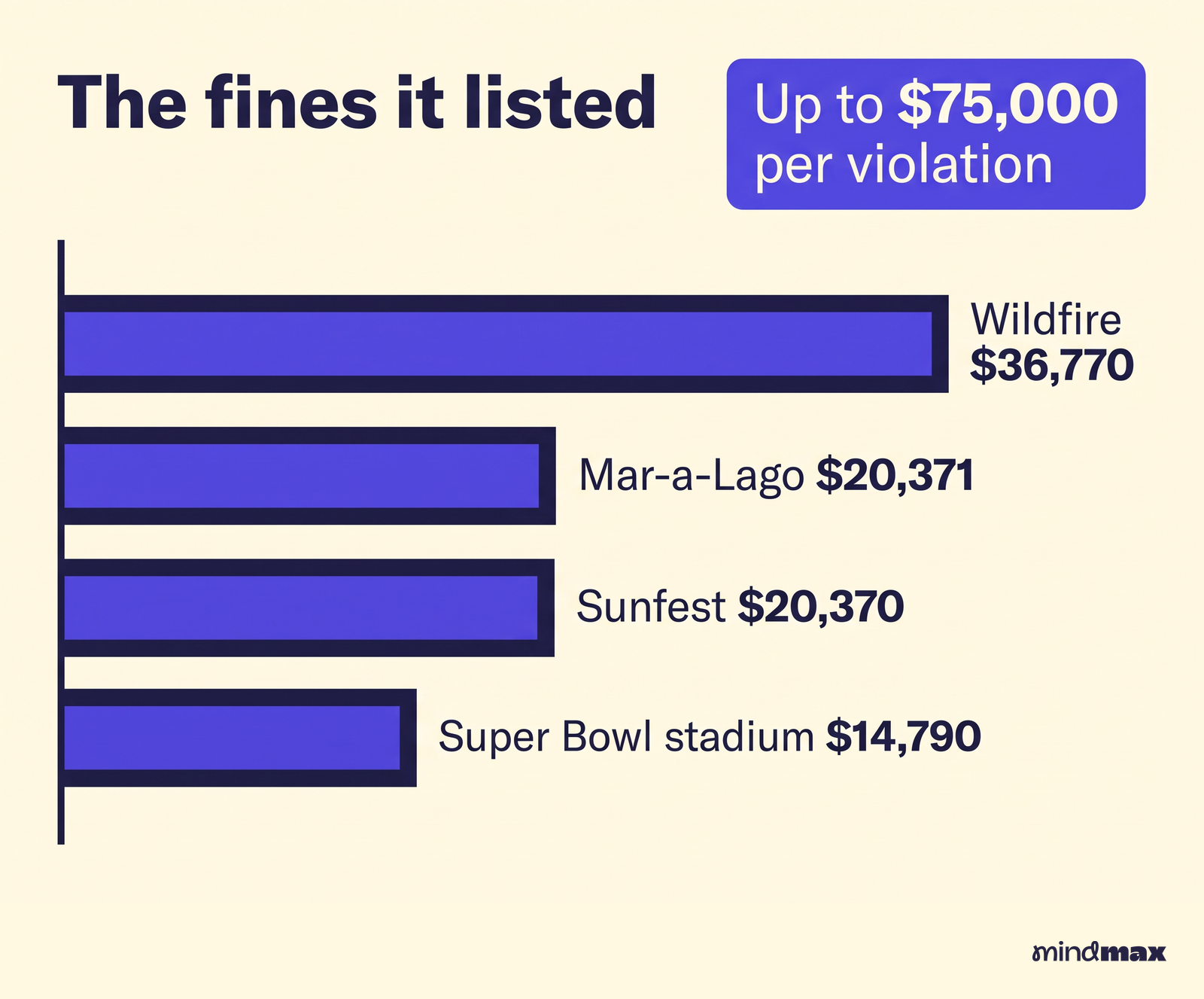
The fines it listed ran from $1,771 to $36,770 across 18 operations with violations between 2023 and 2025. Some examples.
- $36,770 for flying near emergency aircraft at a wildfire in 2023
- $20,371 for restricted airspace near Mar-a-Lago in 2025
- $20,370 for flying over people at Sunfest in 2024
- $14,790 near the Super Bowl stadium in 2023
Eight remote pilots had certificates suspended or revoked in 2025. In 2026 the FAA updated its policy to require legal action when drone operations endanger the public, violate airspace restrictions, or are conducted in furtherance of another crime.
So what about the YouTuber who never flies anywhere risky? Forum posters point out that they can't find enforcement actions over a plain monetized channel, and one summed it up as "Maybe, probably" you'd get away with it. That's true as far as published cases go. But the FAA encourages the public to report unsafe flights to the local Flight Standards District Office and says it reviews all credible reports. A neighbor's complaint or one airspace mistake on an uncertified job is how most trouble starts, and then you face it without the certificate you were supposed to hold.
Is Part 107 worth it for occasional paid jobs?
For most people taking even a few paid jobs a year, yes. The direct costs are small next to the risk.
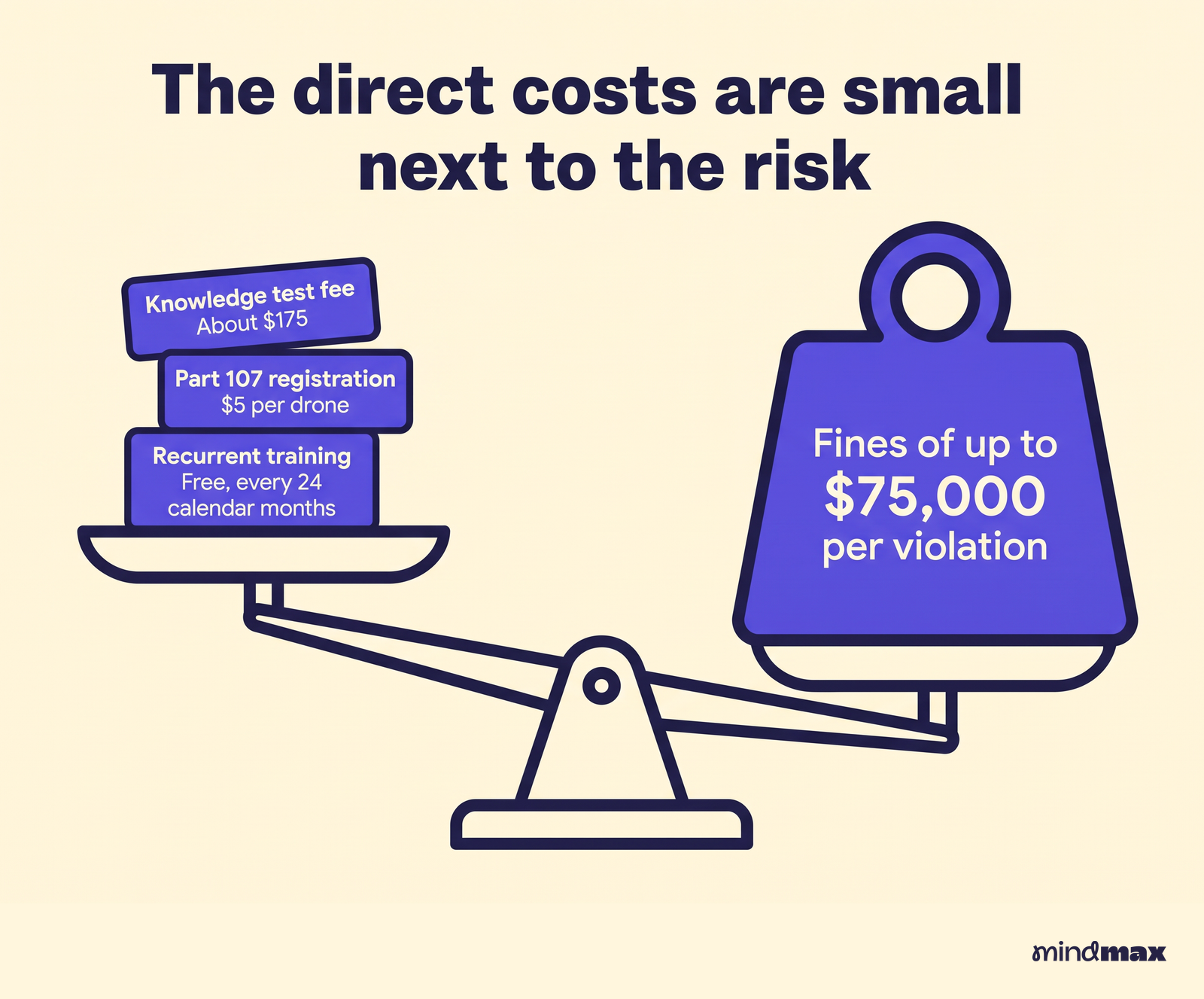
| Cost | Amount |
|---|---|
| Knowledge test fee, paid to the testing center | About $175, per prep providers |
| Part 107 registration | $5 per drone, valid 3 years |
| Recurrent training (ALC-677) | Free, every 24 calendar months |
| Prep course | Optional |
Compare that with fines of up to $75,000 per violation. Clients may also expect to see your certificate before hiring you.
What getting certified takes
You need to be at least 16, able to read, speak, write and understand English, and fit to fly safely. You create an IACRA profile for an FAA Tracking Number, book the "Unmanned Aircraft General, Small (UAG)" test with PSI, and bring a government photo ID. The test has 60 scored questions, a 2 hour limit and a 70% pass mark. If you fail, you wait 14 days to retest. For the full sequence, see our step by step guide to getting your Part 107 license.
After passing, you file Form 8710-13 in IACRA, which can take up to 48 hours to show your result, then clear a TSA background check before the temporary certificate arrives. Our guide to how long the temporary certificate takes after you pass covers that wait. Start well before your first booked job. If you already hold a Part 61 pilot certificate with a current flight review, you take the free online ALC-451 course instead of the test.
Choosing how to study
Plenty of candidates pass with the free FAA study guide and free practice tests. If you want structure, the two big paid courses both back their results.
- Pilot Institute, Part 107 Made Easy offers 15 hours of video, unlimited practice exams, a cheatsheet and a flashcard app. If you fail the first time, it promises the $175 test fee plus a full refund.
- Drone Pilot Ground School has a "3X Guarantee" that refunds the course and covers the $175 test fee if you fail after finishing the course and scoring at least 85% on 3 practice tests.
If you'd rather have a plan built around your own deadline, MindMax is an adaptive tutor app from Ed Cooke and Daniel Zohar, who built Memrise. It turns your goal of passing into short daily lessons you work through in conversation with a tutor you choose, adapting as you ask questions, whether you have months or days left. For how much study most people need, see how hard the Part 107 test is and how long to study.
Frequently asked questions
Can I post drone videos on a YouTube channel that isn't monetized without Part 107?
The FAA judges each flight by its purpose, not by whether money changes hands. A flight made purely for fun or personal enjoyment, with no business purpose, can fall under the recreational exception. If the channel promotes a business or you plan to monetize it, treat those flights as Part 107 and follow the recreational rules carefully in the meantime.
Do I need Part 107 if my employer asks me to fly a drone for work?
Yes. A flight made for your job is in furtherance of a business, even if you aren't paid extra for flying. Roof inspections and property photos are both FAA examples of flights that need Part 107.
How old do I have to be to get a Part 107 certificate?
You must be at least 16 to be certificated. The FAA testing matrix lets you take the UAG knowledge test from age 14, as long as you'll reach 16 before your test report expires.
Does a Part 107 certificate expire?
The certificate itself stays with you, but you have to stay current to use it. To act as remote pilot in command, you must have passed the test or completed the free online recurrent training within the previous 24 calendar months.
What happens if I fail the Part 107 test?
You must wait 14 calendar days before you can retest, and you pay the test fee again. You bring your failed test report to the testing center. No instructor endorsement is needed for the retake.