
NATE Certification for HVAC, Exams, Cost and Is It Worth It
11 min read ·
What is NATE certification?
NATE stands for North American Technician Excellence, the largest nonprofit certification organization for heating, ventilation, air conditioning, and refrigeration (HVACR) technicians. It shows real-world knowledge of installing and servicing systems, and NATE designs its exams for techs with at least two years in the field. It is not a license and it does not replace your EPA 608. You earn it by passing a 50-question Core exam plus a 100-question Specialty exam, or five 30-question CHP-5 exams. Exam fees are set locally, you renew every two years, and it pays off most when your employer covers the cost or rewards it.
How HVAC NATE certification fits next to your EPA 608
Your EPA 608 is the federal requirement for handling refrigerant. You need it to work on refrigerant circuits, and nothing NATE offers changes that. NATE sits on top of it as a way to show you know the systems, not just the refrigerant rules. NATE even runs EPA 608 exams through its own online proctoring.
If you're still working toward your 608, start there. Our guide on how to study for the EPA 608 exam and pass Universal first try covers that step.
RSES, an official NATE testing and training organization, calls NATE the nation's largest non-profit certification organization for heating, ventilation, air conditioning and refrigeration technicians. It's based in Arlington, VA.
Who it's for
NATE says its certification exams are designed for professional technicians with at least two years of practical experience. Treat that as a guide to who the exams suit. If you've been in the field less than a year, NATE points you to its entry-level Ready-to-Work and HVAC Support Technician certificates instead.
State and local HVAC or mechanical licenses are a separate question. They vary by state, and NATE doesn't stand in for any of them.
The NATE certification test, two pathways
You can get certified two ways. Either way, you must pass every exam in the pathway you choose.
Traditional pathway
The Traditional pathway is a 50-question Core exam plus a 100-question Specialty exam. Your specialty leads to an Installation, Service or Senior certification.
The Core exam covers these official topics.
- Safety
- Tools
- Basic Construction
- Using Basic Science
- Achieving Desired Conditions
- Taking Temperature and Humidity Measurements
- Basic Electrical
CHP-5, five shorter exams
The Certified HVAC Professional pathway, called CHP-5, splits things into five 30-question exams. They are HVAC Fundamentals, Electrical and Controls, Comfort and Airflow, Installation, and Service.
You can take them in any order, though NATE recommends the order listed. You can take up to six months between each exam, which helps if you'd rather study one chunk at a time around a full work week. NATE has said the Traditional pathway is not being removed, so you can still choose two longer exams if you prefer.
Which specialties you can choose
RSES lists 21 NATE installation, service and senior tests. They span Air Conditioning, Air Distribution, Heat Pumps, Gas Furnaces, Oil Furnaces, Hydronics Gas, Hydronics Oil, Light Commercial Refrigeration, Commercial Refrigeration and Senior HVAC Efficiency Analyst.
Heat Pump is worth a close look. NATE's Heat Pump Service and Installation certifications are recognized by the U.S. Department of Energy as Energy Skilled in Heat Pump Installation and Heat Pump Comfort Advisor.
NATE also runs a few other exams.
- Senior Level Efficiency Analyst. You must already hold two Service specialties in approved combinations, such as AC plus AD, GS, OL, HG or HO. This one is open book.
- Low-GWP Refrigerants certification. It has its own study guide.
- Ground Source Heat Pump Loop Installer. Run jointly with IGSHPA, it gives a 3-year certification.
- HVAC Performance Verifier. Discontinued after December 31, 2023.
How you take the NATE test
Every NATE exam except Ready-to-Work must be proctored. You sit it either at a Testing Organization near you or from home through NATE's Live Online Proctoring, known as LOP. Paper and online tests are both offered, and NATE says offerings and pricing vary by location.
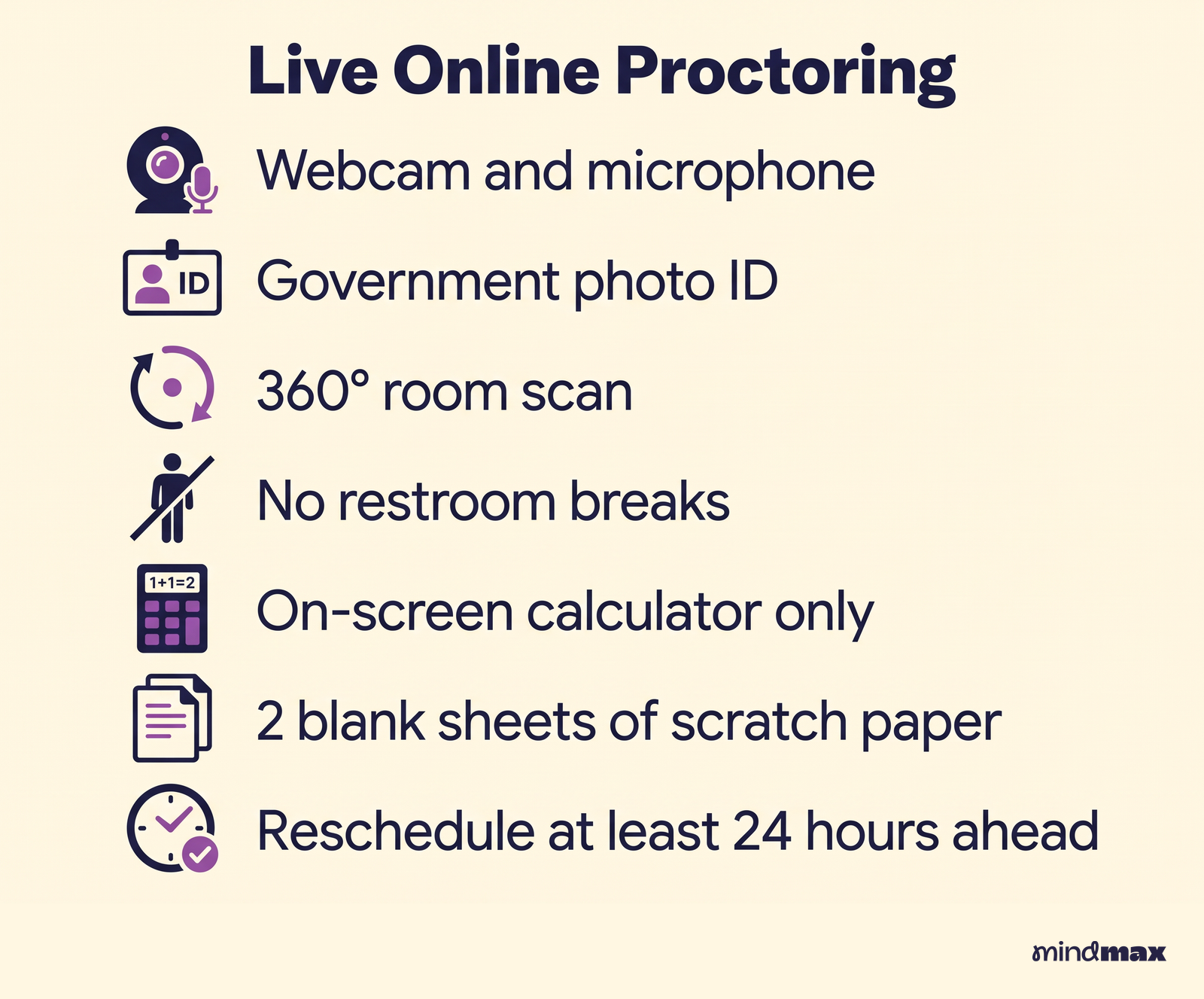
LOP is ordered through your myNATE account and delivered by Meazure Learning / ProctorU. Online exams include Core, Core in Spanish and most of the main Service and Installation specialties.
The home setup is strict. You need a computer with a webcam and microphone. Chromebooks, tablets, iPads and dual monitors are not allowed. Have your government photo ID ready, because you'll show it, and expect to do a 360° room scan before you start. There are no restroom breaks. You get the on-screen calculator only, plus 2 blank sheets of scratch paper. If you need to move your slot, reschedule at least 24 hours ahead, because no-shows are not refunded.
Before you book, ask your testing organization for the passing score and time limit of the exams you plan to take, so test day holds no surprises.
How much does it cost to get a NATE certification in HVAC?
There's no single price. NATE doesn't publish one exam fee. Testing Organizations set their own in-person fees, and for online exams NATE tells you to check the LOP tab of your NATE account for current pricing.
For a rough idea, prep sites give unofficial estimates of $130 to $200 for Core, $130 to $250 per Specialty, and about $300 to $500 for Core plus one Specialty. These are not NATE's figures, so confirm your real price before you budget around them.
CHP-5 means five exams instead of two, so its total is likely to run higher, but NATE publishes no price for it either.
Then add the ongoing cost. Renewal runs $30 plus 16 CEHs every two years if you go the continuing education route. Study guides and online courses are extra, and you'll need to check those prices with the seller.
The cheapest NATE certification is the one your employer pays for. Ask before you spend a dollar.
What renewal costs every two years
NATE certifications must be renewed every two years. You renew by submitting 16 continuing education hours, or by retaking the specialty exam only, before your two-year period ends.
If you renew with CEHs, NATE's fees are set out on its Policies and Fees page for recertification.
| Renewing with CEHs | Fee |
|---|---|
| First specialty | $30 |
| Hydronics Gas | $25 |
| Two specialties together | $35 |
| Three specialties together | $40 |
| Four specialties together | $45 |
| Five or more | $5 each |
Two renewals come bundled at no extra cost. Heat Pump renewal includes AC, and Service renewal includes Installation. If you renew by retesting instead, the Testing Organization sets that fee.
Don't let it lapse. To become NATE-certified again after it expires, you must retake both the Core (if required) and the specialty tests. NATE calls claiming NATE status after it expires fraudulent and unethical.
Is the NATE cert something you should strive for?
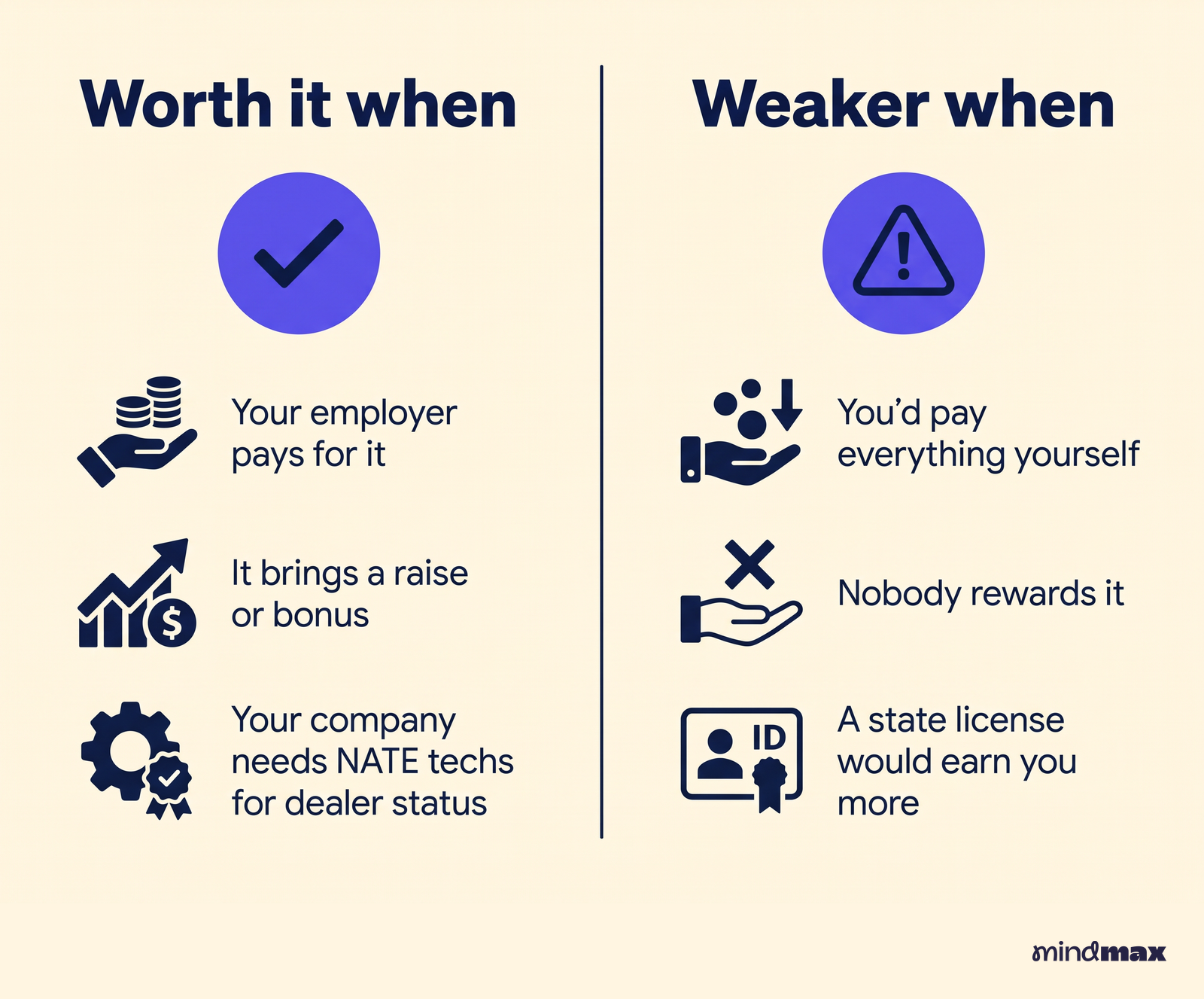
It depends on where you work. NATE is worth it when your employer pays for it, when it brings a raise or bonus, and when your company needs NATE techs for dealer status. It's weaker when you'd pay everything yourself, nobody rewards it, or a state license would earn you more. Employers, contractors, and manufacturers can value it for credibility, and higher pay potential.
The evidence from techs on r/HVAC is mostly from threads a few years old, but the pattern is clear.
Where it pays
One tech said it got them a $2 to $3 an hour raise and their company covered it. The company paid for the first test and the CE classes, so they just pay $30 every two years. Others report about a dollar an hour raise for each test, or a $100 per certification incentive.
The bigger driver is often dealer status. Some techs say their supplier gives equipment discounts when the company has enough NATE certified technicians, and that Carrier wants a certain number of NATE techs for better equipment deals. If your shop is in that position, your certification has real value to them, and that's leverage for a raise.
Where it doesn't
Many experienced techs are skeptical. Some job listings say NATE preferred, but most employers don't care. Plenty of techs work for years with a 608 and nothing else.
Upkeep puts people off too. Credit classes take time, and some techs let NATE lapse to put that money toward maintaining a state license, which they see as paying more.
The part people undervalue
The studying itself. One tech said nobody ever asked about their NATE certification, but they got a good job because of things they learned for that test. If you're two years in and want to fill gaps in electrical, airflow or diagnostics, the exam gives you a structured reason to do it.
A fair rule. If your boss pays and rewards it, go for it. If you'd pay everything with no raise, weigh it against a state license first.
How to prepare for the NATE exams
Start with NATE's free Knowledge Areas of Technician Expertise, the KATEs. These are official topic outlines for each exam, and they make the best study checklist you'll find.
From there, your main options are these.
- NATE study guides. Paperback guides for Core and Specialty and for CHP-5, with practice questions at the end of each chapter. There's a separate Low-GWP guide.
- NATE Training Academy, run with Interplay Learning. On-demand online courses with field-like 3D and VR simulations, videos and knowledge checks, covering Core, Specialty and CHP-5.
- RSES. Local chapters run training and exams, and RSES offers recertification programs. You can also use RSES courses toward your CEHs.
- NATE Recognized Training Providers. In-class training you can find through NATE's locator.
Some techs also mention prepping on SkillCat or with ESCO Institute material. Check what each actually covers for NATE before you rely on it.
Match your specialty to the work you do every day. You'll study faster when the material is stuff you touch on every call, and the certification will mean more to the employer you already work for. One tech reported passing CHP-5 on the first go, with the boss paying.
Before you sign up, a short checklist
- Ask your employer whether they pay exam and CE costs, whether there's a written raise or bonus, and whether NATE counts toward manufacturer dealer status.
- Pick a pathway. Traditional is two long exams. CHP-5 is five short ones with up to six months between them.
- Pick a specialty that matches your daily work. Heat Pump carries DOE recognition and its renewal covers AC.
- Find your local price through NATE's testing organization locator or the LOP tab in myNATE.
- Budget for renewal, 16 CEHs plus $30 every two years, and put the deadline on your calendar.
- Download the KATEs for your exams and study against them.
- Check your state or local license rules separately, since NATE doesn't cover them.
If you're weighing where NATE fits in your longer career, our piece on whether trade school for HVAC is worth it or you should apprentice covers the earlier steps of the path.
Frequently asked questions
Can I take NATE exams with less than two years of experience?
NATE says its certification exams are designed for technicians with at least two years of practical experience, which reads as guidance rather than a hard rule. If you have less than a year in the field, NATE steers you toward its entry-level Ready-to-Work and HVAC Support Technician certificates. Check with your testing organization if you're unsure whether you can register.
Does NATE certification count as an HVAC license?
No. NATE is a voluntary industry certification, not a license. State and local HVAC or mechanical licenses are separate, vary by state, and have their own requirements. Check your state's licensing board for what you need to work legally.
Can I take my EPA 608 exam through NATE?
Yes. NATE offers EPA 608 exams through its Live Online Proctoring, ordered in your myNATE account. The 608 is still a separate federal certification, and passing a NATE specialty does not give you one.
Which NATE specialty should I take first?
Pick the one that matches the work you do most days, since you'll study faster and your employer will value it more. Heat Pump is a popular choice because the DOE recognizes it and renewing Heat Pump also covers your AC certification. Use the free KATEs to see what each specialty covers before you decide.
Is CHP-5 easier than the traditional NATE pathway?
It isn't easier in content, it's just split up differently. CHP-5 is five 30-question exams you can space up to six months apart, while the traditional route is a 50-question Core and a 100-question Specialty. CHP-5 suits techs who want to study one chunk at a time, though five exams will likely cost more in total.