
How Long to Study for the NCLEX-RN After Graduating
13 min read ·

Co-founder of MindMax and Memrise, Grand Master of Memory
How long should I study for the NCLEX-RN after graduating?
Most new grads study for the NCLEX-RN for 3 to 6 weeks after graduating, at 2 to 5 hours and 50 to 100 practice questions a day. Six weeks at 2 to 3 hours a day suits most recent grads. Three to four weeks works if you can study like it's a full-time job. If you work full time, plan on about 9 weeks. If you've been out of school for years, plan on several months and check your board's rules first. Whatever you choose, test early in your ATT window.
What the exam itself tells you about study time
There is no official study timeline. NCSBN, which runs the exam, says it "does not recommend or endorse any review courses or study materials." What it does tell you is who the exam is written for, "a newly licensed nurse with no more than 12 months of nursing experience." You aren't expected to know everything. You're expected to think like a safe new nurse.
The exam you'll sit runs on the 2026 NCLEX-RN Test Plan, in force from April 1, 2026 through March 31, 2029. It's adaptive, it gives you 85 to 150 items, and you get 5 hours including the tutorial and all breaks. That length matters for your plan, because your stamina has to last the full 5 hours even if the exam might stop early.
Two weeks is a real option too, but mostly for repeat takers or people who have already done a full review. The sections below cover each situation in turn.
How many NCLEX practice questions should I do a day?
For most people, 50 to 100 a day is the working range. Doing them well matters more than the number.
Here's what the common targets look like.
- UWorld's free study plans (updated 2026) range from 50 to 75 a day on the 9-week plan up to 85 to 150 a day on the 2-week plan.
- Kaplan suggests 75 questions a day from its Qbank, according to candidates who use it. One instructor told a student to do "100/day till I test."
- Candidates on Reddit often say "Aim for a minimum of 60 questions a day. If you're feeling off, at least do 30."
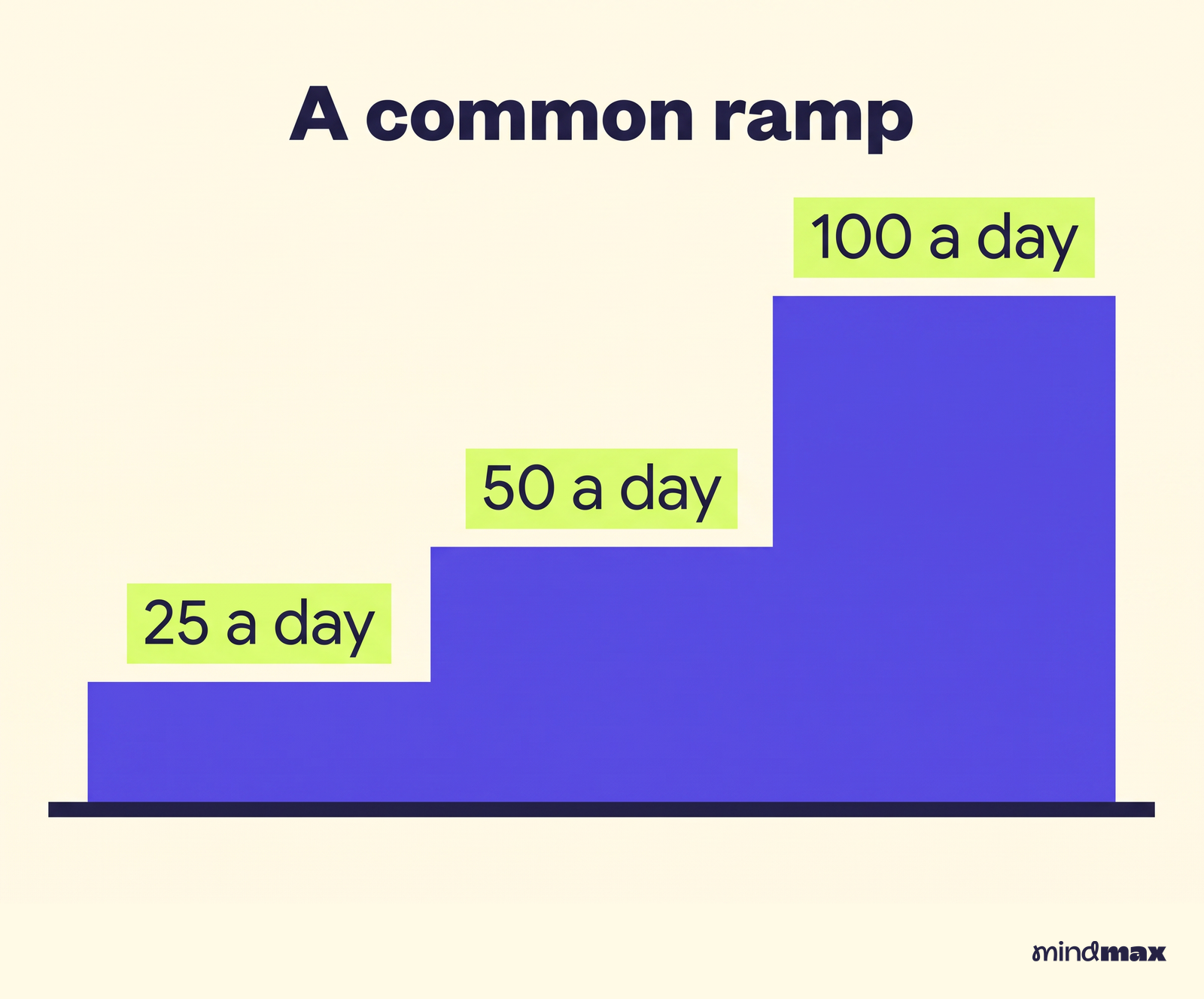
Don't start at 100 if you haven't touched a question bank yet. A common ramp is 25 a day, then 50 a day, then 100 a day. One candidate on a 7-week plan started at about 30 a day and read every rationale.
Rationales are where the learning happens
A set of 75 questions with careful review can take 4 to 6 hours. That's normal. One retaker who passed did 75 questions a day in untimed tutor mode and took notes on every single one. If you're rushing through 150 a day and skimming the explanations, cut the number and slow down.
Use your scores to steer, not to panic
Prep companies set their own readiness markers. UWorld points to QBank scores of 75%. Many candidates treat anything under 60% in a content area as a weak spot to drill. These are provider and community rules of thumb, not NCSBN standards. Near the end of the real exam you'll usually get items you have about a 50% chance of answering fully correctly, so practice that feels hard is a fair rehearsal.
Is 3 weeks enough, or should I do 6 weeks?
Three weeks is enough if you can study 3 to 5 hours a day with no job in the way, and your content knowledge is solid. Six weeks is the safer choice for most recent grads, because it gives you room to fix weak areas and still have a final week of timed practice.
UWorld's free plans are the clearest public guide to these choices. Here's how they compare.
| Plan length | Hours a day | Questions a day | Who UWorld says it suits |
|---|---|---|---|
| 2 weeks | 4 to 6 | 85 to 150 | Repeat takers or people who've already done a full review |
| 3 weeks | 3 to 5 | 75 to 120 | Recent grads treating prep "like a full-time job" |
| 4 weeks | 3 to 5 | 50 to 100 | "the gold standard for dedicated recent graduates" |
| 6 weeks | 2 to 3 | 60 to 85 | "the sweet spot for recent nursing graduates" |
| 9 weeks | 2 | 50 to 75, with 2 rest days a week | People working part-time or with family commitments |
UWorld is blunt about the shortest plan. If you're a first-time test-taker who hasn't opened a QBank yet, it says to start with the 4-week plan instead.
Candidates' own stories match this range. Plenty passed after two weeks of 3 to 5 hours a day. Others did about a month at 3 to 4 hours. On the other side, one repeat taker wrote, "I felt like I wasn't prepared at all with those short three weeks."
The cost of guessing wrong is real. A failed attempt means a new registration and a new fee, plus a wait before you can test again, commonly cited as 45 days. Check the current NCLEX Candidate Bulletin for the exact rule. Repeat takers also pass at much lower rates than first-timers. So if you're torn between 3 and 6 weeks, lean longer unless you have a strong reason not to.
How soon after graduation should I take the NCLEX?
Sooner is better, as long as you've done a real review. The strongest evidence comes from NCSBN itself. In NCSBN's study of lag time and NCLEX pass rates, covering 176,539 RN exams, researchers found that RN candidates tested on average 34.79 days after becoming eligible, and that "lag time is inversely related to candidates' pass rate." The longer people waited, the lower their pass rate.
That data covers July 2006 to June 2008, so it's old, and the authors are careful. They say "a delay in taking the NCLEX does not cause a candidate to fail." Less-confident people may simply choose to test later. Still, their advice was clear. Candidates "should be encouraged to schedule and take the examination earlier rather than later in the eligibility period." They also warned that unless you're practicing nursing in some way, your knowledge may decline over a long gap.
Waiting until you feel ready has its own trap. In an NCSBN survey of eligible candidates who never tested, the top reason was not feeling confident they could pass. Another 15% said their authorization to test had expired. A plan with a booked date beats a plan that waits for confidence.
How many total practice questions should I finish before the NCLEX?
No official source sets a total. UWorld's weekly targets add up to roughly 1,500 to 3,000 questions overall, and that's a sensible goal for most first-time takers.
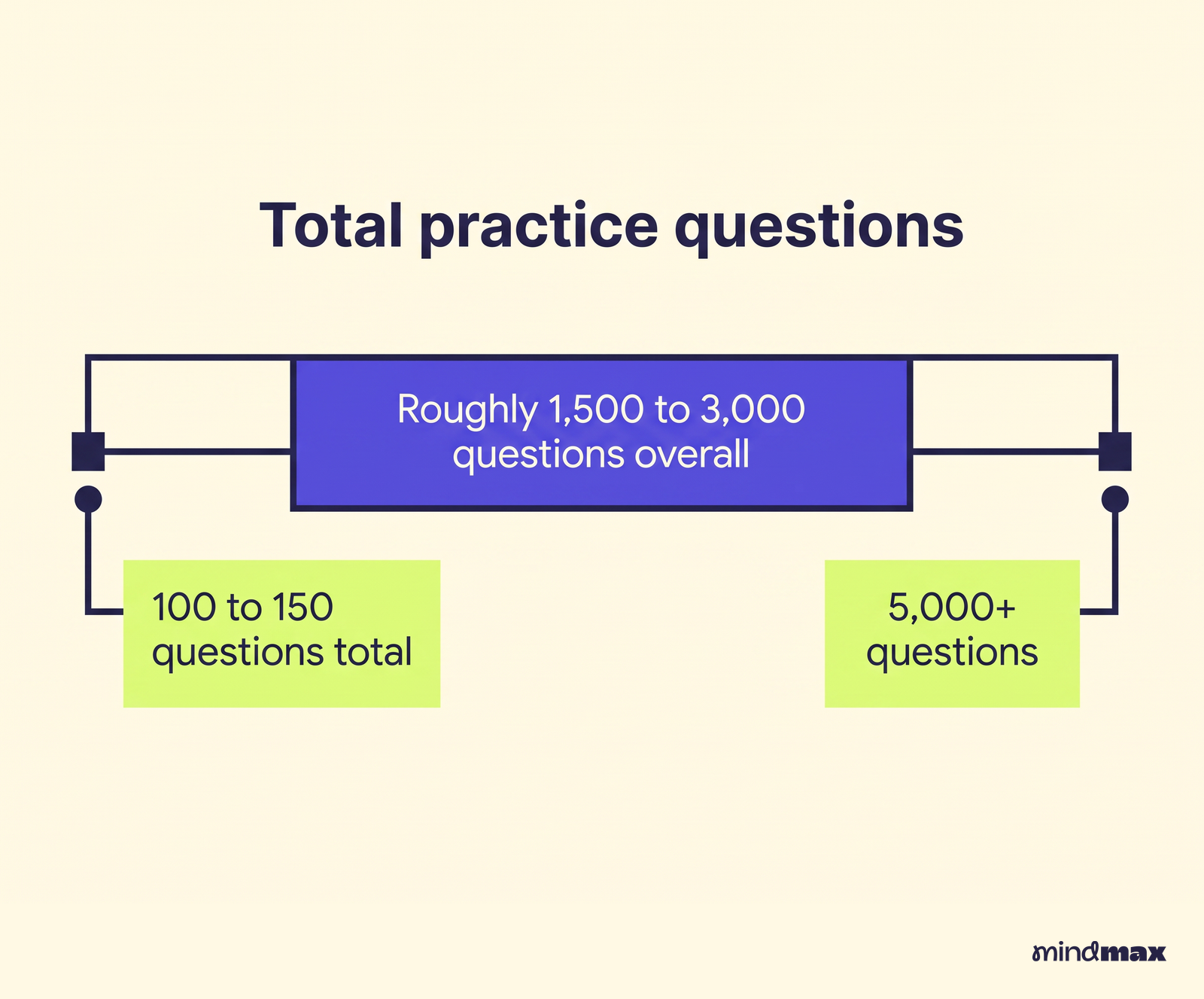
Candidates land all over the map.
- A common piece of advice on allnurses is to "go through 1500-2000 questions and rationales before your test."
- One candidate studied 4 weeks, did about 2,000 questions, and passed.
- Some report 4,000 or 5,000+ questions.
- One new grad did only 100 to 150 questions total on an app and passed at 90 items. Don't plan around that.
If you finish a question bank early, don't rush to buy a second and third one. Retakers say again and again that what helped was fewer resources, done properly. Redo the ones you missed and review the rationales you still can't explain in your own words.
How to study for the NCLEX while working full time
Plan on about 9 weeks at 2 hours a day. That's UWorld's plan for people with a job or family commitments, at 250 to 375 questions a week with 2 rest days built in. It's slower, but it adds up to the same total range as the shorter plans.
Here are some ways to make it work around shifts.
- Pick one fixed block. Two hours before or after work, every workday, is easier to protect than "whenever I get time."
- Put your longer sessions on days off. Use them for content review of weak areas and the occasional longer timed set.
- Keep the rest days. Two a week stops burnout from eating your last few weeks.
- Do your full-length practice on a day off. You need to know how you feel at hour four.
It can be done. One candidate took the exam about a month after graduating while working full time as a graduate nurse. Another, 8 years out of school, passed the NCLEX-PN on her first try after 3 months of study while working two jobs, 60 or more hours a week. She booked the test 12 weeks out and worked back from the date. That's a PN story, but the approach carries over.
If your hours are tight, short lessons that fit around shifts help. MindMax builds a daily study plan around your exam date in bite-sized lessons, whether you have months or days left, and its NCLEX-RN course follows the 2026 Test Plan.
I've been out of nursing school for 8 years. How long should I study for the NCLEX?
Plan on several months, not weeks. One candidate who was almost 8 years out and had failed at 150 questions recommended about 5 to 6 months of study. Others with long gaps report about 3 months of part-time study.
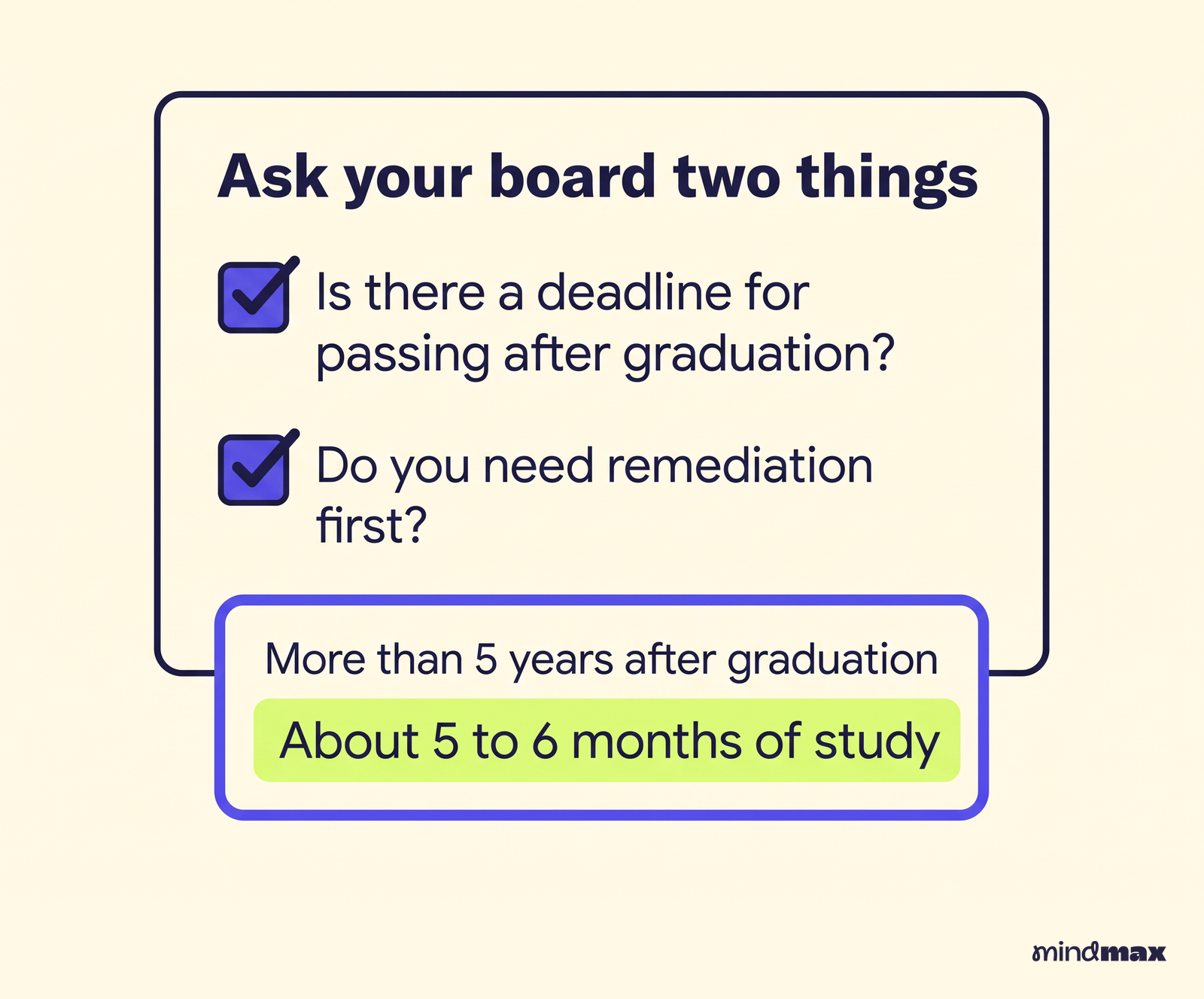
Before you plan any timeline, call or email your board of nursing. Rules vary by state, and NCSBN says it "does not maintain a list of requirements for each NRB." Ask your board two things.
- Is there a deadline for passing after graduation?
- Do you need remediation first?
West Virginia is one example of how far this can go. A first-time RN applicant testing more than 5 years after graduation must complete two activities before the board will issue an ATT. One is either a self-study plan submitted to the board or a formal NCLEX review course finished in the past 12 months. The other is either 10+ hours of tutoring with an MSN-prepared RN or a nursing science or pharmacology course passed with a C or better. Your state may have nothing like this, or something stricter. Ask before you buy a course, because your board may specify which kind counts.
For your study plan, start with content review before you lean on question volume. Eight years is long enough for drug names, lab ranges and priority frameworks to fade. Begin at 25 to 30 questions a day, build up, and save the heavy question weeks for the second half.
Is it too early to start studying for the NCLEX in my last semester?
No. As one allnurses veteran put it, you technically study for the NCLEX all through your program, and most students start a dedicated review shortly after graduation or even shortly before. One candidate started UWorld about 6 months before graduation and took the NCLEX a week after classes ended.
In your last semester, a light load works well. Try 20 to 30 questions a few days a week, focused on what your classes are covering. Save the full daily plan for after finals.
The bigger win is paperwork. Your board application and your Pearson registration are separate steps, and your ATT only arrives after the board makes you eligible. Your Pearson registration stays open 365 days waiting for that eligibility, so registering in your final semester gives you a head start. Check your own board's timing for when you can apply.
A sample 6-week NCLEX-RN study schedule
This follows UWorld's 6-week pacing of 2 to 3 hours and 60 to 85 questions a day, with a gentler start. Adjust the topics to your weak areas.
| Week | Daily questions | Focus |
|---|---|---|
| 1 | 30 to 50 | One or two body systems a day, tutor mode, notes on every rationale |
| 2 | 50 to 60 | Finish the systems, add pharmacology every day |
| 3 | 60 to 75 | Mixed sets, priority and delegation, first readiness assessment |
| 4 | 75 to 85 | Mixed timed sets, case studies, drill any area under 60% |
| 5 | 75 to 85 | Timed sets, second readiness assessment, review weak systems |
| 6 | 50 to 60 | One full-length timed practice exam early in the week, light review, rest the day before |
A few notes on the plan.
- Mix question styles every week. The exam includes three case studies with six items each, plus stand-alone clinical judgment items. Select-all-that-apply and priority questions are the ones candidates name most.
- Pharmacology deserves daily time. Pharmacological and Parenteral Therapies is about 16% of the 2026 Test Plan, second only to Management of Care at 18%.
- Practice the full length. The exam can run all 150 items. Candidates who panicked when it didn't stop at 85 say it hurt their performance. Read what it means when the NCLEX shuts off at 85, so the count doesn't rattle you on the day.
If you're a repeat taker, this layout still works, but build it around your Candidate Performance Report. Our CPR and 45-day retake plan covers that in detail.
Count your timeline back from your ATT
Your real deadline is your Authorization to Test. Once the board makes you eligible and the ATT arrives, you must test within its validity dates. NCSBN says the average ATT lasts 90 days, the window varies by board, and the dates "cannot be extended for any reason." If it expires, you register and pay again.
So the order runs like this. You apply to your board, register with Pearson, wait for the ATT, then schedule. Build your study plan so your planned test date falls early in that window, with room to move it if you get sick.
If you do need to move it, cancel more than 24 business hours before your appointment. Miss that cutoff or don't show up and you lose the fee. There are no refunds for any reason.
Watch the fee date too. The registration fee is $200 in the US now. From Feb 1, 2027 it rises to $350 in the US and Australia, and to $570 CAD in Canada. The fee depends on the date you register, not the date you test, and retakes cost the same. If you graduate this winter, registering before Feb 1, 2027 saves you $150.
Frequently asked questions
Should I take a break after graduation before I start studying for the NCLEX?
A short break is common and usually fine. Many candidates take a week or two off, then do about 4 weeks of focused review. Keep it short, because NCSBN's research found pass rates drop the longer candidates wait after becoming eligible.
Can I reschedule my NCLEX if I don't feel ready?
Yes, as long as you cancel more than 24 business hours before your appointment and still test within your ATT dates. If you cancel later or don't show up, you lose the fee. The ATT dates themselves can't be extended, so a new date has to fit inside your current window.
Should I use more than one NCLEX question bank?
Most people do better with one bank done thoroughly. Retakers often say their fix was cutting back to a single question bank and reviewing every rationale. Add a second resource only for a specific weak area, such as a prioritization and delegation book.
How long do internationally educated nurses study for the NCLEX-RN?
IENs often report about 6 weeks to 3 months of study, sometimes with longer days in the final week. The exam is only one step in a longer process that can include credential evaluation, English testing and a visa. Check your target board of nursing for its requirements before you set a test date.
Do I need to study the night before the NCLEX?
Light review is fine, but a heavy session the night before rarely helps. Many sample plans keep the last day for rest. You need to be fresh enough to concentrate for up to 5 hours, including breaks.