
Real Estate Exam Explained, Questions and Passing Score by State
11 min read ·

Co-founder of MindMax and Memrise, Grand Master of Memory
How does the real estate exam work?
There is no single national real estate exam. Each state sets its own real estate license exam for new salespeople. In most states, Pearson VUE or PSI runs it in two parts, a national portion with 80 scored questions and a state law portion, and you pass each separately. California and New York write one combined state exam. Pass marks usually fall between 70% and 75%. Most states test you in person, though Pennsylvania lets you test online at home.
How many questions are on the real estate exam?
You'll hear it called the realtor exam, the salesperson exam or the sales agent exam. It's the same test, the one that makes you eligible for your first license. The figures below apply as of late 2026, and your own state's candidate handbook always has the final word, so check it before you book.
The question count depends on your state. A national plus state exam usually means 80 to 85 national items and 40 to 60 state items. California's single exam has 150 questions. New York's is shorter.
The national portion
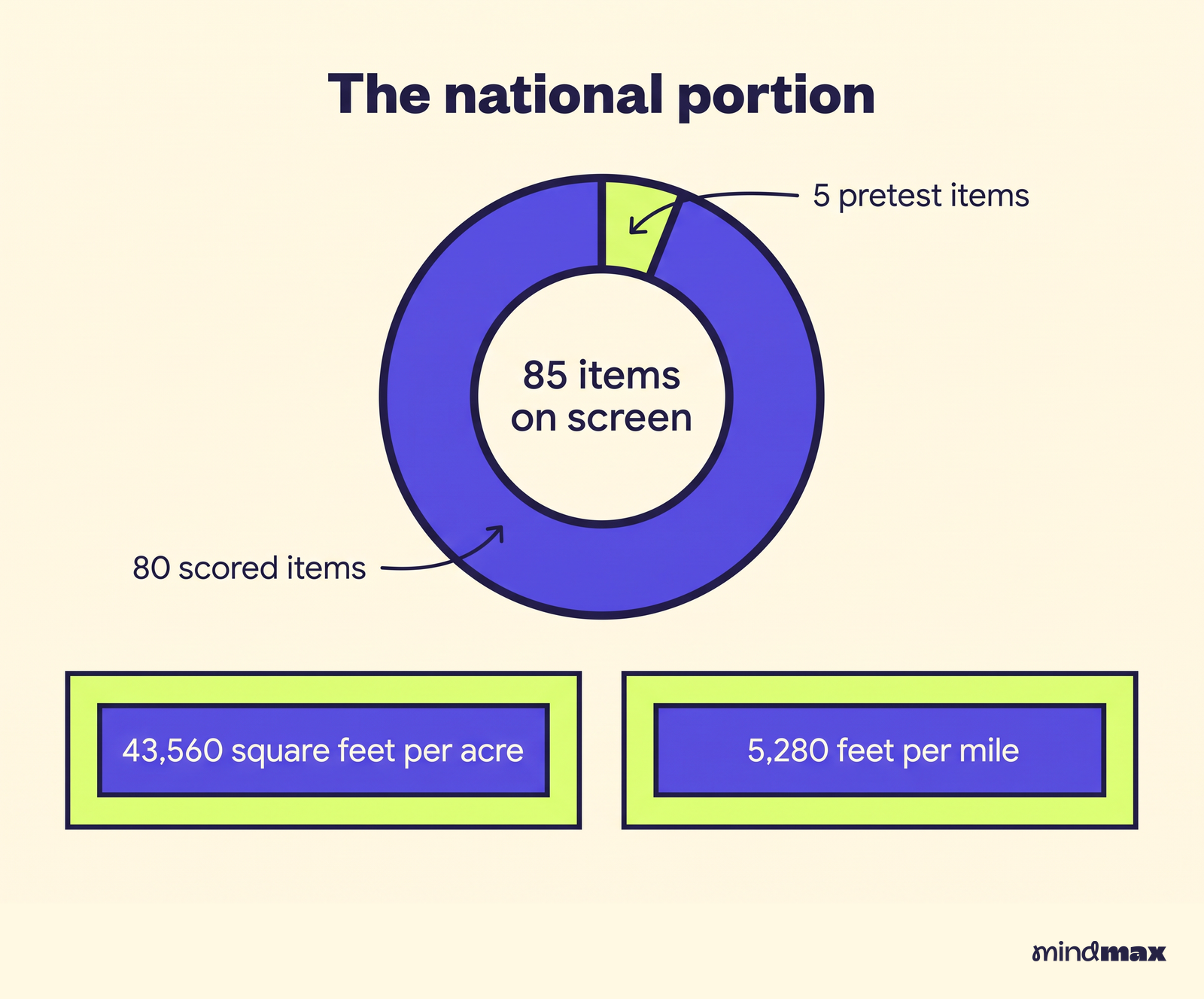
In Pearson VUE states, the national portion follows one shared content outline, which took effect June 1, 2025. It has 80 scored items plus 5 pretest items that don't count, so you see 85 items on screen. The pretest items look exactly like the scored ones, and you can't tell them apart, so answer every question. Each item is written to test knowledge, application or analysis.
Here is how the 80 scored items split across topics, according to the Pearson VUE national salesperson content outline.
| Content area | Scored items |
|---|---|
| Real Estate Contracts and Agency | 16 |
| Real Property Characteristics, Legal Descriptions, and Property Use | 11 |
| Property Value and Appraisal | 11 |
| Real Estate Practice (including Fair Housing) | 10 |
| Forms of Ownership, Transfer, and Recording of Title | 9 |
| Property Disclosures and Environmental Issues | 9 |
| Financing and Settlement | 7 |
| Real Estate Math Calculations | 7 |
| Total | 80 |
Compared with the 2020 outline, Real Estate Practice dropped from 14 items to 10. Property characteristics rose from 9 to 11, and ownership and disclosures each went from 8 to 9. If your study book still shows the old split, it was written before the change.
Math is only 7 items, but two facts aren't supplied at the test center. You need to memorize 43,560 square feet per acre and 5,280 feet per mile. Proration questions tell you whether to use a 360 or 365 day year.
State portions and single state exams
| State | Format | Questions | Time | Pass mark | Exam fee |
|---|---|---|---|---|---|
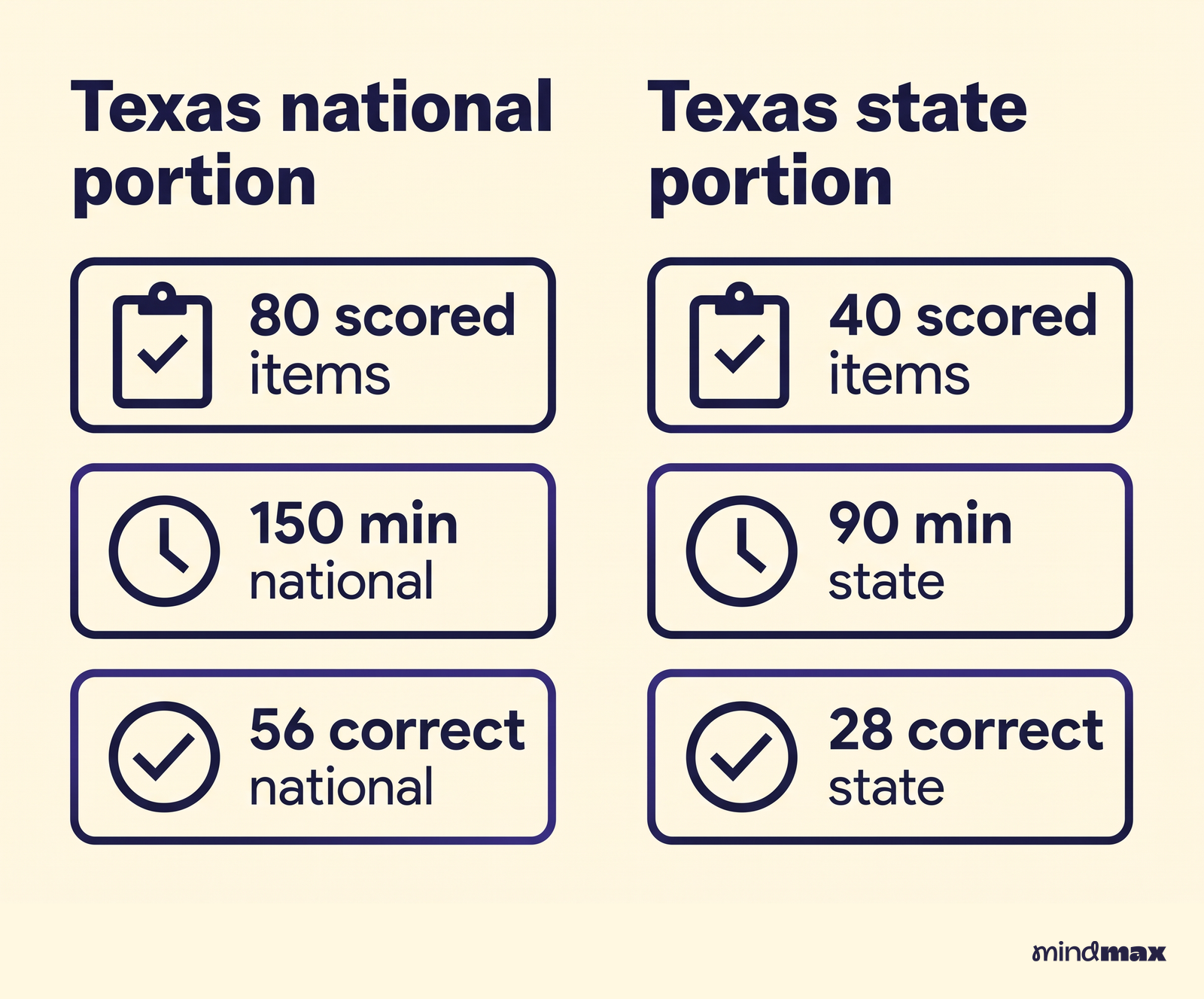
| Texas | National + state | National 85 (80 scored), state 50 (40 scored) | 150 min national, 90 min state | 56 correct national, 28 correct state | $58 |
| Pennsylvania | National + state | National 80 scored, state 40 scored, plus 5 to 10 pretest items each | 150 min national, 60 min state | 75% on each, scaled | $52 national, $49 state |
| California | One state exam | 150 | 3 hours | 70% (105 correct) | $100 |
| New York | One state exam | 75 (unofficial) | 90 minutes | 70% (unofficial), pass or fail only | $15 |
| Florida | One exam | 100 (unofficial) | 3.5 hours (unofficial) | 75% (unofficial) | Check official page |
A few details the table can't hold.
- Texas. The current handbook (rev 08/2026) lists 125 items for taking both portions, but 85 plus 50 is 135, which also matches the pass marks. Expect 135 items across 240 minutes.
- Pennsylvania. Because each portion carries 5 to 10 pretest items, the number on your screen can vary. Taking both portions together costs $52.
- California. The current DRE page says 3 hours, though some older prep material says 3 hours 15 minutes. Every question has four answer choices. The broker exam is 200 questions in 4 hours with a 75% pass mark.
- New York. The Department of State confirms the 90 minute limit, the $15 fee and that the exam is based on the 77-hour pre-licensing course. The question count and pass mark come from prep providers, so confirm them with the DOS.
- Florida. These figures come only from prep provider summaries. Check the Florida DBPR or Pearson VUE handbook before you rely on them.
California weights its exam differently from the national outline. Practice of Real Estate and Disclosures is about 25%, Laws of Agency and Fiduciary Duties 17%, Property Ownership and Land Use Controls 15%, Property Valuation and Financial Analysis 14%, Contracts 12%, Financing 9% and Transfer of Property 8%.
What score do you need to pass the real estate exam?
Most states want 70% to 75%, but they count it in different ways.
- Texas counts raw correct answers. You need 56 correct on the national portion and 28 correct on the state portion. Texas brokers need 60 and 38. The score report says pass or fail, and if you fail you also see your score and how many you got right in each content area.
- Pennsylvania uses a scaled score. You need 75 on a 0 to 100 scale for each portion. The handbook is clear that the reported score is neither the number you answered correctly nor a percentage.
- California uses percent correct. You need 70%, which is 105 of 150. Results show on screen when you finish. If you pass, you aren't told your score, because the exam is qualifying. If you fail, you get your score and a percentage for each subject area, but averaging those percentages won't give you the overall score.
- New York reports pass or fail only.
You may see claims online that California requires 80%. That isn't right for the salesperson exam. California has no separate state portion, and its salesperson pass mark is 70%. The higher 75% figure belongs to the broker exam.
How many can I miss on a 150 question real estate exam?
The 150 question exam is California's salesperson exam. You need 70%, or 105 correct, so you can miss up to 45 questions and still pass.
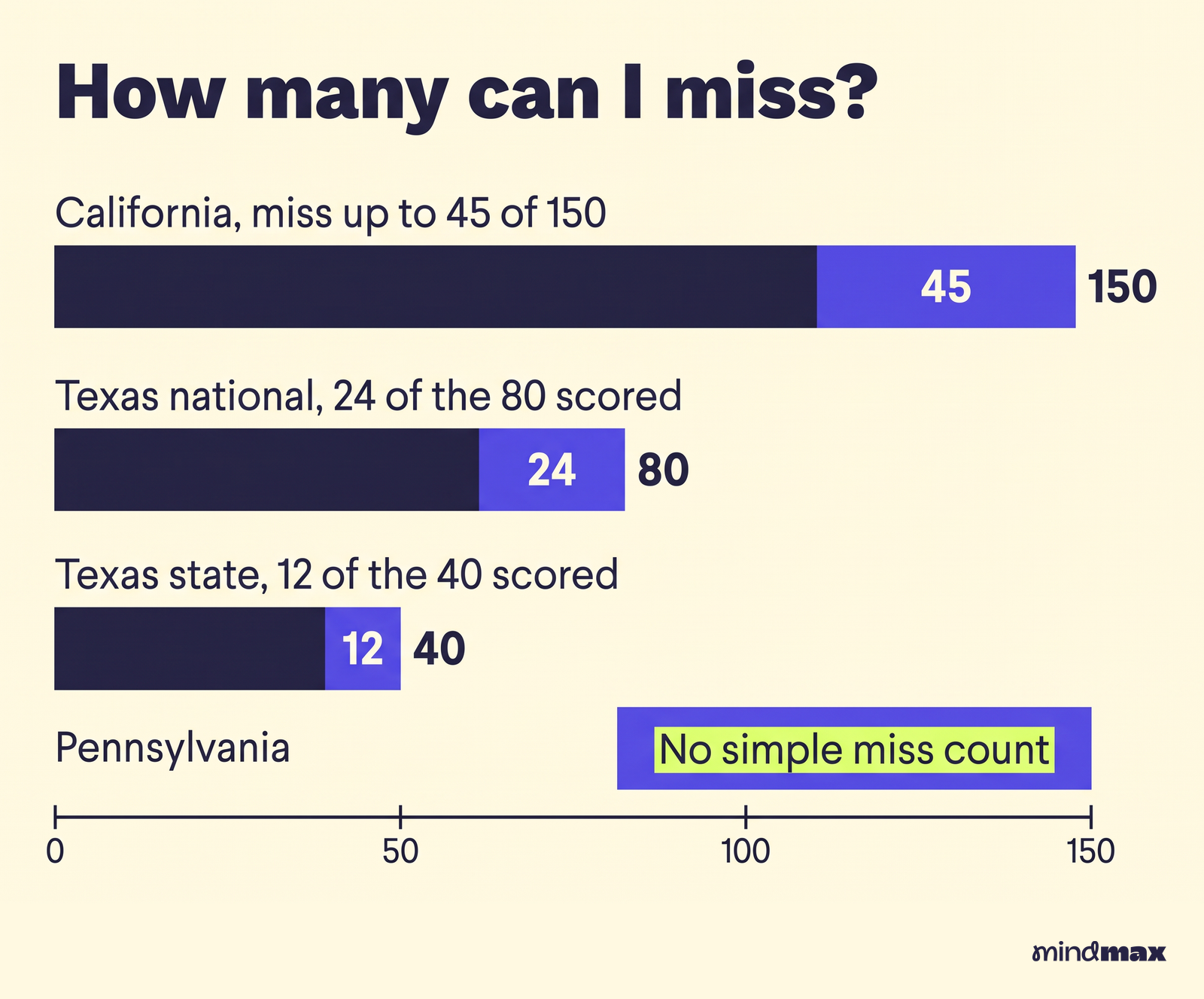
In the two-part states, each portion has its own allowance. In Texas you can get 24 of the 80 scored national items wrong and 12 of the 40 scored state items wrong. Those numbers apply to scored items only. Pretest items don't count for or against you, but since you can't spot them, treat every question as if it counts.
Pennsylvania is the tricky one. Because it uses a scaled score, there is no simple miss count. Aim well above the line rather than trying to calculate how close you can cut it.
That's why many passers set a target before booking. A common rule among candidates is to score above 80% on practice tests first, which leaves room for nerves and odd wording. You can test yourself with these real estate exam practice questions with worked answers.
Can you take a real estate exam at home?
Only in some states. Most still require a test center.
- Pennsylvania, online at home through OnVUE. You need a quiet, private location, a webcam and a strong internet connection. There are no unscheduled breaks. You must wait 7 days between OnVUE attempts. You schedule the national and state portions separately, but you can take them back to back.
- Texas, test centers only. Pearson VUE centers run the exam, including on-base military test centers around the world.
- California, DRE exam centers. The state runs its own five centers in Fresno, La Palma, Oakland, Sacramento and San Diego. All of them are in California, even for out-of-state applicants.
- New York, DOS exam sites. You test in person at a Department of State site.
For other states, the rule depends on the vendor and the state. Some candidates report that Ohio allows online testing through PSI and that Georgia and Florida don't, but that's unconfirmed. Check your state's testing vendor page before you plan around it.
Is the state portion of the real estate exam harder than the national portion?
For many candidates it is, especially in Texas. But it's not universal, and the reasons matter more than the label.
The state portion is shorter, but it leans on specifics you have to memorize, such as deadlines, dollar figures, license rules and title details. One Texas passer called the state section full of tricky questions that needed a lot of numbers memorized. Another passed the national portion, failed the state, and said the state questions looked very different from the course practice. A third kept scoring 100% on practice tests and still struggled on the state exam. New York candidates say their exam often has questions where more than one answer looks right.
The national portion catches people too. A Nevada candidate found the national much harder and the state very easy. A Colorado candidate failing for the third time blamed the volume of tax and math questions.
In Texas, the share you can miss is the same on both parts, about 30%. But the state portion has half as many scored items, so each wrong answer there costs twice as much.
The practical upshot is to give the state law real study time instead of treating it as an afterthought, and to practice with questions written for your state. In California, where it's all one exam, the first-time pass rate averaged 63.1% over fiscal years 2020/21 to 2023/24, and just 19.6% for retakes. You can see more on pass rates by state and why the state portion trips people up.
If you want state-specific practice, MindMax offers courses for Texas, California, New York, Pennsylvania, Florida and several other states, plus one for the national portion. Each builds a study plan around your exam date, with short lessons where you can ask the tutor questions as you go, and a timed mock exam of its own design, 100 questions in 200 minutes with a 70% pass mark.
One piece of good news in two-part states is that a bad day on one portion doesn't sink the other. In Texas and Pennsylvania you retake only the part you failed.
What to sort out before you book
You can't schedule the exam until your state says you're eligible, and that usually means finishing pre-licensing education first.
- Texas. Finish your education, apply to TREC, and wait for the eligibility letter with your TREC ID. Only then can you book with Pearson VUE.
- Pennsylvania. Complete 75 hours of education and get approval through Clarus.
- New York. Complete the 77-hour course and set up an eAccessNY account.
- California. Upload your course transcripts through eLicensing. You must pass the exam within two years of filing the application.
Fingerprints are often part of the process. Texas uses IdentoGO by IDEMIA. California uses Live Scan, or a $49 card processing fee for out-of-state applicants.
On test day, Texas wants two forms of ID with names that exactly match your registration. Texas and New York allow a non-alphanumeric financial calculator but don't provide one. California's own pages disagree on calculators, so check the DRE's current rules.
If you already hold a license elsewhere, you may skip the national portion. Texas can waive it if you passed an ARELLO-approved national exam, and Pennsylvania can waive it if you hold a recent out-of-state license.
Plan for retakes and expiry too. Texas gives you three attempts within one year of applying. After a third failure you need 30 more education hours, or 60 if you failed both parts. Pennsylvania allows unlimited attempts within 5 years of your first course, and passing results stay valid for 3 years. New York results stay valid for 2 years. California allows unlimited attempts in the two years after you file. You'll find fees and waiting periods in this guide to how many times you can retake the real estate exam, and the steps after a pass in what to do once you pass, from brokers to license timelines.
Frequently asked questions
Can I take the national and state portions on the same day?
In Texas you can book both together, with 240 minutes in total. In Pennsylvania you schedule each portion separately, but you can take them back to back, including online. Other states set their own rules, so check your handbook.
Do I find out if I passed the real estate exam right away?
Usually yes. California shows your result on screen when you finish, and Texas hands you the official score report before you leave. New York candidates report getting results within about 48 hours.
Is the broker exam the same as the salesperson exam?
No. In California the broker exam is 200 questions in 4 hours with a 75% pass mark, compared with 150 questions in 3 hours at 70% for salespeople. In Texas brokers need 60 correct on the national portion and 38 on the state portion.
Does passing the national portion in one state count in another?
Sometimes. Texas may waive the national portion if you hold an active license in another state and passed an ARELLO-approved national exam. California has no reciprocity with any other state, so everyone takes its full exam.
Is the real estate exam offered in languages other than English?
California says its exam is offered only in English. The Texas handbook lists only an English edition. Check your own state's handbook if you need another language.