
FAA Part 107 Remote Pilot Certificate Requirements and Forms
11 min read ·
What are the FAA Part 107 Remote Pilot Certificate requirements?
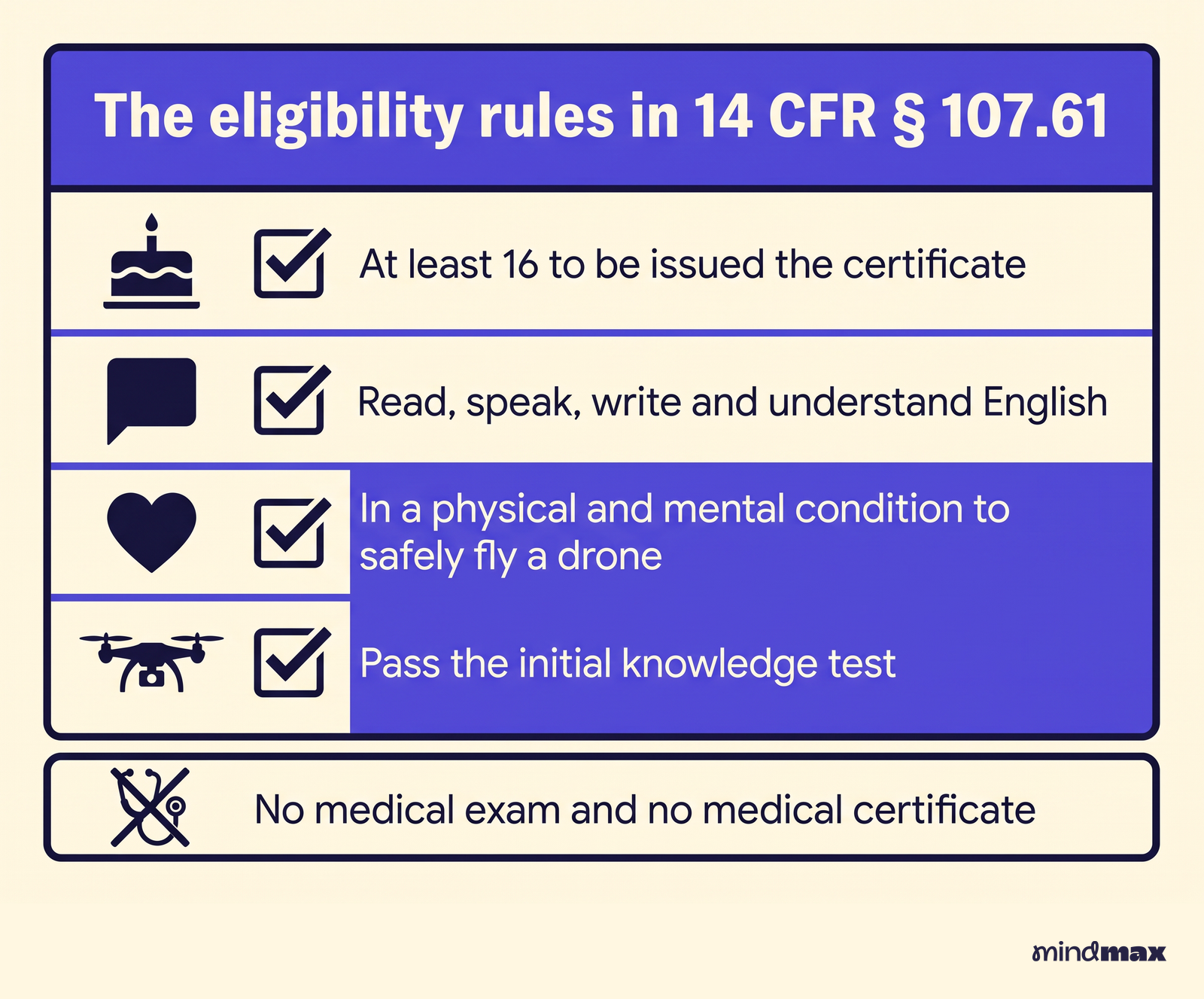
To get an FAA Part 107 Remote Pilot Certificate you must be at least 16 and able to read, speak, write and understand English. You must not know of any physical or mental condition that would make flying a drone unsafe, and no medical certificate is needed. You must pass the FAA's UAG knowledge test, which you can take from age 14. US citizenship is not required, but every applicant clears a TSA security check. You then apply on FAA Form 8710-13 in IACRA.
The eligibility rules in 14 CFR § 107.61
Most people say "drone license" or just "Part 107." The FAA's term is a Remote Pilot Certificate with a small UAS rating. They all mean the same credential. If you are still deciding whether you need it at all, see when YouTube, real estate and other flying needs Part 107.
The drone license requirements live in one short federal regulation, 14 CFR Part 107 Subpart C, the remote pilot certification rules. They are the same in every state and territory, so there are no state versions to check.
Age
You must be at least 16 to be issued the certificate. You can take the test earlier, which the next section explains.
English
You must be able to read, speak, write and understand English. The test is only offered in English. There is one exception. If a medical reason stops you meeting one of these, the FAA may issue the certificate with operating limitations rather than deny it.
Health
The rule says you must not know, or have reason to know, that you have a physical or mental condition that would interfere with safe drone operation. The FAA's own page phrases it as being "in a physical and mental condition to safely fly a drone." This is a self-assessment. There is no medical exam and no medical certificate.
Aeronautical knowledge
First-time applicants must pass the initial knowledge test, called UAG, "Unmanned Aircraft General, Small." Holders of a Part 61 manned pilot certificate with a current flight review take a free online course instead.
Things that can get you denied
- A federal or state drug conviction can lead to denial for up to 1 year after the final conviction.
- Refusing an alcohol test can do the same.
- Cheating on the test bars you from all FAA tests and certificates for 1 year.
There is no education requirement, no minimum training hours and no instructor sign-off. The FAA's testing matrix says the UAG "Requires NO instructor endorsement or other form of written authorization."
Drone pilot license age requirement, 14 to test and 16 to certify
This is where people get mixed up, and you will see both numbers repeated online. You can sit the UAG knowledge test at 14, and you must be at least 16 to be issued the Remote Pilot Certificate.
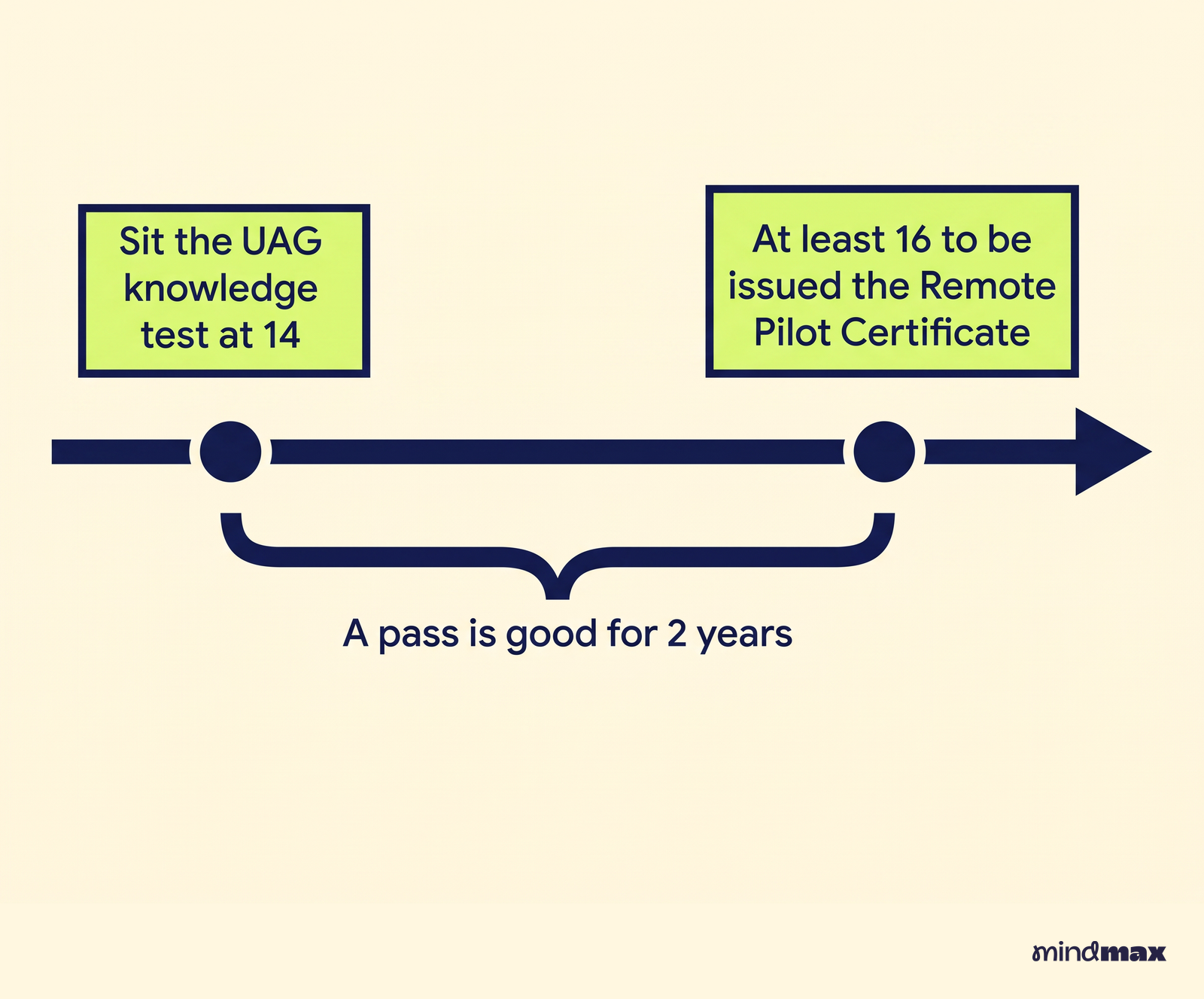
The FAA Airman Knowledge Testing Matrix lists 14 as the minimum age for the UAG. The regulation backs this up. Section 107.67 says the ID you show at the test must have a date of birth showing you meet "or will meet" the age requirement before your test report expires.
One official document says otherwise. The Aeronautical Information Manual, in a paragraph headed "Eligibility for Testing," says applicants must be at least 16. The testing matrix and the regulation are the more specific testing rules, so the 14 and 16 split is the better-supported answer. If you are 14 or 15, it is sensible to confirm with PSI when you book.
Can I take the Part 107 test at 14 or 15 if I won't be 16 until later?
Yes. You can pass the test at 14 or 15 and apply in IACRA once you turn 16. You cannot fly under Part 107 until then, because the temporary certificate is only issued after you are 16 and have cleared the TSA check.
How long your passing score lasts
The FAA rules refer to an expiration date on the test report, but the FAA's main pages do not state its length for the UAG. The common understanding among drone pilots and prep providers is that a pass is good for 2 years. Separately, § 107.65 requires you to have passed the test or completed recurrent training within the previous 24 calendar months before you can act as remote pilot in command.
In practice, a 14-year-old who passes should plan to apply within about 2 years. If you test at 14 and turn 16 just after that window, you may need to test again.
Under 14 or flying only for fun
If you fly purely as a hobby, the recreational route is TRUST, the FAA's free recreational safety test. It has no minimum age or other eligibility requirements, you can retake it any time, and you only do it once.
ID rules at the testing center
The test is in person at an FAA-approved testing center run by PSI. Your ID must be valid and current. Across one or more documents it has to show your photo, date of birth, signature, and physical residential address.
| Applicant | Acceptable ID |
|---|---|
| US citizens and resident aliens | A US state, territory or government ID (driver license or permit, government ID card or military ID), or a passport, or an alien residency card |
| Non-US citizens | A passport plus a US state or territory driver license, or an ID card issued by any government entity |
If you are under 18
You do not automatically need a parent with you. Some courses tell teens they must bring one, but the FAA rule is narrower. If you have no acceptable ID, a parent or legal guardian must come with you, show their own ID, and attest to your identity. If you have a valid ID of your own, that covers it.
If your ID has no address
Many teen IDs and some passports lack a home address. You can use a parent's address, or bring an approved proof of address. Accepted examples include the following.
- A utility statement (cable bills are not accepted)
- A mortgage statement or signed lease
- A property deed or tax bill
- An insurance statement
- A vehicle title or registration
- A voter registration card
- A signed letter on school letterhead
A PO box, rural route, employer address or flight school address (unless you live there) is not accepted. The regulation also asks for a permanent mailing address. If yours is a PO box, you must give a residential address too.
If you have asylum status and no passport, take your government documentation to an FAA Flight Standards District Office or International Field Office for approval before testing.
Keep your name and date of birth identical across your ID, your PSI account and your IACRA profile. That is standard advice from prep providers, and a mismatch is an easy way to lose a test day.
Can a non-US citizen get a Part 107 remote pilot certificate?
Yes. The FAA says foreign nationals are eligible "in the same way that a U.S. citizen is eligible." There is no citizenship rule in § 107.61. What changes is the practical side.
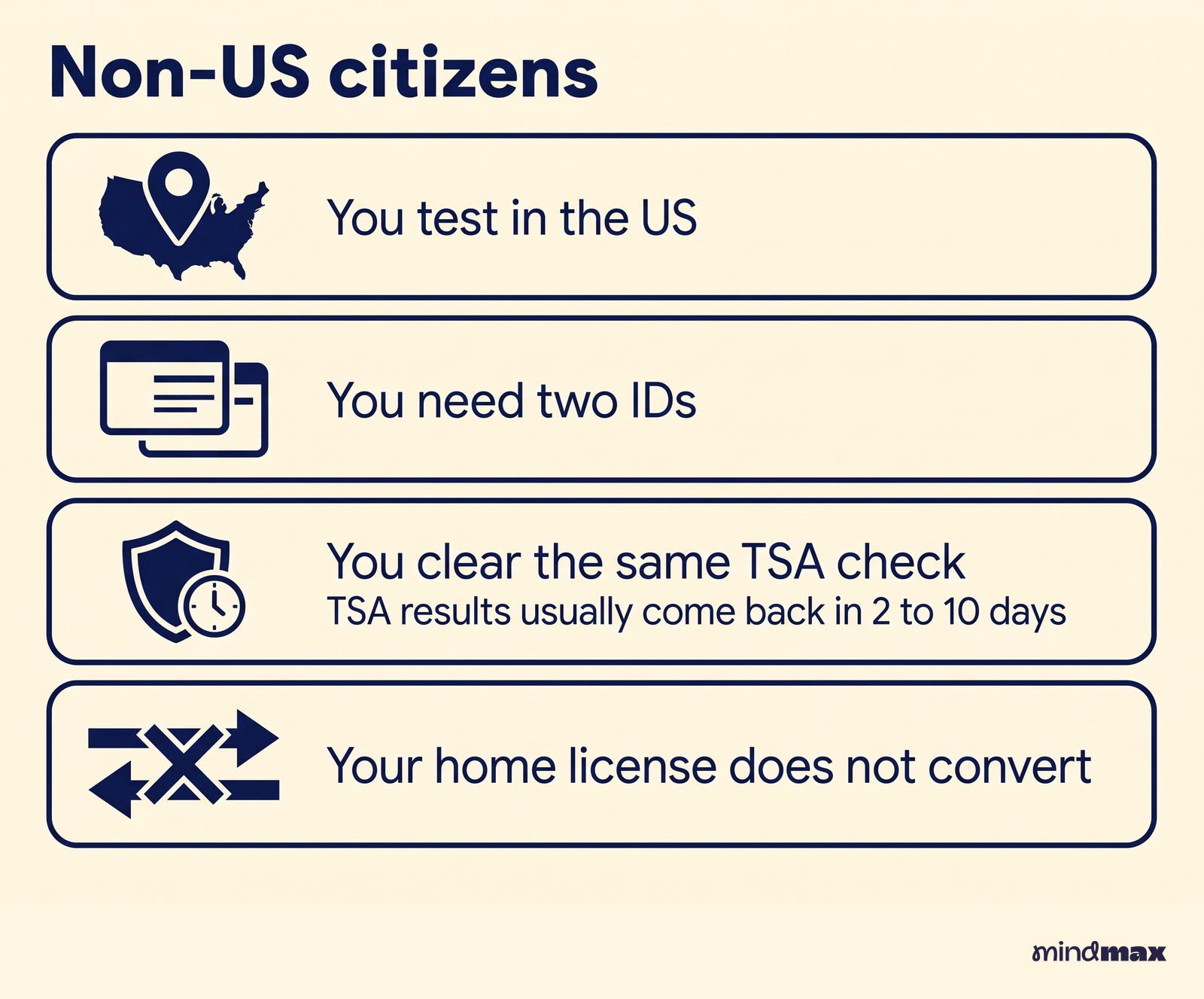
You test in the US. All testing centers are located there, and foreign nationals without a US Part 61 certificate must pass the initial knowledge test like anyone else.
You need two IDs. That means a passport plus a US driver license or a government-issued ID card, together showing a residential address.
You clear the same TSA check. Every applicant, of any nationality, must pass a TSA Security Threat Analysis before the FAA issues a temporary or permanent certificate. Pilot Institute says TSA results usually come back in 2 to 10 days, and that unresolved visa overstays can be flagged.
Your home license does not convert. The US has no agreements to convert a foreign drone license, and the FAA does not currently recognize any foreign remote pilot certificate. Without a US certificate, you can still fly under the direct supervision of a US remote pilot in command who can take over immediately.
If you plan paid work in the US with a drone registered in another country, you also need a Notice of Identification filed in FAADroneZone and a DOT foreign aircraft permit under 14 CFR Part 375. Apply for the permit at least 15 days ahead, and expect it to take about 30 days. Canadian and Mexican nationals may be covered by a USMCA blanket permit for certain specialty air services. These details come from an FAA international operators page last updated in December 2024, so check it before you travel.
What documents must a remote pilot complete to apply?
The one application form is FAA Form 8710-13, "FAA Airman Certificate and/or Rating Application," which you fill in online in IACRA. The full sequence for first-time pilots looks like this.
- Create an IACRA profile to get your FAA Tracking Number (FTN). Do this before booking.
- Book the UAG with PSI and bring your government-issued photo ID. Prep providers put the fee at $175 per attempt.
- Pass the test. It has 60 scored questions in 2 hours, and you need 70%.
- In IACRA, start a new application, choose "Pilot," then "Remote Pilot," then "Other Path Information." Enter your 17-digit Knowledge Test Exam ID, sign and submit.
- Wait for the TSA check, then print your temporary certificate from the link in the confirmation email.
- Receive the permanent card by mail.
The FAA says your exam ID may take up to 48 hours to appear in IACRA. One candidate was told by the FAA help desk it can take up to 60 business hours, so do not panic if it is missing the next morning. For the full walkthrough, see how to get your Part 107 drone license step by step, and for wait times after the test, how long the temporary certificate takes.
You do not need any letter from an instructor or school. Pilot Institute advises uploading your ID in IACRA, but the FAA's own steps do not mention this.
If you fail, you wait 14 calendar days, bring your failed test report, and retest. No endorsement is needed. MindMax's Part 107 course builds a study plan around whatever time you have before your test date, with a timed mock of 60 questions in 120 minutes and a 70% pass mark that it sets for its own practice.
The route for Part 61 pilots
If you hold a Part 61 pilot certificate, not a student certificate, and have a current flight review, you skip the UAG. Take the free FAASTeam course ALC-451, complete Form 8710-13 in IACRA, then have your identity checked by a FSDO, DPE, ACR or CFI. Bring the 8710-13, proof of your flight review, photo ID and the course completion certificate. A CFI cannot issue a temporary certificate.
Keeping the certificate valid
Getting the card is not the end of the rules. Your temporary certificate lasts up to 120 calendar days while you wait for the plastic card, so it covers the usual mailing delay.
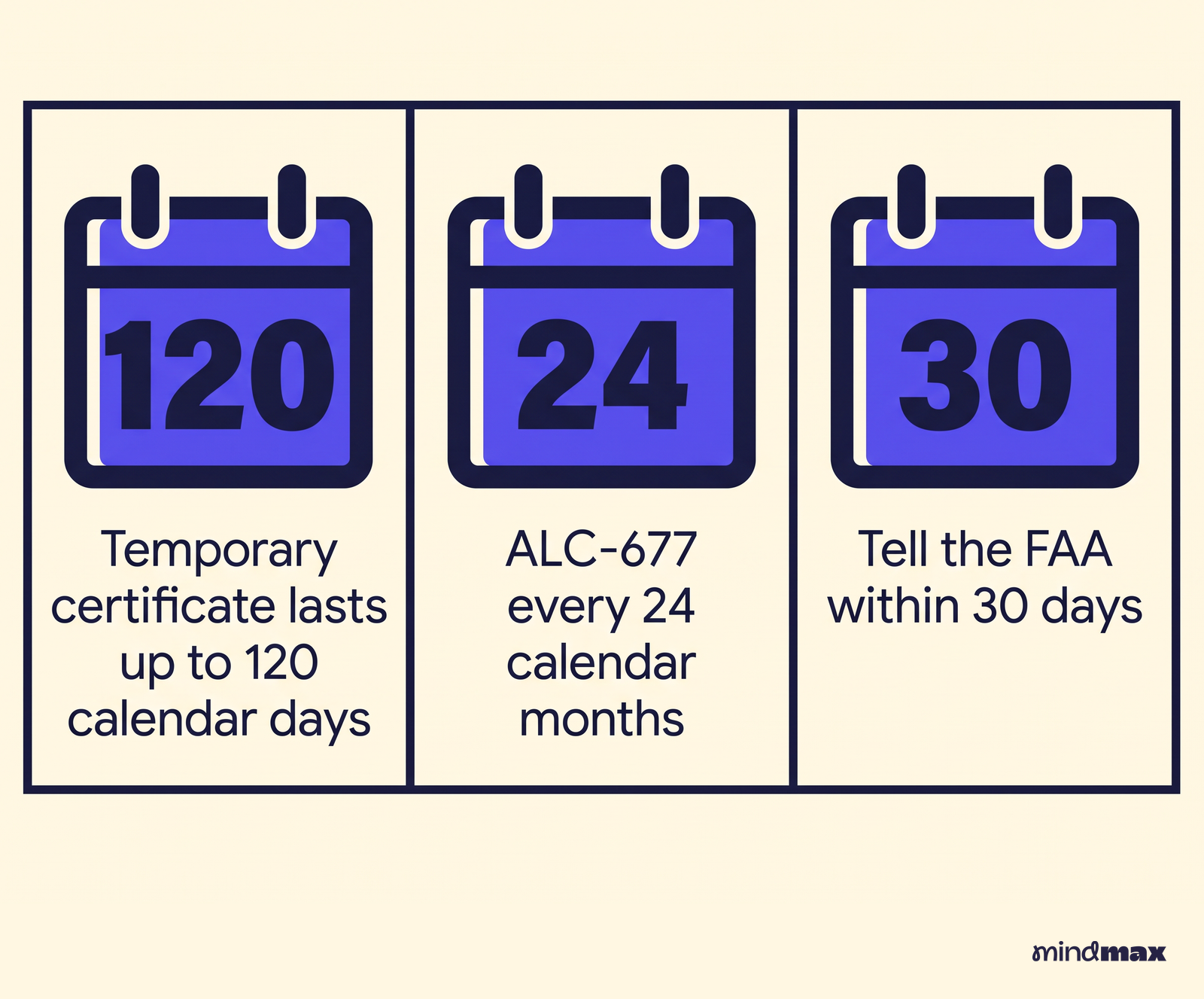
To stay current, complete the free online course ALC-677 every 24 calendar months. There is no second test to sit.
If you move, tell the FAA within 30 days, or you may not use the certificate. And whenever you fly, keep the certificate easily accessible.
For more on what the certificate lets you do once you hold it, see what the Part 107 drone license is.
Frequently asked questions
Do I need a medical exam for a Part 107 drone license?
No. Part 107 has no medical exam and no medical certificate. You only have to be honest that you do not know of any physical or mental condition that would make flying a drone unsafe.
Does my 15-year-old need a parent at the Part 107 testing center?
Only if they have no acceptable ID of their own. In that case a parent or legal guardian goes with them, shows their own ID and attests to the teen's identity. A teen with a valid ID showing the required details can test alone.
Is the Part 107 test offered in Spanish or other languages?
No. The UAG is only given in English, and the rules require you to read, speak, write and understand English. Some courses offer subtitles in other languages, but the test itself stays in English.
Can I take the Part 107 test online from home?
No official source offers online proctoring for the UAG. You take it in person at an FAA-approved testing center booked through PSI, and all of those centers are in the US.
Does a past drug conviction stop me getting a remote pilot certificate forever?
No. A federal or state drug conviction can lead to denial for up to 1 year after the final conviction. After that window you can apply in the normal way, though you still go through the TSA security check.