
FAA Part 107 Remote Pilot Certificate, What the Drone License Is
11 min read ·

Co-founder of MindMax and Memrise, Grand Master of Memory
What is the FAA Part 107 Remote Pilot Certificate?
The FAA Part 107 Remote Pilot Certificate is the federal credential you need to fly a drone under the FAA's Small UAS Rule, 14 CFR Part 107. Its formal name is a remote pilot certificate with a small UAS rating, and most people call it the Part 107 drone license. It lets you fly a drone under 55 lb for work or business. To get one, you must be at least 16, pass the UAG knowledge test, apply in IACRA and clear a TSA background check.
Is the Part 107 License the Same as the Remote Pilot Certificate?
Yes. "Part 107 license", "FAA 107 license", "drone license" and "commercial drone license" are all informal names for one credential, the remote pilot certificate with a small UAS rating. The FAA calls it a certificate, not a license, but you'll hear both everywhere.
In the FAA's words, the certificate "demonstrates that you understand the regulations, operating requirements, and procedures for safely flying drones." The FAA's page for holders is titled "Certificated Remote Pilots including Commercial Operators", which tells you who it's for. If you fly for money in any form, from real estate photos to roof inspections to a monetized YouTube channel, Part 107 is the route. Our guide on when you need a Part 107 license for YouTube, real estate and other work walks through the gray areas.
If you only ever fly for fun, you don't need Part 107. Hobby flyers take TRUST instead. The TRUST certificate is not a remote pilot certificate, and it doesn't allow commercial work.
There's one certificate for the whole country. It's federal, so eligibility, the test and the rules are the same in every state. State and local drone laws do exist, though, so check the rules where you plan to fly.
Who Can Get a Remote Pilot Certificate?
The requirements come from 14 CFR 107.61 and the FAA's application page. To qualify, you must meet four conditions.
- Be at least 16 years old to hold the certificate.
- Be able to read, speak, write and understand English.
- Be in a physical and mental condition to fly a drone safely. No medical certificate is required.
- Pass the UAG initial knowledge test.
A drug conviction or an alcohol violation can lead the FAA to deny your application for up to 1 year. Cheating on the test bars you from any FAA test or certificate for 1 year.
If you already fly manned aircraft
If you hold a Part 61 pilot certificate (not a student pilot certificate) and your flight review is current, you skip the UAG. The steps are different.
- Complete the free online FAASTeam course ALC-451.
- Fill in Form 8710-13 in IACRA.
- Have your identity verified at a FSDO, or by a DPE, ACR or CFI. Bring the form, proof of your flight review, photo ID and the course certificate.
- Receive a temporary certificate on the spot, unless a CFI verified you. CFIs cannot issue temporary certificates.
That means nearly everyone who sits the UAG is a non-pilot. Expect manned-aviation topics like airport operations and radio procedures to feel new.
How Is the Certificate Different From the Knowledge Test?
These are two separate things, and mixing them up causes a lot of confusion.
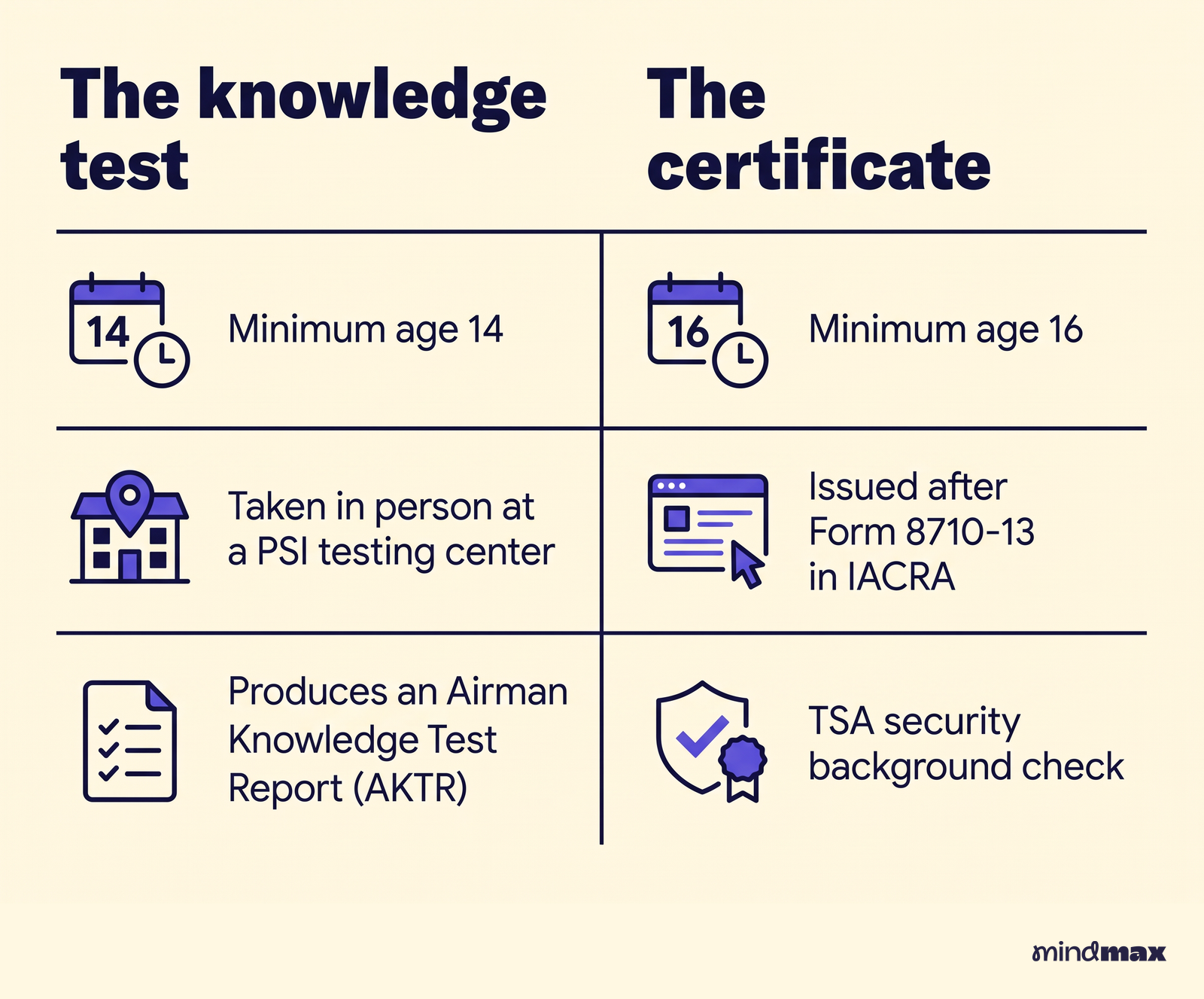
The knowledge test is the "Unmanned Aircraft General, Small" test, coded UAG. It's taken in person at a PSI testing center. Passing it produces an Airman Knowledge Test Report (AKTR). That report is not a certificate.
The certificate is issued after Form 8710-13 in IACRA, and only once you pass a TSA security background check. You can take the test at minimum age 14, but you need minimum age 16 to hold the certificate.
Here is the UAG format from the FAA's Airman Knowledge Testing Matrix (effective April 24, 2023).
| Item | What the FAA says |
|---|---|
| Scored questions | 60, plus possible unscored validation questions |
| Time allowed | 2 hours, including the validation questions |
| Passing score | 70, which is 42 of 60 correct |
| Minimum age to test | 14 |
| Instructor endorsement | None required |
| Retest after failure | Wait 14 days and bring your failed AKTR |
| ID | Government photo ID with date of birth, signature and residential address |
The fee is $175 per attempt, paid to the testing center, according to prep providers UAV Coach and Drone Pilot Ground School. Confirm the current price when you book with PSI.
Pass rates and the 2026 change
FAA statistics, as reproduced by prep provider Drone U, show the UAG pass rate slipping year by year. It was 87.07% in 2023, 84.20% in 2024 and 82.96% across 73,914 tests in 2025. These count tests taken, not people. For a fuller look at difficulty, see Part 107 pass rates and study time.
Since October 26, 2026, the UAG includes image-based questions not found in the test supplement. The images come from current VFR sectionals and IFR low charts. The FAA's sample questions ask about the airspace at Millville Muni (MIV) and the CTAF at Grand Canyon (GCN) when the tower is closed. The printed testing supplement stays available at test centers until the FAA sets a removal date. Memorized answer banks help less now, so you need to actually read charts.
If you want structured practice, MindMax's Part 107 course builds a study plan around your test date and includes its own timed mock exam of 60 questions in 120 minutes with a 70% pass mark, so you can rehearse the pace before test day.
How Do You Go From Passing the Test to the Plastic Card?
The FAA lays out the steps for first-time pilots on its Become a Certificated Remote Pilot page.
- Get an FAA Tracking Number (FTN) by creating an IACRA profile before you register for the test.
- Schedule the UAG with PSI at an FAA-approved testing center, and bring a government photo ID.
- Pass the UAG.
- Complete Form 8710-13 in IACRA, choosing Pilot and then Remote Pilot, and enter the 17-digit Knowledge Test Exam ID from your AKTR. Your result can take up to 48 hours to appear in IACRA.
- Clear the TSA security check. The FAA then emails instructions to print the temporary certificate from IACRA.
- Wait for the permanent card by mail, sent once FAA internal processing is done.
- Carry the certificate whenever you fly.
How long each stage takes
The temporary certificate is valid for up to 120 calendar days. It ends on its stated date, when the permanent card arrives, or if your application is denied.
The FAA gives no timeframe for a first-time pilot's permanent card. UAV Coach says the temporary takes about 10 business days and the permanent card six to eight weeks. Candidates often report faster temporaries. One r/drones poster could print theirs 3.5 days after the test, and others saw it in IACRA before the email arrived, so check the site directly. Permanent cards in that thread took from a little over a month to about six and a half weeks.
For a fuller walkthrough, see how to get your Part 107 drone license step by step and how long the temporary certificate takes after you pass.
What Does the Part 107 License Let You Do?
The main privilege is commercial flying. With the certificate, you can fly a drone under 55 lb for work or business, as long as you follow Part 107. That comes with operating limits.
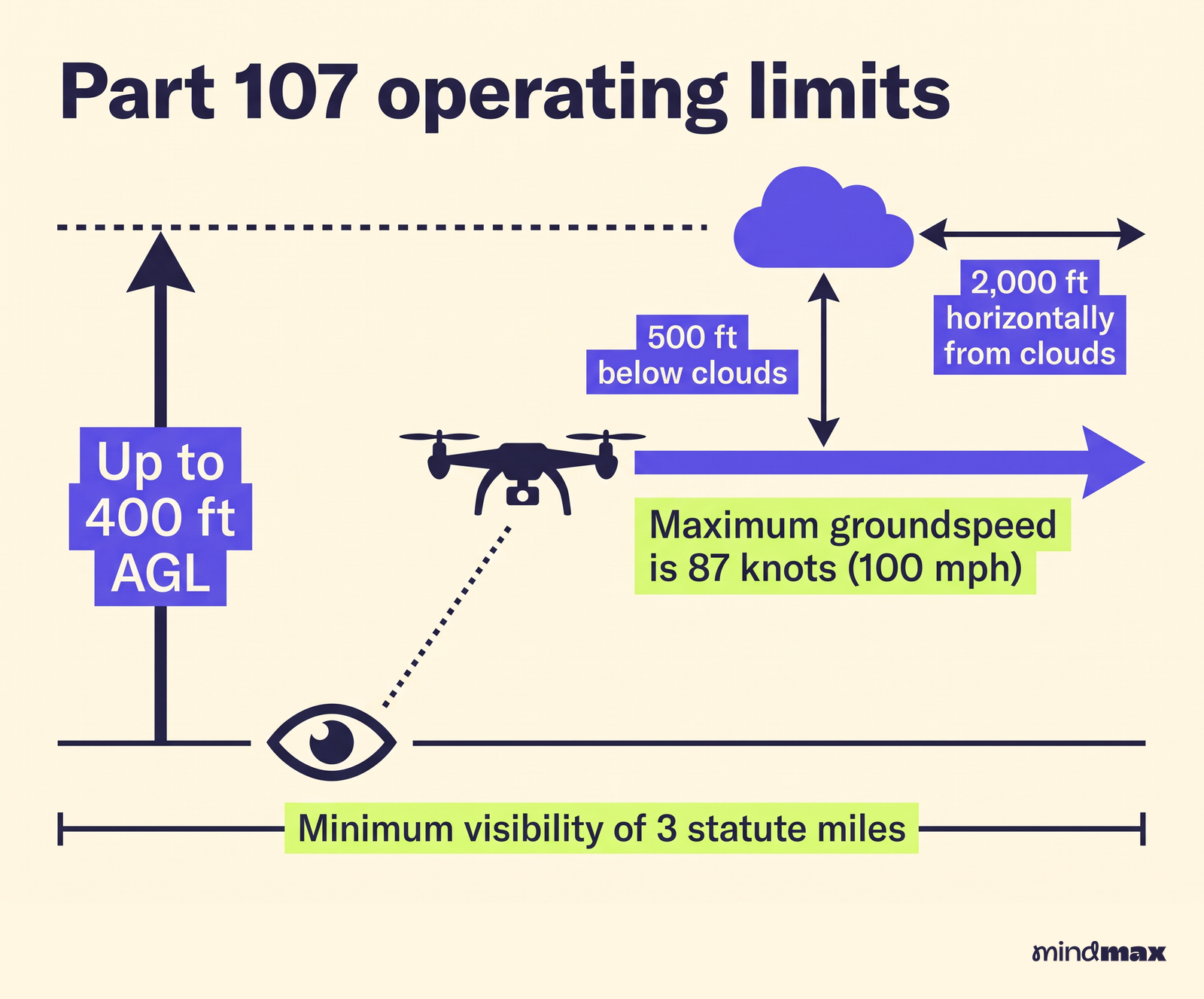
The numbers to memorize cover height, speed and weather. You can fly up to 400 ft AGL, or higher near a structure as long as you stay within 400 ft of it and no more than 400 ft above its top. Maximum groundspeed is 87 knots (100 mph). You need minimum visibility of 3 statute miles, and you must stay 500 ft below clouds and 2,000 ft horizontally from clouds.
The other rules shape how and where you fly.
- Line of sight. Keep the drone in visual line of sight with your own eyes, corrective lenses allowed.
- Other traffic. Yield to all aircraft, fly one drone at a time and carry no hazardous materials.
- Controlled airspace. You need prior ATC authorization in Class B, C, D or surface-area Class E airspace.
- Night. Allowed without a waiver if your initial test or training came after April 6, 2021. The drone needs anti-collision lighting visible for 3 statute miles, at night and in civil twilight.
- Over people and moving vehicles. Allowed without a waiver under the Operations Over People rule, effective April 21, 2021, if you meet its requirements. Night flights in controlled airspace still need an airspace authorization.
- Supervising others. Someone without a certificate can fly only under your direct supervision, with you able to take control immediately.
Many of these limits can be waived under §107.205, including night, line of sight, moving vehicles, visual observers, multiple drones, right of way, flight over people, airspace and the operating limits in §107.51.
The certificate also brings a duty to report. Within 10 days, you must report any serious injury, loss of consciousness, or property damage over $500.
How Do You Keep a Remote Pilot Certificate Current?
The certificate itself shows no expiry date. What lapses is your right to use it. To act as remote pilot in command, you must have passed the initial test or completed recurrent training within the previous 24 calendar months (§107.65).
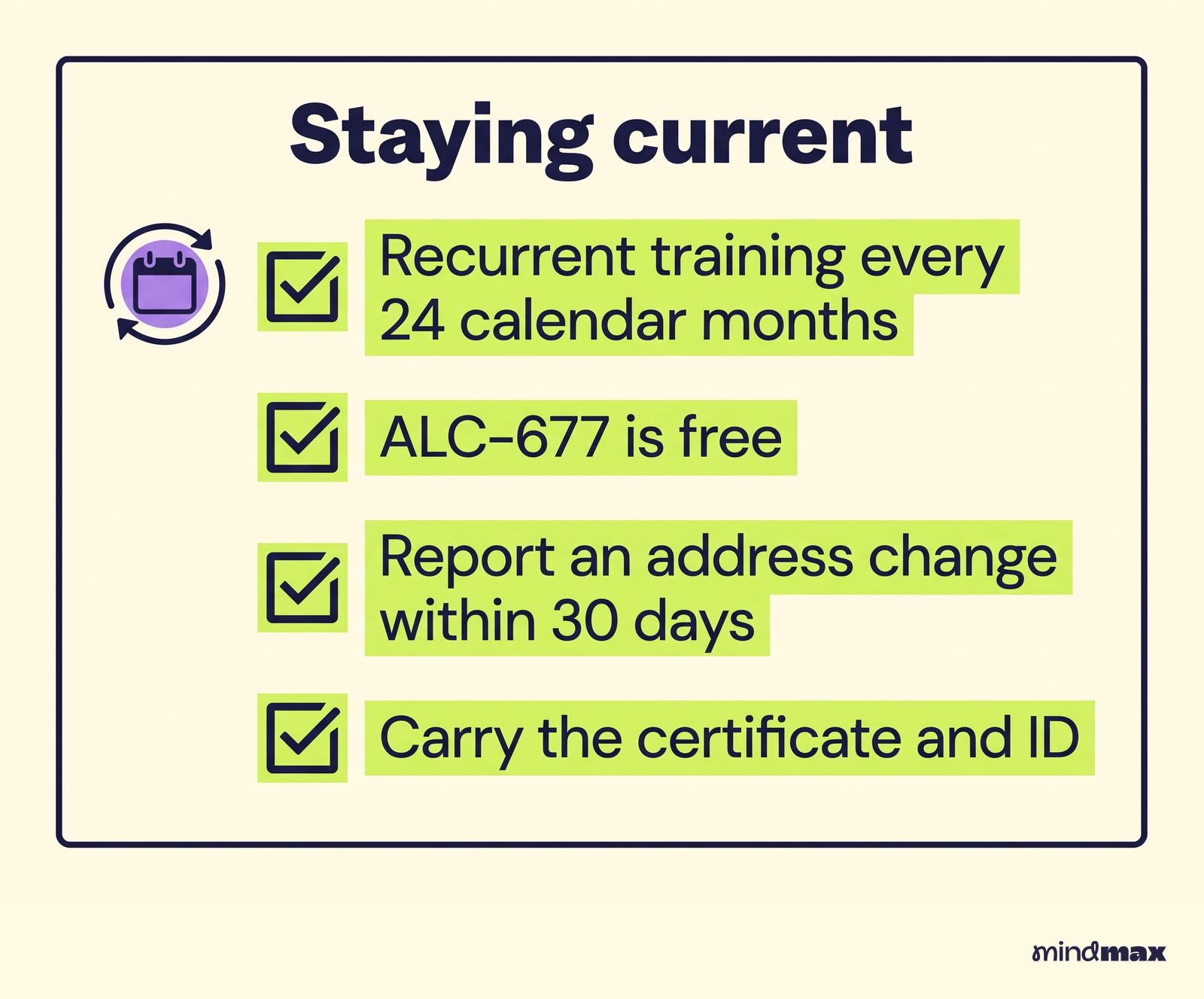
So plan on recurrent training every 24 calendar months. ALC-677 is free and online, and Part 61 pilots with a current flight review can take ALC-515 instead. Some guides still say you must pass a recurrent knowledge test every 24 months. The FAA replaced that with online training from April 6, 2021, so follow the FAA.
Candidates offer one useful tip. Count your 24 months from the date you passed the test, not the date printed on your card.
Two other duties apply. You must report an address change within 30 days, and until you do, you can't use the certificate. You also need to carry the certificate and ID when you fly, and show them on request to the FAA, NTSB, TSA, or federal, state or local police.
What the Remote Pilot Certificate Doesn't Cover
The certificate is about you, the pilot. A few things about the drone and the airspace sit outside it.
- Drone registration. Register in FAADroneZone under "Fly sUAS under Part 107". It costs $5, lasts 3 years, and the drone must be marked with its registration number.
- Remote ID. Since September 16, 2023, any drone that needs FAA registration must broadcast Remote ID, unless you fly inside a FRIA.
- Airspace authorizations. These come through LAANC or DroneZone, separately from your certificate.
- State and local rules. Your federal certificate doesn't override local drone laws, which vary.
- Foreign operators. The FAA can authorize foreign-registered drones to operate without an FAA certificate under §107.12(c), and it keeps a dedicated page for this.
Get the certificate, register the drone, make sure it broadcasts Remote ID, and you have the core pieces for legal work flying in the US.
Frequently asked questions
Can I fly commercially with just the temporary certificate?
The temporary certificate is issued under §107.64 and is valid for up to 120 calendar days, or until your permanent card arrives. It serves as your certificate during that time. Print it from IACRA and carry it with your ID whenever you fly.
What happens if I fail the Part 107 test?
You wait 14 calendar days before you can retest. You don't need an instructor endorsement, but you must bring your failed AKTR. Prep providers say you pay the full test fee again for each attempt.
Can I take the Part 107 test online from home?
No official source offers online proctoring for the UAG. You take it in person at an FAA-approved Knowledge Testing Center run by PSI, and you book through PSI's FAA portal.
What ID do I need on test day?
US citizens and resident aliens need a valid government photo ID showing date of birth, signature and residential address, such as a driver's license, military ID or passport. Non-US citizens need a passport plus a US driver's license or a government-issued ID card. If your ID lacks an address, a utility bill or lease can work, but a P.O. box is not accepted.
Does the AKTR tell me what I got wrong?
Yes, in a general way. The UAG report prints ACS codes for the knowledge areas you answered incorrectly. It doesn't show the questions themselves, but the codes point you to topics to review.