
How Long to Get a Part 107 Drone License, a Real Timeline
11 min read ·

Co-founder of MindMax and Memrise, Grand Master of Memory
How long does it take to get a Part 107 drone license?
For most first-time candidates, getting a Part 107 drone license takes about 2 to 6 weeks from the first study session to a printable temporary certificate. Plan on 1 to 4 weeks of study, plus however long it takes for a PSI test seat to open near you. After you pass, your result reaches IACRA within 48 hours, and the TSA check and temporary certificate usually follow in a few days to about a week. The plastic card arrives 6 to 10 weeks after that, but you can start paid work on the temporary certificate.
What the Part 107 license actually is
People call it a drone pilots license, a drone FAA license or Part 107 certification. The FAA calls it a Remote Pilot Certificate under the Small UAS Rule, also known as Part 107. You need it to fly a drone for anything other than recreation, and that includes paid jobs and money from drone content such as YouTube ads. If you're unsure whether your plans count, see when you need a Part 107 license for YouTube, real estate and more.
It's one federal credential. The process, the test and the rules are the same in every state, so a candidate in Texas follows exactly the same steps as one in California or New York.
To hold the certificate you must
- be at least 16 (you can sit the test from age 14)
- be able to read, speak, write and understand English
- be in a physical and mental condition to fly a drone safely
- pass the initial knowledge test, called Unmanned Aircraft General, Small, or UAG for short
The UAG has 60 scored multiple choice questions, a 2 hour time limit and a 70% pass mark, which means 42 correct. The FAA may add a few unscored validation questions, so you might see 65 on screen. No instructor endorsement is needed.
The Part 107 timeline, stage by stage
The FAA lists the official order in its steps to become a certificated remote pilot. Here is how long each stage really takes and where you can save time.
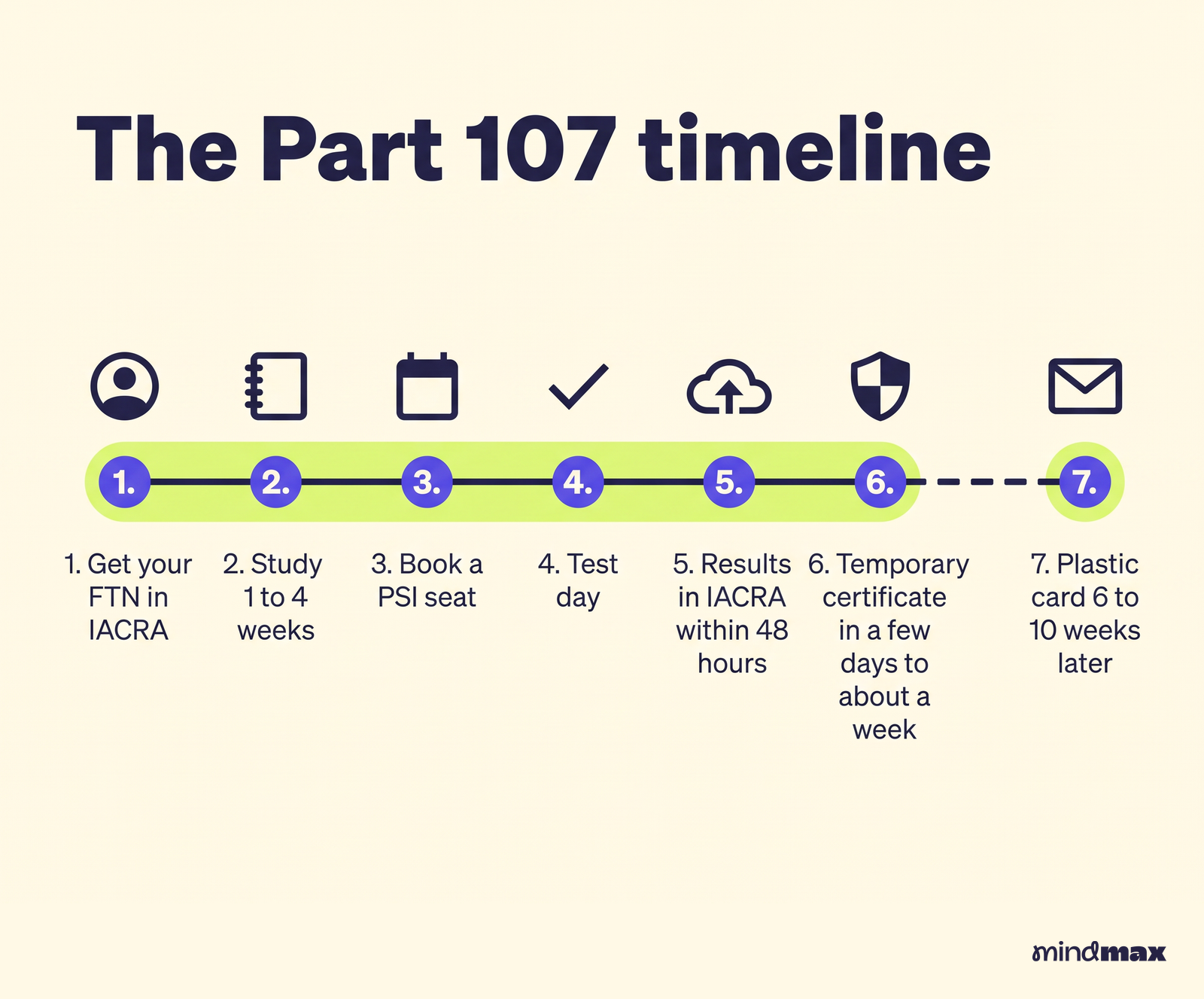
1. Get your FTN in IACRA
Create a profile in IACRA, the FAA's application system, to get an FAA Tracking Number (FTN). You need it before PSI will let you book. Do this on day one, even before you open a study guide, so it never holds you up later. Make sure the name matches your ID.
2. Study 1 to 4 weeks
This is the stage with the widest range and the one you control most. Drone Pilot Ground School puts the work at 15 to 20 hours. Candidates report anything from a two day cram to five weeks of steady study. The common readiness signal isn't hours at all. It's scoring 85 to 90% on practice tests consistently, then booking.
The hardest material for most people is sectional charts and airspace, followed by weather reports. Since October 26, 2026, some chart questions show sectional excerpts on screen that aren't in the printed testing supplement, so memorizing supplement figures is no longer enough. Our guide on how to read sectional charts for the Part 107 exam covers the new chart images. The format, the 2 hour limit and the 70% pass mark did not change.
3. Book a PSI seat
You book with an FAA-approved Knowledge Testing Center through PSI's FAA portal. The test is taken in person. Booking lead times aren't published and depend on the centers near you, so check open dates early. Expect to pay roughly $175 per attempt, according to prep providers. The fee is non-refundable.
A smart move is to book a date in advance. Pilot Institute suggests this to push yourself to study, and many candidates do it.
4. Test day
Bring a valid, current ID that shows your photo, date of birth, signature and home address. A US state ID or passport works for US citizens. Your score appears on screen right after you finish, and you leave with a printed test report that carries a 17-digit Knowledge Test Exam ID.
5. Results in IACRA within 48 hours
The FAA says it may take up to 48 hours from the test date for your result to show in IACRA. Once it does, fill out Form 8710-13. Go to Start New Application, then Pilot, then Remote Pilot, enter the 17-digit exam ID, sign and submit.
6. Temporary certificate in a few days to about a week
After you submit, the TSA runs a security background check. The FAA doesn't publish how long this takes. Candidates report a few days, "around 4-5" days, or within a week. One who passed on a Friday was told to expect the temporary certificate by Monday or Tuesday. You get an email explaining how to print it from IACRA. A temporary certificate is valid for up to 120 days. For more on this wait, see how long after passing Part 107 you get your temporary certificate.
7. Plastic card 6 to 10 weeks later
The FAA says the permanent card typically takes 6 to 10 weeks from the date the temporary certificate was issued. If it hasn't arrived after 8 weeks, contact FAA Airmen Certification. You don't need to wait for it to fly. The temporary certificate is your certificate until then.
How fast can I get a Part 107 license?
The shortest path candidates report is about one week from first study to a printable certificate. One candidate studied for about 6 days, mostly by listening to the "In Command" podcast and taking a practice test every day for the four days before the test. They scored 97% and had their temporary certificate a few days later. Another prepared for just two days, scored 80 and received the temporary certificate six days afterward.
So the realistic floor looks like this.
- About 6 days of focused study
- A PSI seat that's open soon after
- Up to 48 hours for results to reach IACRA
- A few days for the TSA check
That's roughly 10 days to two weeks if the scheduling falls your way. The catch is the risk. A failed attempt means a 14-day wait before you can retest and another fee of about $175, which turns a fast plan into a slow one. A two day cram that scrapes 80% worked for one person. It won't work for everyone, and the charts are where crammers most often get caught.
Fastest way to get your Part 107 while working full time
Most people taking this test have a job. Drone Pilot Ground School says most students with full-time jobs take 2 to 3 weeks. Candidate advice runs a little longer. For someone with a full-time job, about four weeks is the usual recommendation. If you work from home a few days a week, two weeks can be enough.
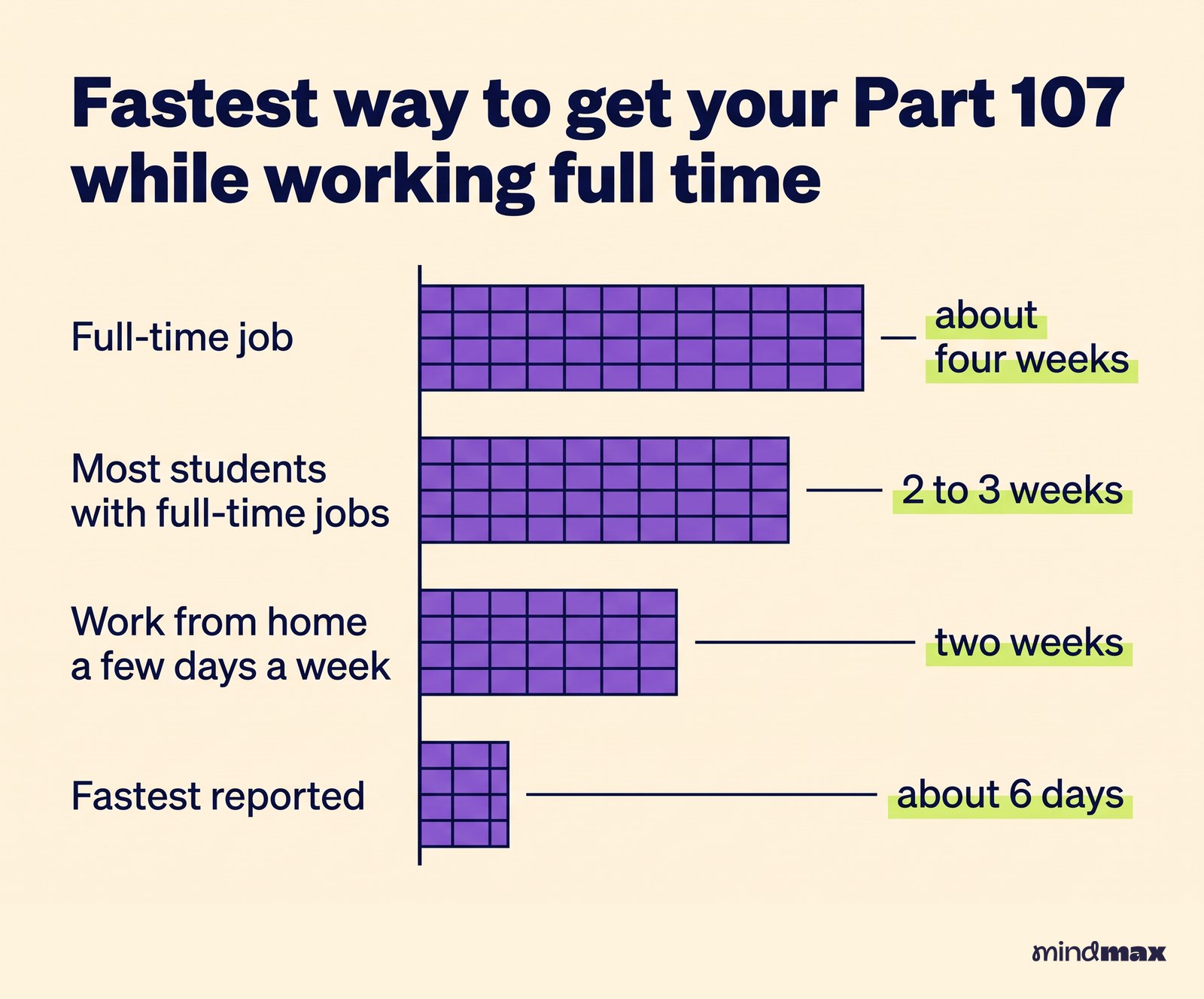
The fastest way to fit it around work is short daily sessions instead of one big weekend. Pilot Institute builds its course around one hour of study a day for 14 days, and candidates who studied a couple of hours each evening plus a weekend of practice tests passed in about a week.
Here is a plan that works for most full-time workers.
- Make your IACRA profile and get your FTN on day one.
- Book a PSI date about three weeks out, so the deadline is real.
- Spend weekday evenings on one topic at a time, starting with airspace and sectional charts.
- Use your commute or lunch break for audio, such as a podcast or recorded lessons.
- From the second week, take a full timed practice test every couple of days and drill whatever you miss.
- If you aren't scoring 85 to 90% consistently a few days out, move the date rather than gamble a fee.
If you want the plan built for you, MindMax maps your study into bite-sized lessons timed for your day and counted down to your exam date. You can take lessons as audio, ask the tutor questions mid-lesson, and sit its own timed mock exam of 60 questions in 120 minutes with a 70% pass mark.
For a fuller picture of study hours and difficulty, read how hard the Part 107 test is.
What slows the process down
Most delays come from avoidable mistakes rather than the FAA.
| Delay | Time it costs | How to avoid it |
|---|---|---|
| Failing the test | At least 14 days plus about $175 | Book only once you score 85 to 90% on practice tests |
| No FTN when you try to book | Days of back and forth | Make your IACRA profile first |
| ID without a home address | A turned-away test day | Check your ID before you go, or bring an accepted proof of address |
| IACRA stuck on "Partially Complete" | Until you notice and resubmit | Submit from a computer, not a phone, and enter your exam ID before final submission |
| Waiting for a PSI seat | Varies by area | Check open dates the week you start studying |
The IACRA trap catches people right at the end. One candidate's application sat at "Partially Complete, Ready for Next Action" until support told them that submitting from a phone can corrupt the application. They resubmitted and it changed to "Completed".
If you do fail, you don't need an instructor to retake. Bring your failed test report and book again after 14 days.
Before your first paid flight
Passing and printing the temporary certificate makes you legal as a pilot. Don't fly a paid job on the test report alone, though. Candidates warn that flying with only your score report still counts as flying illegally under Part 107. Wait for the temporary certificate printed and with you, since you must carry your certificate whenever you fly.
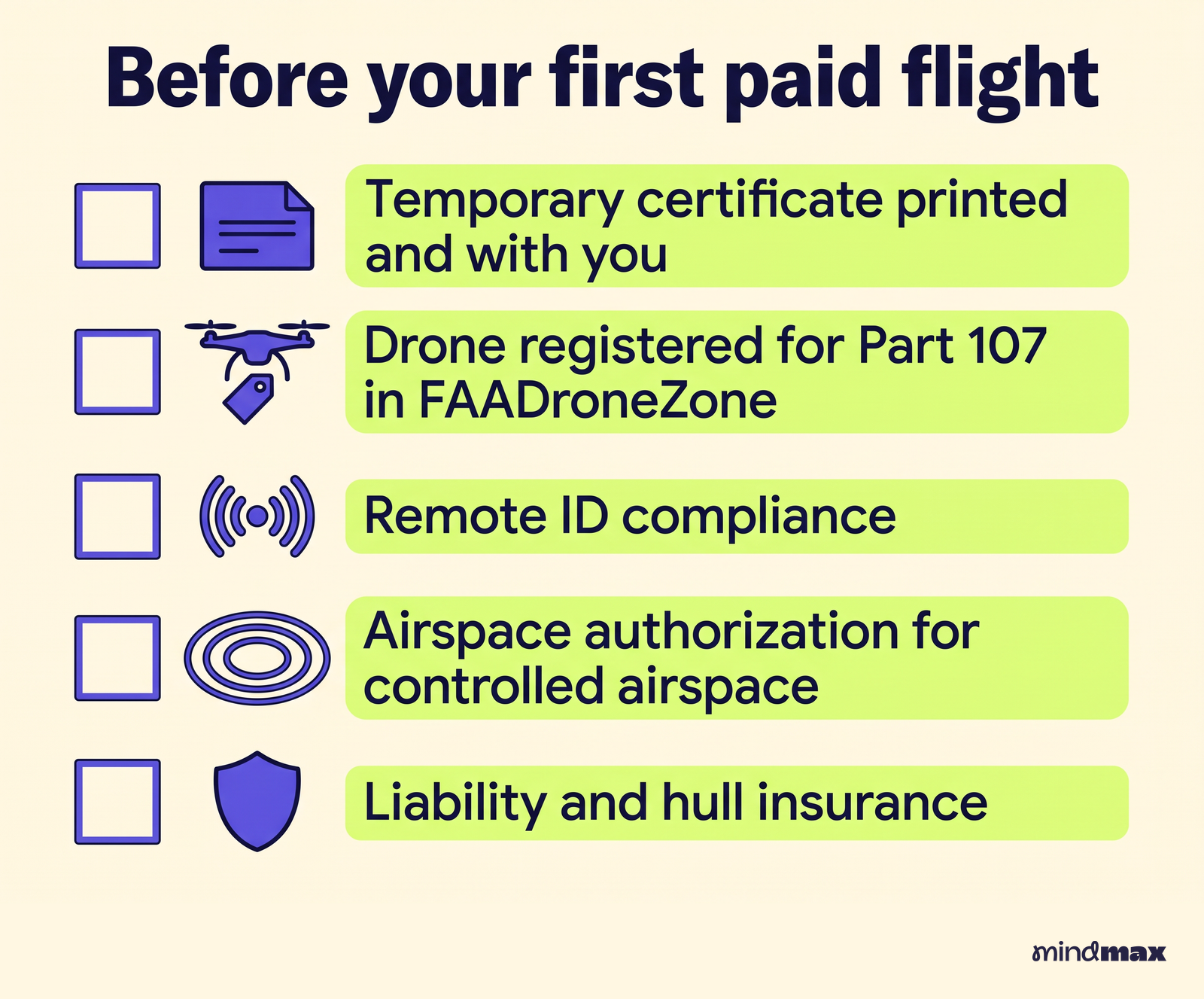
Your drone needs some attention too. Paid flying requires your drone registered for Part 107 in FAADroneZone and Remote ID compliance. Sort both out while you wait for the TSA check, so they don't add days at the end.
Check where your first job is. Work in controlled airspace may need airspace authorization for controlled airspace from air traffic control, so leave time for that before the shoot date. Experienced pilots also tell newcomers to get liability and hull insurance before taking paid work.
Finally, keep it current. Every 24 calendar months you must complete the FAA's free online recurrent course, ALC-677, to keep flying under Part 107. If you already hold a Part 61 manned pilot certificate with a flight review in the last 24 months, you skip the UAG entirely and take the free online ALC-451 course instead.
Frequently asked questions
Can I take the Part 107 test online from home?
No. The FAA tells first-time applicants to book at an FAA-approved Knowledge Testing Center through PSI and bring photo ID, and prep providers say you take the exam in person. Plan travel time to the nearest center into your schedule.
What if my temporary certificate runs out before the plastic card arrives?
A temporary certificate is valid for up to 120 days, and the card typically takes 6 to 10 weeks from the date the temporary was issued. If the card hasn't arrived after 8 weeks, contact FAA Airmen Certification so it gets sorted before the temporary lapses.
Can I start the Part 107 process at 14 or 15?
Yes. You can sit the UAG test from age 14, but you must be 16 to hold the certificate. Applicants under 18 without acceptable ID can have a parent or guardian vouch for their identity at the test center.
Does a Part 107 certificate expire?
The certificate itself stays with you, but you must complete the free online recurrent course ALC-677 every 24 calendar months to keep flying under Part 107. There is no in-person retest for recurrent training.
Do I need to take the test again if I already fly manned aircraft?
Not if you hold a Part 61 pilot certificate and have had a flight review in the last 24 months. You complete the free online ALC-451 course, apply in IACRA, and have your identity checked by a FSDO, DPE, ACR or CFI. A CFI can't issue the temporary certificate.