
How to Become a Real Estate Agent, From License to First Deal
12 min read ·

Co-founder of MindMax and Memrise, Grand Master of Memory
How do you become a real estate agent?
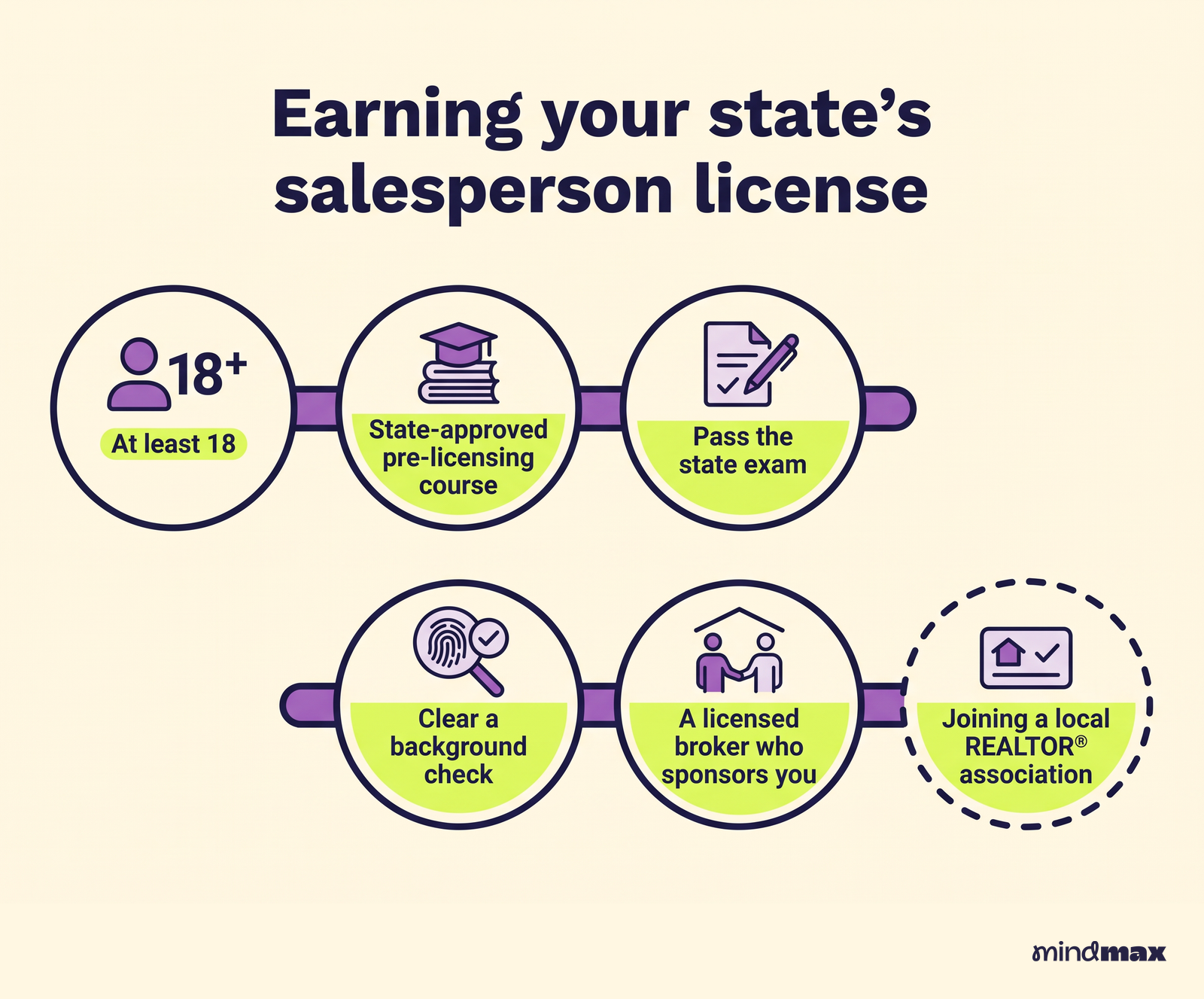
You become a real estate agent by earning your state's salesperson license. In most states you must be at least 18, finish a state-approved pre-licensing course, pass the state exam, clear a background check and then work under a licensed broker who sponsors you. Hours and fees vary by state. California requires three courses of at least 45 hours each and charges $100 for the exam. Texas requires 180 classroom hours. Becoming a REALTOR® is a separate, optional step after licensing, done by joining a local REALTOR® association.
Why do the rules differ by state?
There is no national real estate license. Each state writes its own rules, and a license from one state typically doesn't transfer to another. The U.S. Bureau of Labor Statistics tells candidates to check with the licensing commission in the state where they want to work, and its overview of real estate agent licensing, pay and job outlook is the best national starting point.
Below, California, Texas and Florida serve as examples because their rules are well documented and they license huge numbers of agents. If you plan to work anywhere else, your own state's commission has the final word on hours, fees and exam format.
Agent or REALTOR®, which one are you becoming?
People use "agent" and "realtor" as if they mean the same thing. They don't.
- A real estate agent (called a salesperson, sales agent or sales associate depending on the state) is anyone holding a state license to help people buy and sell property.
- A REALTOR® is a licensed agent who has also joined the National Association of REALTORS® (NAR) and agreed to follow its Code of Ethics. NAR describes the term as a registered collective membership mark.
So if you're asking how to become a realtor, the answer has two parts. First get licensed, then join. You can't skip the license, and you can work as a licensed agent without ever joining NAR. Many agents do join, often because their brokerage expects it.
The licensing steps in California, Texas and Florida
The national baseline is simple. Every state requires a license, and the typical minimums are being 18 or older, having a high school diploma or equivalent, completing pre-licensing courses and passing an exam. Some states add a background check. Here is how three big states handle it.
| California | Texas | Florida | |
|---|---|---|---|
| Who licenses you | Department of Real Estate (DRE) | Texas Real Estate Commission (TREC) | DBPR and the Florida Real Estate Commission |
| Minimum age | 18 | 18 | 18 (confirm with DBPR) |
| Pre-licensing education | 3 college-level courses, each at least 45 hours | 180 hours in six 30-hour courses | 63-hour course (unconfirmed, check DBPR) |
| Exam | One state-run exam, 150 questions, 3 hours | National and state portions with Pearson VUE | State exam with Pearson VUE (check DBPR) |
| Known fees | $100 exam, $350 license, $49 Live Scan | $58 per exam attempt, other fees on TREC's schedule | Check DBPR |
| Time limit | Unlimited retakes for 2 years from your application | 1 year from filing your application | Course certificate reportedly valid 2 years |
| Reciprocity | None with any state | None, but the national portion may be waived | Check DBPR |
California
You take Real Estate Principles, Real Estate Practice and one elective from the DRE's list, such as Finance, Appraisal or Legal Aspects. That's at least 135 hours in total. Since January 1, 2024, the Practice course has to cover implicit bias and fair housing, with a role-play component. You can file the exam application alone or a combined exam and license application, which costs $450. Licenses last four years, and renewal takes 45 hours of continuing education and a $350 fee.
Texas
TREC lays out the order clearly.
- Create an account in TREC's online system.
- Finish all 180 hours. TREC says not to apply until your education is complete.
- Apply and pay. Application fees are non-refundable.
- Get fingerprinted.
- Pass the exam.
- Get sponsored by a broker.
You must also be a US citizen or lawfully admitted alien and meet TREC's honesty and integrity standards. After you're licensed, Texas requires 270 total qualifying hours, including Sales Agent Apprentice Education, plus Legal Update I and II before your first renewal. After that it's 18 hours of continuing education every 2 years. TREC adopted a new fee schedule effective September 1, 2026, so check its fee page for current application amounts.
Florida
Florida's route is widely described as a 63-hour course with a school final, then a state exam. Those details aren't confirmed from official text, so read the DBPR sales associate page before you enroll.
Check your background before you pay
If you have a criminal record, find out where you stand first. California says a conviction may result in the denial of a license. Texas lets you request a Fitness Determination before you apply, which can save you course fees.
What the licensing exam looks like
The exam is the step most people worry about, and with reason. In California, 63.1% of first-time salesperson candidates passed on average across fiscal years 2020/21 to 2023/24. That figure comes from the DRE's 2024 Sunset Review, so it's a few years old.
- California gives one exam of 150 multiple-choice questions in 3 hours. You need 70%, which is 105 correct. If you pass, you aren't told your score.
- Texas splits it into a national portion and a state portion. Salespersons need 56 correct on the national and 28 on the state, and you retake only the part you fail. Each attempt costs $58. You get three attempts, and after a third failure you need 30 more education hours for one failed portion or 60 for both.
Candidates often say the state portion is harder than the national one, and that school practice tests are worded more gently than the real thing. For question counts and pass marks in more states, see how the real estate exam works, with passing scores by state. When you're ready to study, this guide covers how to pass the real estate exam on your first try.
If you study best in short bursts around a job, MindMax has courses for the California, Texas and Florida exams and several other states. It builds a daily plan of bite-sized lessons counted down to your exam date, with a tutor you can ask questions as you go and a timed mock exam to practice under the clock.
How to choose a sponsoring broker
Passing the exam doesn't let you work on your own. The BLS is blunt about it. Sales agents must work with a real estate broker. In Texas, a sales agent must be sponsored by a licensed broker to perform any real estate services. In California you can hold a license without a broker, but you can't do anything that requires one until you have a responsible broker.
Treat this as a business decision, not paperwork. Your broker shapes your training, your income and your daily life. In Texas, for example, the broker supervises you and is responsible for your advertising. Clients sign with the broker, not with you, so you can't take buyer clients along if you switch firms. Every commission flows through your sponsoring broker.
Training varies a lot. Some firms run formal classroom programs and some offer almost nothing. Agents who've been through it suggest interviewing at least four brokerages and asking each the same things.
- Who will mentor me, and how often will we talk?
- What training happens in my first 90 days?
- Do you provide leads, and how are they shared?
- What is the full list of fees, including the commission split, desk or tech fees, transaction fees and MLS costs?
One commenter mentioned a 20 to 40% brokerage cut, but splits differ widely, so get every firm's numbers in writing. Many candidates line up a brokerage before the exam so they can start within days of passing. There's more on that in what to do after you pass, from picking a broker to license timing.
How to join the REALTOR® association
Once you're licensed, becoming a REALTOR® takes three steps.
- Hold an active real estate license.
- Join a local REALTOR® association, which also makes you a member of your state association and NAR.
- Pay your dues.
Your broker has a big say here. Each firm has a designated REALTOR®, and if a principal of the firm who qualifies decides not to join, nobody affiliated with that firm can be a REALTOR®. Ask about this when you interview brokerages.
NAR's national dues for 2027 are $156, prorated by month in the year you join, plus a $45 special assessment for its consumer advertising campaign that isn't prorated. NAR's board kept those figures unchanged on June 18, 2026. Local and state association dues are added on top and differ by area. Members also complete Code of Ethics and fair housing training every three years.
What it costs to get started
Budget for more than the license. In California, the official fees alone are a $100 exam fee, a $350 license fee and $49 for Live Scan fingerprints, which comes to $499 before you pay for a single course. Course tuition varies by school, so compare a few approved providers.
If you join NAR, add the $156 in national dues (less if you join late in the year) and the $45 special assessment, then your local and state dues. MLS access and brokerage fees come on top.
The bigger number is the cost of running your business. NAR members reported median business expenses of $9,530 a year, with vehicle costs of $1,580 the largest single item. Since 86% of REALTORS® work as independent contractors, you'll usually pay self-employment taxes and have no salary to cover these costs while you build up. For a fuller look at the math, see whether a real estate license is worth it, costs versus real pay.
What the job pays and how long until your first deal
In 2025, the BLS put the median pay for real estate sales agents at $52,830 and for brokers at $73,220. The lowest 10% of agents earned under $32,970 and the top 10% earned over $123,590. NAR's 2026 Member Profile, using 2025 data, found median gross income of $59,200 for all REALTORS® and $88,500 for REALTORS® with 16 or more years of experience. The typical agent closed 9 transaction sides in 2025.
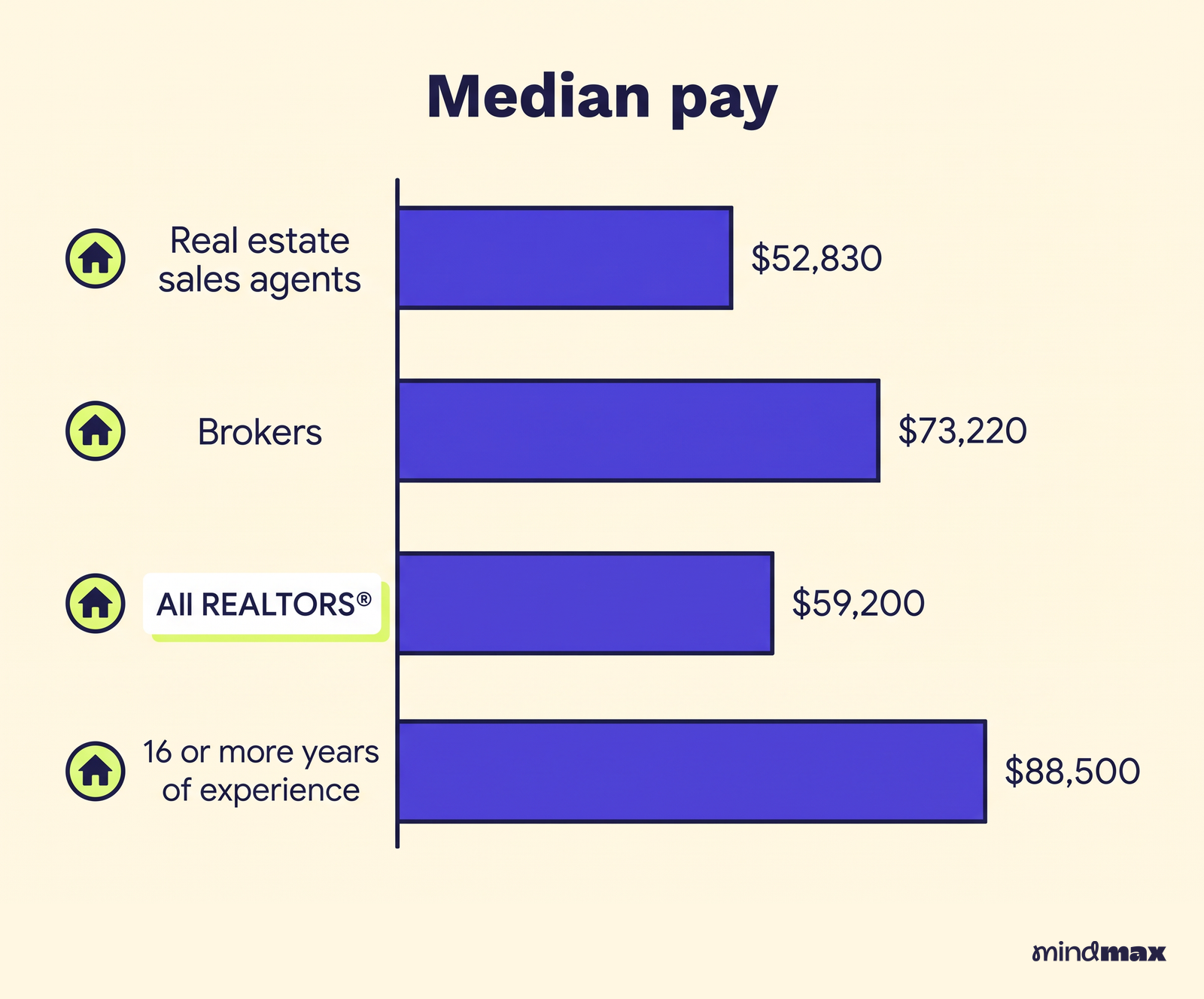
Those are medians across people who've been working for years, not starting pay. The BLS warns that earnings can be irregular, especially for beginners, and that agents sometimes go weeks or months without a sale. Some agents online report 4 to 6 months before their first closing. Plan your savings around that gap.
The field isn't shrinking. There were 427,000 sales agents in 2025, and the BLS projects 2% growth from 2025 to 2035, with about 40,400 openings a year across agents and brokers, mostly from people leaving. That turnover is a reminder that many newcomers don't last. One skeptic on Reddit put it plainly, saying a huge majority of agents can't sustain themselves financially on one job.
Can I become a realtor at 40?
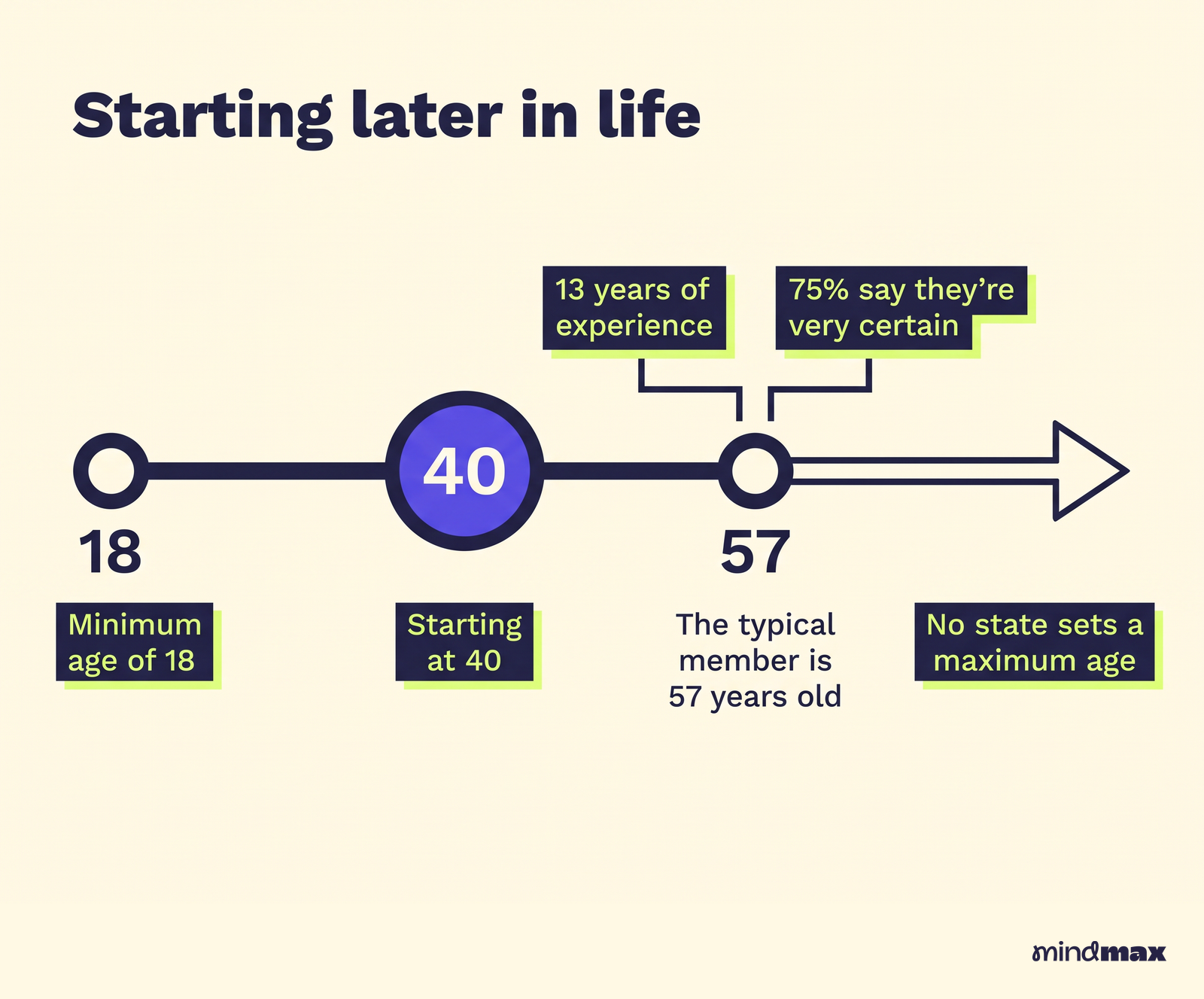
Yes. No state sets a maximum age, only a minimum age of 18. Starting at 40, 50 or later is normal in this field. NAR's 2026 Member Profile found that the typical member is 57 years old, with 13 years of experience, and 75% say they're very certain they'll stay active for at least two more years. That means most REALTORS® are older than you'll be when you start.
Later starters show up constantly in agent forums, and the replies are often encouraging. One agent wrote, "Started at 36, now a broker at 40." On one 46-year-old's post, many agents said they wished they had started older, pointing to people in their 50s who did well.
What matters more than your age is your cushion. One career changer said they could afford no income for a year, and that's the right way to think about it. Before you leave a salary, ask yourself three things.
- Can you cover 6 to 12 months of living costs plus business expenses?
- Does your past work give you a network to draw on?
- Are you ready for evening and weekend showings?
If the answers are yes, 40 is a fine age to start. Later, you can go further. A broker license usually requires at least 2 years as an agent in most states.
Can you get into real estate part time?
You can. The BLS says most agents work full time, often evenings and weekends, but some work part time. Getting licensed doesn't require you to quit your job, and plenty of candidates study during lunch breaks or after work.
The catch is the broker. Policies on part-time agents vary, so ask during interviews. A practical path many career changers take is to finish the course and pass the exam while still employed, interview brokerages, and switch to full time once deals start coming in.
Frequently asked questions
How long does it take to become a real estate agent?
It depends mostly on your state's course hours and how fast you study. California's three courses add up to at least 135 hours and Texas requires 180, so many people need a few months before they sit the exam. Texas gives you 1 year from filing your application to finish everything, and California allows unlimited retakes for 2 years from your application.
Do I have to be a REALTOR to sell houses?
No. A state license is what lets you work as an agent under a broker. REALTOR membership is optional, though some brokerages expect their agents to join, and a firm's principals decide whether any of its agents can.
Can I use my real estate license in another state?
Usually not. Licenses typically don't transfer between states, and California and Texas have no reciprocity with any state. Texas may waive the national portion of its exam if you hold an active license elsewhere and passed an ARELLO-approved national exam.
What happens if I fail the real estate exam?
You can retake it, but the rules vary. California charges $100 per retake and lets you book only after you get your results. Texas charges $58 per attempt, lets you retake just the failed portion, and requires extra education hours after three failures.
Do I need a college degree to become a real estate agent?
No. The typical baseline is a high school diploma or equivalent plus your state's pre-licensing courses. California's courses are college-level, but you don't need a degree to take them.